
WorkOS launches Airlock for AI agent authorization
Serge Bulaev
WorkOS has launched Airlock, an early-access tool that helps companies manage what AI agents can do by checking each request against set rules and intent. Airlock may allow, deny, or send a request for human review, and then keeps a record for audits. Surveys suggest many organizations struggle to track agent actions, so tools like Airlock aim to help with real-time authorization and clear tracking. Early reviews for WorkOS are positive, but there appear to be few independent case studies for Airlock so far, showing interest is mainly at the pilot stage. Which agent management tools succeed may depend on how quickly companies adopt strict and measurable rules without slowing down agent work.

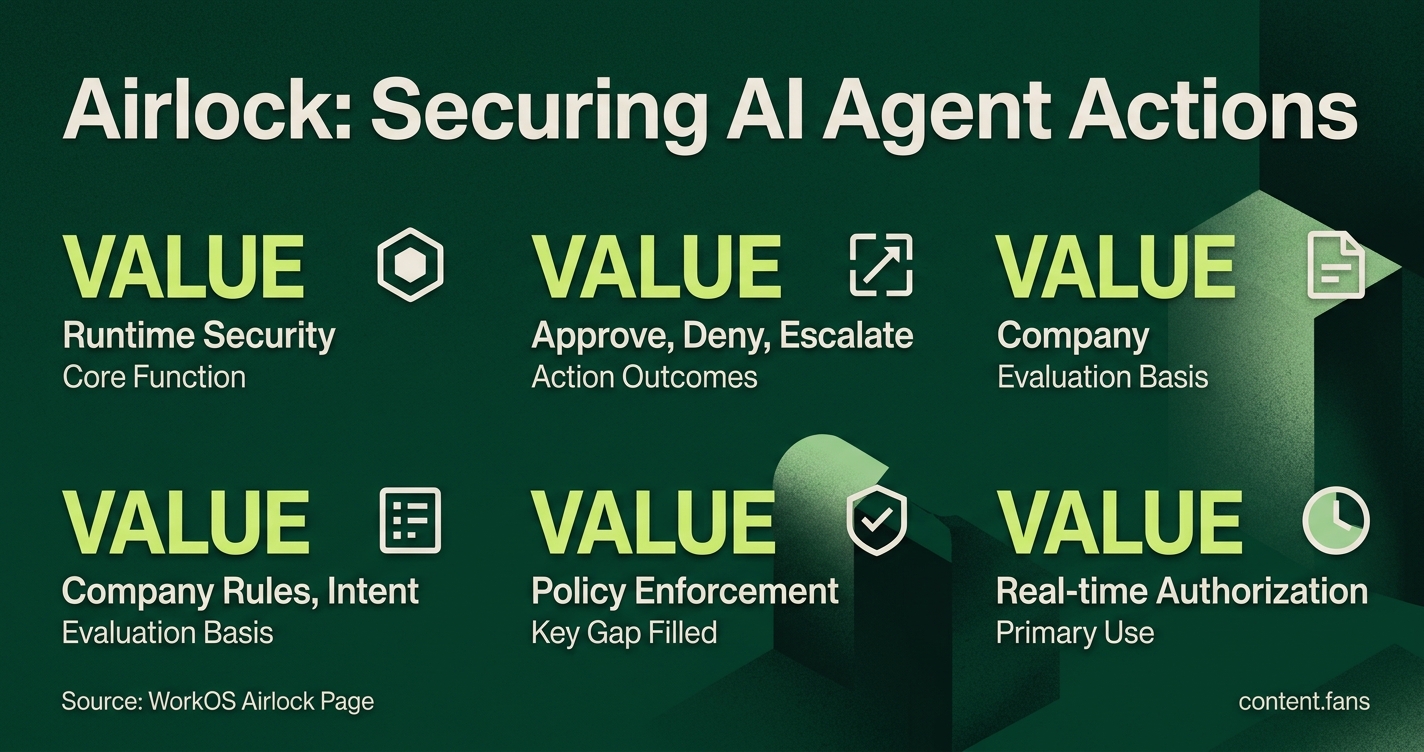
WorkOS is launching Airlock for AI agent authorization, a new security layer designed to manage the actions of autonomous agents within the enterprise. This early-access platform evaluates each agent request against predefined company rules and stated intent. As detailed on the official WorkOS Airlock page, Airlock can approve, deny, or escalate requests for human review, logging all activity for audit and compliance purposes.
This article explains what Airlock does, why enterprises require this capability, and how it fits into the competitive market.
How Airlock works at runtime
WorkOS Airlock is a runtime security solution that intercepts and evaluates every tool call made by an AI agent. It acts as a guardrail, comparing the agent's request against established policies to either permit, block, or flag the action for human review, ensuring secure and compliant automation.
Airlock operates as a proxy between AI agents and enterprise systems. When an agent using a platform like Claude, Codex, or a Model Context Protocol (MCP) gateway attempts an action, Airlock parses the request and evaluates it against security policies. By leveraging the MCP standard, Airlock can focus on policy enforcement rather than protocol translation. While MCP provides a common language, it lacks built-in credential management, policy enforcement, or comprehensive auditing. WorkOS positions Airlock as the essential security layer that fills these gaps, enforcing least-privilege access for diverse AI agents.
Why enterprises are evaluating specialized agent authorization
The need for specialized agent authorization stems from a significant governance gap. Organizations are increasingly struggling to reliably differentiate between agent and human activity, and the non-deterministic nature of AI agents renders static access controls less effective.
Enterprises therefore require solutions for real-time authorization and auditable logging - Airlock's primary functions. While WorkOS has an established reputation in B2B identity, with its core platform earning high marks on G2, specific case studies for Airlock are not yet public, indicating that the solution is currently in pilot phases with early adopters.
Competitive context and procurement questions
Airlock enters a competitive landscape where major identity and access management (IAM) vendors are also building agent control planes. Established players like Saviynt, Ping Identity, and Broadcom are extending their policy engines to manage agents as distinct identities. Okta has also announced comprehensive services including agent discovery, credentialing, and runtime revocation, positioning it as a suite against point solutions.
When evaluating these platforms, security leaders should consider key questions:
- Can the platform discover shadow agents or does it rely on manual registration?
- Does it evaluate every tool call or only initial authentication?
- How are "intent" and "policy" expressed, and who approves changes?
- Is there instant revocation if an agent misbehaves?
Airlock's key differentiator is its deep, language-level inspection of agent prompts and intent before each action. In contrast, competitors often emphasize the breadth of their control plane and integration with existing identity graphs. The prevailing approach will be determined by whether enterprises prioritize granular, prompt-level control or broader, suite-based management without hindering agent productivity.