
WorkOS unveils Airlock for AI agents, offers policy enforcement
Serge Bulaev
WorkOS has launched Airlock, a product that may help large organizations manage and control AI agents like regular users. Airlock attaches rules to each action an agent takes and logs all requests, so security teams can review what happened. The product works with many agent platforms and appears to fill gaps in current standards by adding policy enforcement and auditing. Early feedback is limited, but people generally view WorkOS tools positively, and Airlock may appeal to teams already using WorkOS. Experts suggest logging, strong controls, and human review of uncertain actions might soon be required for AI agent systems.

WorkOS has launched Airlock, a new governance solution for AI agents designed to help large organizations enforce security policies and maintain control. As enterprises adopt AI agents, Airlock provides a way to treat them as accountable users rather than opaque processes, attaching policy enforcement to every action and creating a comprehensive audit trail for security teams. Experts suggest that robust logging, strong controls, and human review will soon be required for production AI agent systems.
How Airlock fits the emerging agent stack
WorkOS Airlock is a security product that provides policy enforcement and auditing for AI agents. It intercepts every action an agent takes, evaluates it against predefined rules, and then allows, denies, or escalates the request to a human for review, providing a centralized governance layer.
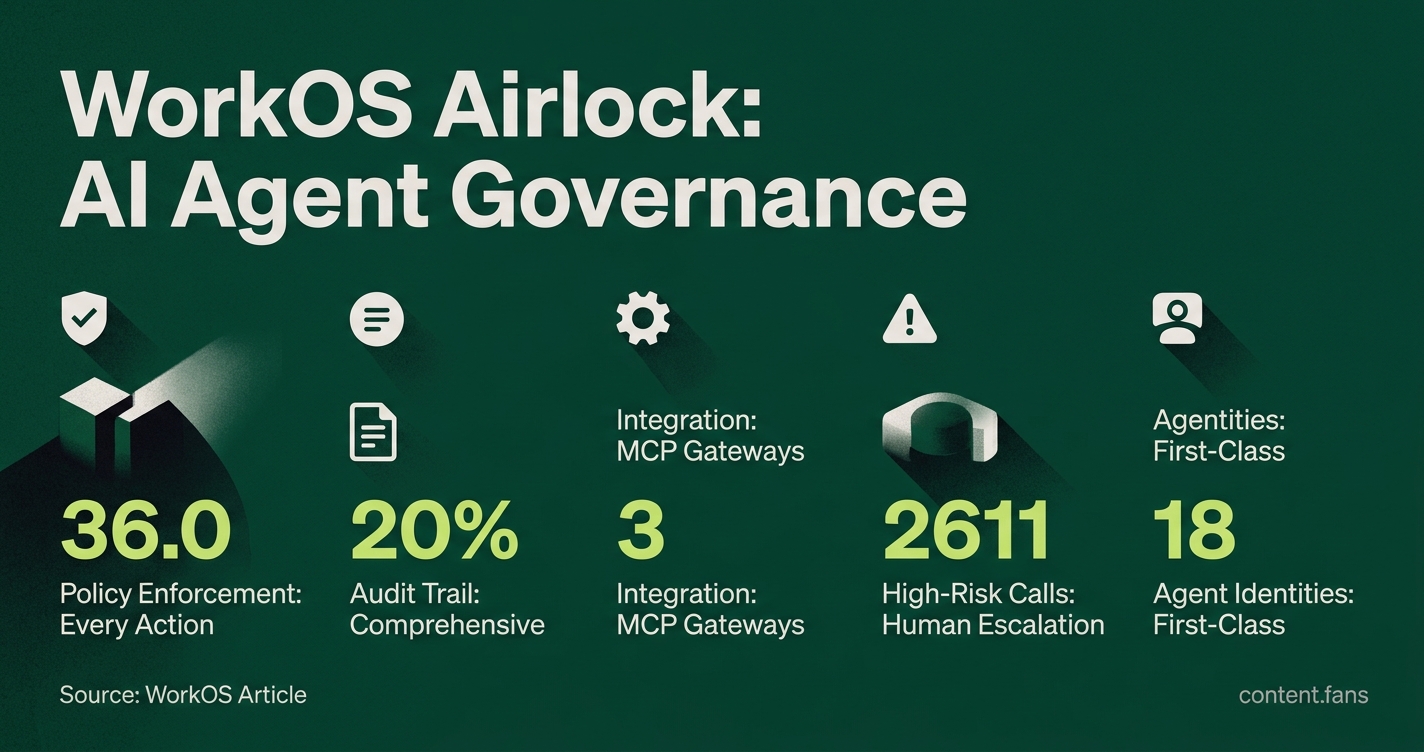
The emerging AI agent stack relies on standards like the Model Context Protocol (MCP) for tool discovery and invocation. However, MCP alone does not define enterprise policy, credential storage, or auditing. WorkOS Airlock is designed to fill this critical gap, acting as a runtime layer that integrates with agent platforms such as Claude and any MCP gateway. This approach aligns with guidance that MCP requires external authorization controls. Without centralized governance, teams must reimplement security workflows for every agent project, a challenge Airlock solves by offering a vendor-maintained alternative that consolidates controls and escalates high-risk calls to humans.
Early reception and comparison points
While independent reviews for the new product are limited, the broader WorkOS platform receives positive community feedback from users for its developer-friendly SSO and directory integrations. In the competitive landscape, enterprise buyers are comparing Airlock to identity-focused solutions from Okta, Saviynt, and IBM. According to market analysis, leading vendors are focusing on key controls for agent governance:
- First-class agent identities instead of shared accounts
- Task-scoped, short-lived tokens
- Runtime authorization at a gateway
- Continuous monitoring and auditability
- Lifecycle governance from registration to decommission
Airlock directly addresses many of these priorities. For full lifecycle management, it integrates with existing WorkOS directory tools. This coupling is expected to attract teams that already use WorkOS for SSO and SCIM, while others may prefer standalone identity providers.
What comes next for agent governance
The future of AI agent governance points toward stricter industry standards. Industry organizations are updating guidance to separate agent identity from access management, and standards bodies are reportedly preparing AI agent interoperability profiles. These developments signal that capabilities like comprehensive logging, least-privilege enforcement, and human-in-the-loop escalation are becoming essential requirements for production agent systems.
Currently, WorkOS Airlock offers a unified control point for managing multiple agent runtimes with both deterministic rules and human review capabilities. As enterprises move AI agent pilots from sandboxed environments to critical business workflows, solutions that consolidate policy, evidence generation, and approval logic will remain a key focus for evaluation.
What is WorkOS Airlock and how does it work?
WorkOS Airlock is an intent-based authorization layer designed specifically for AI agents. It evaluates every call an agent makes against its intent and organizational policies, then makes one of three decisions: allow the action, deny it, or route it to a human for approval.
The product integrates with popular agent platforms including Claude and MCP gateways, positioning itself as a governance solution for enterprises deploying autonomous agents across their infrastructure. Airlock is currently in early access, with WorkOS logging every request and verdict to support audit and compliance requirements.
Why do enterprises need specialized authorization for AI agents?
Traditional access control systems were built for human users and conventional applications - not for autonomous agents that can initiate thousands of actions independently. MCP (Model Context Protocol) standardizes how agents discover and invoke tools, but it explicitly does not define enterprise policies, credential storage, or auditing capabilities.
This creates a dangerous gap: without centralized governance, organizations risk agents accessing sensitive systems without proper oversight, and engineering teams end up reimplementing similar security and onboarding workflows across different projects. Companies have already built custom gateways on top of MCP to add policy enforcement, tool curation, and operational controls - highlighting that this is becoming a widespread enterprise need rather than a theoretical concern.
How does Airlock compare to other AI agent governance solutions?
The AI agent authorization market includes several competing approaches:
| Vendor | Approach | Key Differentiator |
|---|---|---|
| WorkOS Airlock | Intent-based runtime authorization | Human-in-the-loop escalation for ambiguous requests |
| Okta for AI Agents | First-class agent identity | Short-lived, identity-governed tokens instead of stored credentials |
| Saviynt | Identity control plane | Full lifecycle governance from registration to decommissioning |
| IBM | Runtime enforcement | Authorization against mission, intent, context, and current risk |
Airlock's specific positioning emphasizes compatibility across multiple agent platforms and its escalation-to-human workflow for high-risk or unclear requests - a feature particularly relevant for enterprises not yet comfortable with fully autonomous agent decision-making.
What role does MCP play in agent governance, and where does it fall short?
MCP has become a critical standardization layer for AI agent interoperability. It provides structured, secure access to tools, APIs, and data sources, creating enforceable boundaries around what agents can access. The protocol has gained significant adoption across the industry, reinforcing its vendor-neutral status.
However, MCP's impact is limited to the connection layer. The real production-readiness work sits in higher governance layers: identity and delegation, behavior constraints, policy enforcement, observability, and evidence generation. This is precisely where products like Airlock add value - MCP standardizes the interface, but enterprises still need policy engines, audit trails, and compliance evidence that the protocol itself does not provide.
Industry standards initiatives are organizing work around interoperability and security with MCP as a baseline.
What should organizations consider before implementing AI agent authorization?
Based on current market developments, enterprises evaluating solutions like Airlock should prioritize:
Runtime enforcement over static permissions - Modern security guidance emphasizes authorizing "the right people and models to call the right tools with the right permissions" at the moment of action, not through standing privileges.
Human escalation pathways - For production deployments, maintain human oversight for ambiguous or high-risk requests rather than relying solely on automated decisions.
Audit and compliance readiness - Ensure every agent action is logged with sufficient context to satisfy regulatory requirements and internal governance.
Cross-platform compatibility - Given the fragmented agent ecosystem, solutions that work across multiple frameworks (Claude, custom MCP implementations) reduce vendor lock-in and operational complexity.
WorkOS's established reputation in enterprise infrastructure and documented success helping teams deploy SSO and directory sync suggests Airlock may benefit from existing trust relationships, though its specific enterprise adoption remains in early stages.