
Shopify ditches React Native for native Swift/Kotlin with AI agents
Serge Bulaev
Shopify is moving away from React Native and will now use native Swift and Kotlin for app development, with help from AI agents. The company says AI agents may have made it cheaper and easier to build and manage separate codebases for iOS and Android. Shopify's engineers report that the Shop app was rebuilt quickly using AI, but they note that human oversight is still needed. Early signs suggest better performance and stability, but exact numbers are not given. Analysts say it remains to be seen if this approach will stay efficient as the codebase grows and if costs from using AI agents will go down.

Shopify is abandoning React Native, committing to a future of native Swift and Kotlin development for its mobile apps with the help of AI coding agents. This strategic reversal is driven by a new economic reality where AI makes managing two high-performance native codebases more viable than a single cross-platform one, as detailed in the company's announcement, "Native is now the future of mobile at Shopify".
Why Is Shopify Reversing Its React Native Strategy?
Shopify is reversing its strategy because AI coding agents have significantly lowered the cost and complexity of maintaining separate native codebases for iOS and Android. This shift in economics now makes the performance benefits and deeper platform integration of native development more advantageous than React Native's single-codebase efficiency.
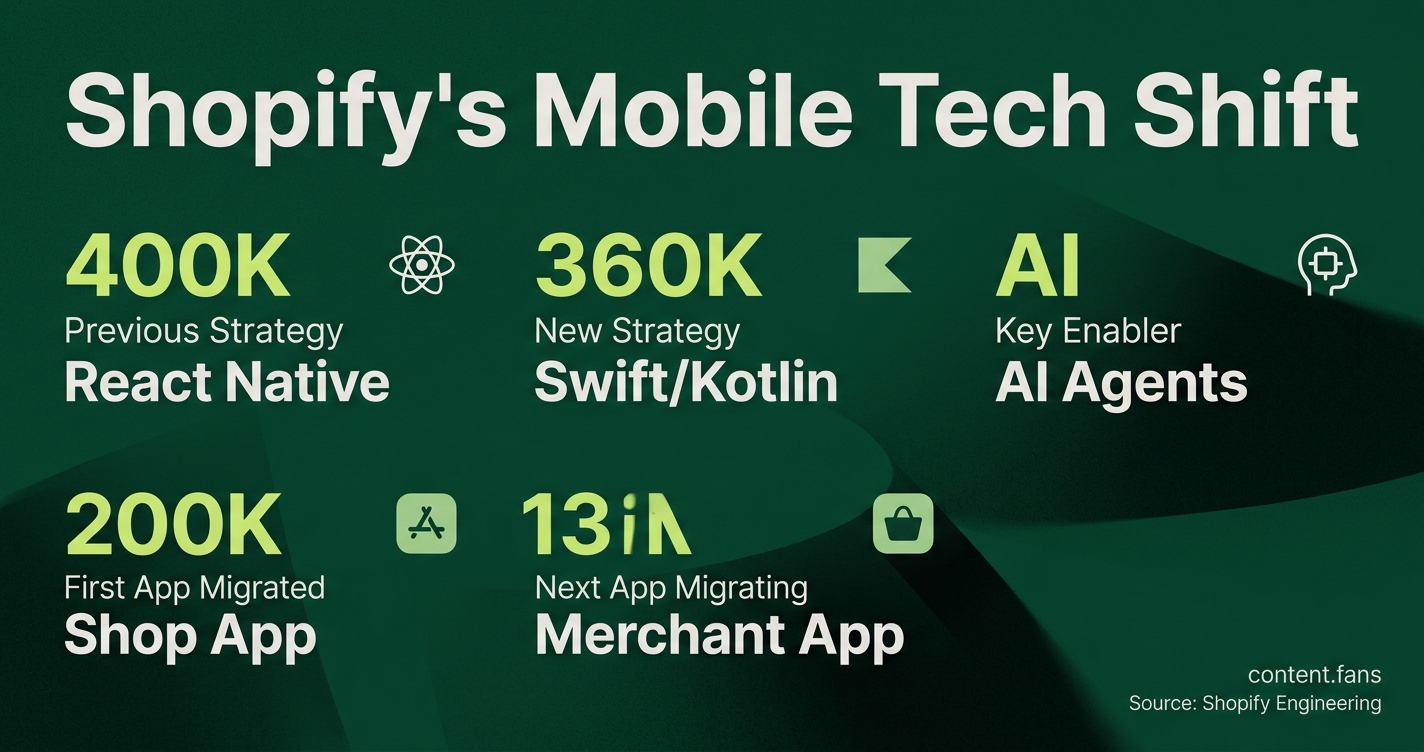
This move marks a sharp turn from their previous strategy, when the company migrated their apps to React Native, celebrating the move in a post on "Five years of React Native at Shopify". The decision was not based on poor performance; the React Native apps demonstrated strong crash-free sessions and fast startup times. Instead, as Director of Engineering Mustafa Ali explained, "coding agents changed what it costs to build mobile apps twice", altering the core financial calculation. Key motivations include:
- Gaining direct access to the latest first-party platform APIs and tooling.
- Reducing reliance on third-party dependencies that can complicate updates.
- Achieving superior performance, including faster app startup and greater stability.
How Does Shopify Use AI in Its Native Workflow?
Shopify's strategy is powered by an internal platform called Helix, which orchestrates the AI-driven workflow. As detailed in a post on the internal tooling, Helix breaks the migration into small, manageable tasks for AI agents. Before any code is merged, it must pass a rigorous gauntlet of unit tests, UI snapshot comparisons, and human-led adversarial reviews. The rebuilt Shop app serves as the primary proof-of-concept for this method.
What Is the Scope and Status of the Migration?
The migration is proceeding in multiple streams of work, with the massive Shopify merchant app serving as the next major test of this AI-assisted model. While no firm deadline has been set, the company emphasizes that its high standards for performance and quality are paramount.
- Shop App: Migration complete, with the new native version live on both the App Store and Google Play.
- Shopify Merchant App: Actively in migration, a massive project encompassing numerous screens, widgets, and integrations with Apple Watch and Siri.
- Other Apps: Niche applications are queued for migration after the merchant app work has stabilized.
What Are the Early Results and Limitations?
Early results from the rebuilt Shop app are promising, with Shopify reporting faster Android release builds and improved session stability. However, engineers stress that this process is not fully automated. Human oversight remains crucial, highlighting the ongoing need for expert human review in AI-assisted development workflows.
What Does This Mean for the Future of Mobile Development?
This move doesn't necessarily signal the end of cross-platform frameworks but reflects a shifting cost-benefit analysis. For a large-scale platform like Shopify that prioritizes deep integration with iOS and Android, the investment in AI-assisted native development is justifiable. Industry analysts are closely watching whether this model can maintain its speed as codebases grow and whether AI inference costs will decrease, which could encourage other enterprises to follow suit. For now, it stands as a pivotal case study on the evolving landscape of app development.