
Shopify ditches React Native for Swift/Kotlin, using AI agents to convert apps
Serge Bulaev
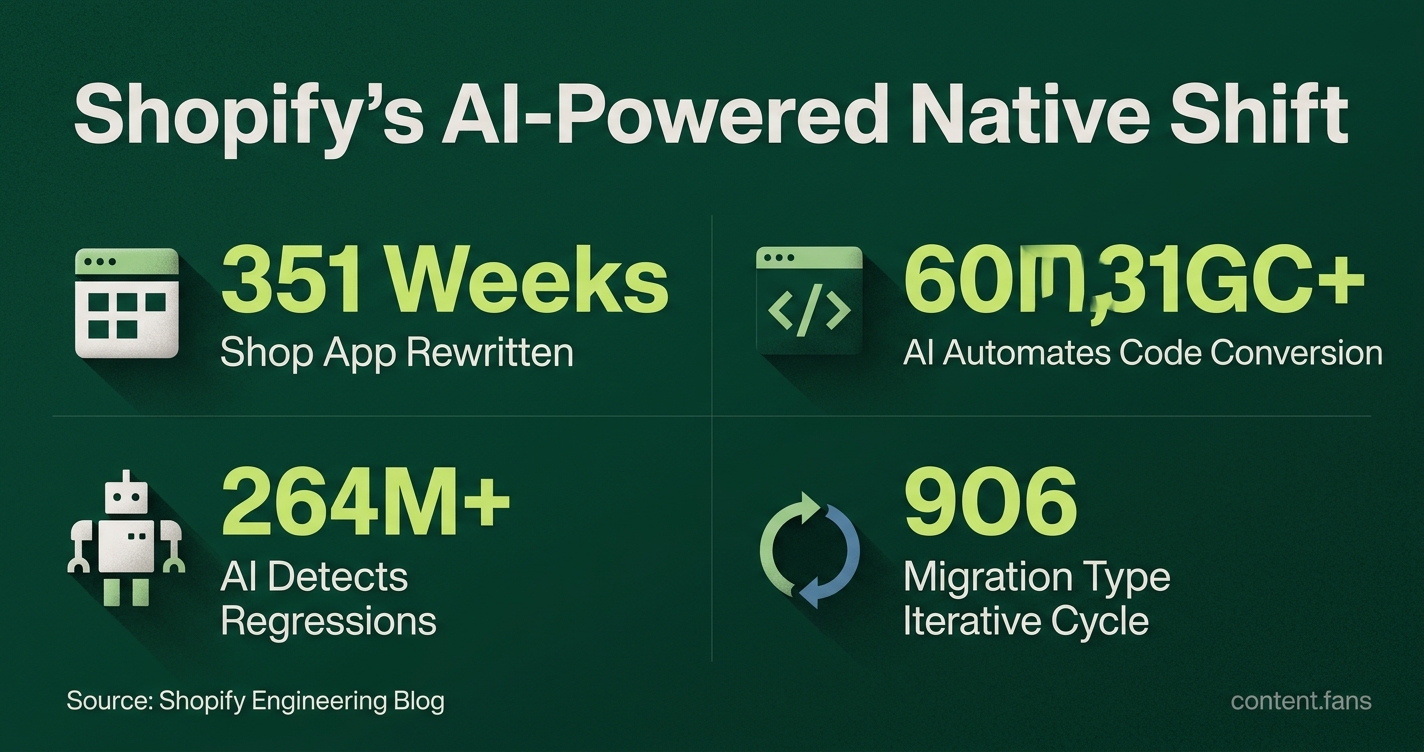
Shopify has decided to move from React Native to native Swift and Kotlin for its mobile apps. The company says new AI agents may make it easier to manage two codebases by automatically translating and checking code. Shopify's engineering note states that the Shop app was rewritten in 12 weeks using this new workflow. The company suggests that performance and first-party integration could be better with native apps, but stresses that React Native is still a good choice for some cases. Exact timelines for moving all apps are not published, and Shopify plans to keep fixing issues in React Native during the transition.

Shopify is ditching React Native for native Swift and Kotlin development, using advanced AI agents to automate the code conversion. The company announced the strategic shift in its engineering blog, explaining that AI has fundamentally altered the economics of managing two codebases versus a single cross-platform framework. As proof of the new workflow's efficiency, the entire Shop app was rewritten in a matter of weeks.
Company leaders frame the decision as a pragmatic evolution, not a repudiation of React Native. While the framework delivered a "step change in productivity" when first adopted, Shopify now states that AI-driven workflows for translation and review allow its teams to leverage native platform benefits without duplicating manual effort.
What has already shipped
Shopify is moving from React Native to native Swift and Kotlin because new AI coding agents have changed the economic equation. These agents automate code translation and testing, allowing Shopify to gain the performance of native apps without the traditional cost of maintaining two separate codebases.
Shopify's consumer-facing Shop app is already live, fully rewritten in Swift and Kotlin. The company detailed the process, which went from a proof-of-concept to a full release in a short timeframe. An internal AI agent enabled engineers to convert large portions of the iOS codebase efficiently, with specialized sub-agents handling testing and parity checks. The migration of the larger Shopify merchant app - spanning hundreds of screens plus watch widgets - is expected to be completed in the coming period, with a strict requirement to maintain feature parity and crash-free stability throughout.
Why AI tipped the scales
According to Shopify, the capabilities of large language models (LLMs) overturned two fundamental assumptions of mobile development. First, AI automates cross-platform translation, meaning two codebases no longer require double the engineering effort. Second, AI verification agents can automatically detect regressions, significantly reducing manual quality assurance time. This shift suggests that for Shopify, the superior performance and UI advantages of native code now outweigh the operational costs, thanks to their investment in AI and testing infrastructure.
Inside the agent workflow
The migration process follows a multi-step, AI-driven loop:
- Analysis: An agent inspects the React Native components and documents their behavior.
- Planning: A second agent proposes equivalent structures in native SwiftUI or Jetpack Compose.
- Implementation: Coding agents write the new native code behind a feature flag.
- Review: Verification agents run shared tests to identify and report any functional gaps.
This iterative cycle repeats until parity is achieved. Shopify credits this checkpoint-based method, rather than a monolithic rewrite, for the rapid completion of the Shop app.
Current performance baselines
Prior to this transition, Shopify's React Native applications already boasted impressive metrics, with fast screen loads and high crash-free session rates. While the company has not yet released performance data for the new native apps, it has mandated that performance must, at a minimum, match these existing high standards throughout the migration.
Broader industry context
Shopify's strategy is notable because it runs counter to a common industry trend where AI agents are used to bolster cross-platform frameworks like Flutter and Kotlin Multiplatform. While many teams use AI to simplify shared codebases, Shopify's move demonstrates that the same AI tools can also make fully native development more viable, especially for companies prioritizing deep platform integration and performance.
What comes next
Shopify has confirmed its commitment to migrating all mobile products to Swift and Kotlin via its AI agent pipeline, although specific timelines have not been released. During the transition, the company will continue to contribute fixes to the React Native framework, underscoring its position that React Native "remains an excellent option" for many use cases. The upcoming merchant app migration is particularly complex, involving Siri Shortcuts and other native extensions that previously relied on bridging layers.
Structured FAQ
Why did Shopify decide to leave React Native after investing so heavily in it?
Shopify's leadership summarized the pivot as React Native being the right choice previously, but native being the right choice now. The primary driver for this change was the maturation of LLM-powered coding agents. These AI tools effectively eliminated React Native's main benefit - a single shared codebase - by automating the translation and verification of features between Swift and Kotlin. This allows Shopify to achieve the superior performance of native development without the historical cost of maintaining two separate but identical apps.
How exactly is Shopify using AI agents for this migration?
Shopify engineered a sophisticated agentic workflow using its internal coding agents. This system uses specialized sub-agents for each migration stage:
- Analysis agents to inspect the original React Native code.
- Planning agents to design platform-specific native structures.
- Implementation agents to write the new Swift and Kotlin code.
- Review agents to run a shared test suite and confirm feature parity.
This workflow proved highly effective, enabling the team to migrate the Shop app from a concept to a published native application efficiently.
What specific benefits does Shopify expect from native development?
The move to native provides several primary benefits:
- Tighter Platform Integration: Engineers can work directly with first-party tools and capabilities, removing the abstraction layers inherent in React Native.
- Superior Performance & Maintenance: AI-driven synchronization delivers platform-optimized performance without the long-term burden of maintaining a cross-platform framework.
- Full Architectural Control: Shopify can adopt new platform features from Apple and Google immediately, without waiting for framework updates or relying on third-party dependencies.
How fast is this migration happening, and what's the scope?
The Shop app migration is complete and the app is fully native on iOS and Android. The migration of the main Shopify merchant app is currently underway. This is a much larger project, involving many screens, widgets, and deep OS integrations like Apple Watch complications and Siri Shortcuts. Shopify intends to migrate all of its mobile apps using this AI-assisted process.
Does this mean React Native is dying, or is Shopify's situation unique?
Industry analysis indicates Shopify's situation is unique and not a signal of React Native's decline. For many organizations, cross-platform frameworks still offer significant speed advantages. Shopify's decision was driven by a unique combination of factors:
- Massive Scale: The complexity of their apps justified a significant investment in custom tooling.
- Deep AI Integration: They built a bespoke agentic workflow, not just using off-the-shelf AI tools.
- Performance Goals: They aim to exceed already high-performance baselines by optimizing directly for each platform.
Ultimately, Shopify's move is better understood as "a bet on AI agents" rather than "a verdict on React Native." The framework remains a strong choice for teams without Shopify's specific resources and goals.
This migration serves as a major case study on how AI coding agents could reshape mobile architecture. Shopify is effectively testing whether AI can eliminate the long-standing trade-off between development efficiency (shared codebase) and peak performance (native code). The results will show whether this AI-native approach becomes a new industry standard or remains a specialized strategy for tech companies with significant resources.