
Shopify ditches React Native, adopts native Swift/Kotlin with AI agents
Serge Bulaev
Shopify is moving away from React Native and using native Swift and Kotlin for its apps, with help from AI agents. Leaders say that AI now makes it easier and cheaper to keep two separate codebases. Early tests suggest that the new native apps may start faster and be more stable than before. However, Shopify warns that AI does not fix all the challenges of native development, and some learning is still needed. Experts suggest this change reflects new options, but what works for Shopify might not work for everyone.

Shopify is ditching React Native for its mobile apps, reversing a five-year strategy in favor of native Swift and Kotlin development. Executives claim that AI coding agents now make it more cost-effective to maintain two separate codebases than to continue with a single cross-platform framework, bringing development teams closer to Apple and Google's powerful first-party tooling.
Why the reversal happened
In 2019, Shopify adopted React Native to eliminate duplicate work and unify its mobile engineering efforts. By 2024, that advantage had diminished. According to the company's official engineering blog, Shopify's leadership now believes AI agents can automate the translation, testing, and implementation of code across platforms, negating the primary benefit of a single JavaScript layer.
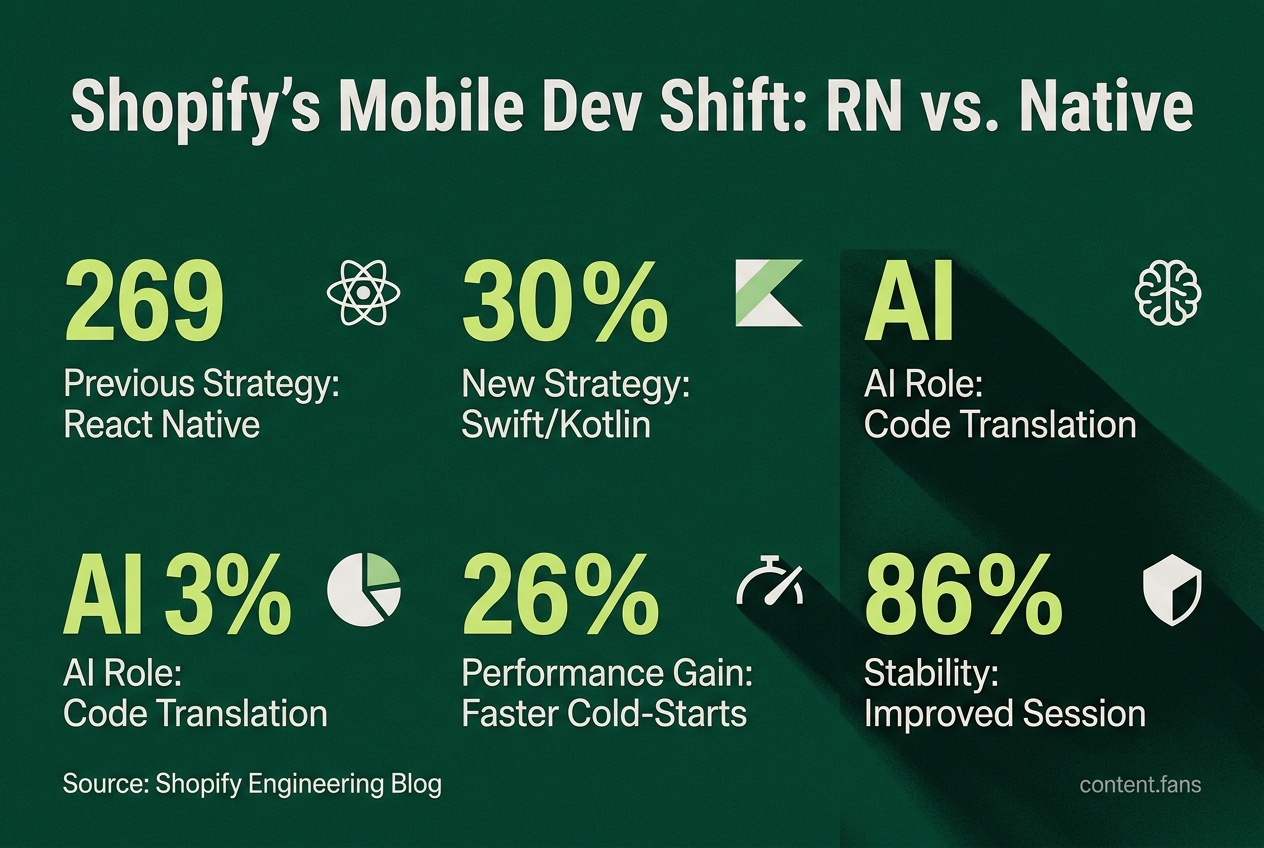
Shopify is moving from React Native to native development because AI coding agents have reduced the cost and effort of maintaining separate Swift and Kotlin codebases. This shift allows their teams to work closer to native platform tooling while achieving better performance and stability.
Prototypes of the Shop app rebuilt in SwiftUI and Jetpack Compose delivered significantly lower iOS cold-start latency and substantially faster Android cold-starts. According to internal benchmarks, session stability improved meaningfully, and Android release builds became considerably faster.
How AI agents fit in
Shopify's new workflow centers on a headless desktop test suite that allows AI agents to quickly verify business logic. In this process, a human engineer implements a feature in Swift, an AI agent ports it to Kotlin, and shared automated tests immediately flag any discrepancies. While human engineers remain "in the loop" for architectural and user experience decisions, the AI handles most of the rote translation work.
Key practices include:
- Agents use one platform implementation as a reference for the other.
- Shared tests execute in seconds on desktop hardware.
- Human review focuses on architectural and UX choices, not boilerplate.
Remaining challenges
Shopify acknowledges that AI does not eliminate all the challenges of native development. Teams must still manage platform-specific architecture, app store compliance, and performance optimization. The company's prior investments in React Native performance tuning may not directly transfer, potentially requiring new learning cycles for the native Swift and Kotlin stacks.
Industry context
Industry observers view Shopify's decision not as a failure of React Native, but as evidence of a new trend where AI is changing the cost-benefit analysis of mobile development. While agents are making native development more viable for large companies, analysts caution that the productivity gains may not apply equally to smaller teams or different types of applications, especially since AI excels at boilerplate code rather than complex refactoring.
What happens next
Shopify has begun migrating its production apps to native code, using AI throughout the process while maintaining its existing crash-free targets. While a definitive timeline has not been released, early native builds of the Shop app are being tested, providing a real-world evaluation of the company's claims regarding improved performance and stability.
Shopify's decision to abandon React Native in favor of native Swift and Kotlin development marks a significant inflection point in mobile engineering. The company is betting that AI coding agents have fundamentally altered the economic trade-offs between cross-platform and native development that have shaped the industry for years.
Here are the key questions and answers about this strategic shift:
Why is Shopify moving away from React Native after five years?
Shopify originally adopted React Native in 2019 to solve three specific problems: avoiding duplicated feature work across iOS and Android, enabling more developers to contribute across the stack, and reducing time spent maintaining feature parity between platforms. The company published a "React Native is the Future of Mobile at Shopify" blog post highlighting these benefits.
However, by 2024, Shopify leadership determined that AI coding agents had reduced the advantages of sharing implementation across platforms. The company's engineering team concluded that the productivity gains React Native offered in 2019 no longer outweighed the benefits of native development when AI could handle much of the cross-platform translation and verification work.
What specific advantages does Shopify see in native Swift and Kotlin development?
Shopify identifies several strategic advantages that have become more compelling as AI reduces the cost of maintaining two codebases:
- Closer integration with platform capabilities and first-party tooling - native code eliminates abstraction layers between the app and the operating system
- Fewer framework and dependency layers to manage and update
- A clean slate to rebuild apps "in the best way possible" without earlier framework constraints
- Faster rebuilds in prototypes - Shopify found it could recreate apps substantially faster using native approaches with AI assistance
The company also reported meaningful technical improvements in its native prototypes: significantly lower iOS cold-start latency, substantially lower Android cold-start latency, improved session stability, and considerably faster Android release build times.
How exactly will AI agents support the migration to native code?
Shopify is deploying AI throughout its migration process in several concrete ways:
Feature translation between platforms - Agents can port features between Swift and Kotlin, using one platform's implementation as a reference for the other. This addresses the core "build twice" problem that originally drove Shopify to React Native.
Cross-platform gap identification and repair - AI agents can detect where implementations diverge between iOS and Android and suggest fixes.
Shared verification testing - Shopify is building a shared verification test suite that validates business logic across both platforms, with tests running headless on desktop to give agents quick feedback loops.
This approach allows Shopify to maintain quality and parity standards while working in separate native codebases.
What does this mean for React Native's future in the industry?
Shopify's move is not a blanket indictment of React Native but rather a specific response to changed cost structures. Industry analysis suggests the decision reflects a broader trend where AI is narrowing the productivity gap between cross-platform and native development.
React Native continues to deliver strong performance for many standard business applications, particularly content-heavy apps like e-commerce listings and dashboards. The framework remains advantageous for teams prioritizing single-codebase efficiency and fast cross-platform feature delivery.
However, Shopify's case demonstrates that for organizations where peak performance, platform fidelity, and long-term control matter most, native development plus AI assistance has become economically viable in ways it wasn't previously.
Is Shopify alone in this shift, or part of a larger trend?
While Shopify's reversal is high-profile, evidence suggests coding agents are becoming increasingly mainstream across mobile development teams. Many developers report that AI tools have had a positive effect on productivity, with a growing number of agent users saying agents reduced time spent on specific tasks.
The research indicates AI tends to help most with repetitive, well-specified tasks - exactly the type of work that made React Native attractive for standard UI development. As agents improve at boilerplate implementation, test creation, and documentation, the relative cost of maintaining platform-specific native codebases decreases.
For Shopify specifically, this was a deliberate, tested decision: prototypes and rebuilt core components in Swift, Kotlin, SwiftUI, and Jetpack Compose preceded the public announcement, with measurable performance gains validating the approach before full commitment.