
OpenAI unveils 20+ products, positions ChatGPT as an OS
Serge Bulaev
OpenAI announced over 20 new products at DevDay 2026, showing that ChatGPT may become a main tool for daily work, not just for conversation. The new features include always-on agents called Dots, a shared workspace called ChatGPT Space, and a fast Decisions API. OpenAI also introduced a new $500 Pro plan with higher limits, while some existing users reportedly had their quotas reduced. Early tests suggest the updates are fast, but some bugs and permission issues appeared. OpenAI says about 1.2 billion people use ChatGPT weekly, but final prices for some new features are not set yet.

At its DevDay 2024 event, OpenAI unveiled over 20 new products and upgrades, signaling a strategic shift that positions ChatGPT as an operating system (OS) for daily work. The rapid-fire announcements detail a vision for ChatGPT as a central hub for documents, agents, and apps, moving it far beyond a simple chatbot. According to OpenAI, these releases aim to establish the service as a "control plane" that orchestrates tasks across existing platforms like Windows and iOS, rather than replacing them.
Inside the 20-plus launches
The key announcements from OpenAI's DevDay 2024 center on making ChatGPT a proactive and collaborative tool. The new features include always-on agents called Dots, a shared workspace named ChatGPT Space, a rapid Decisions API, and the upgraded GPT-4o model, all designed to integrate deeply into user workflows.
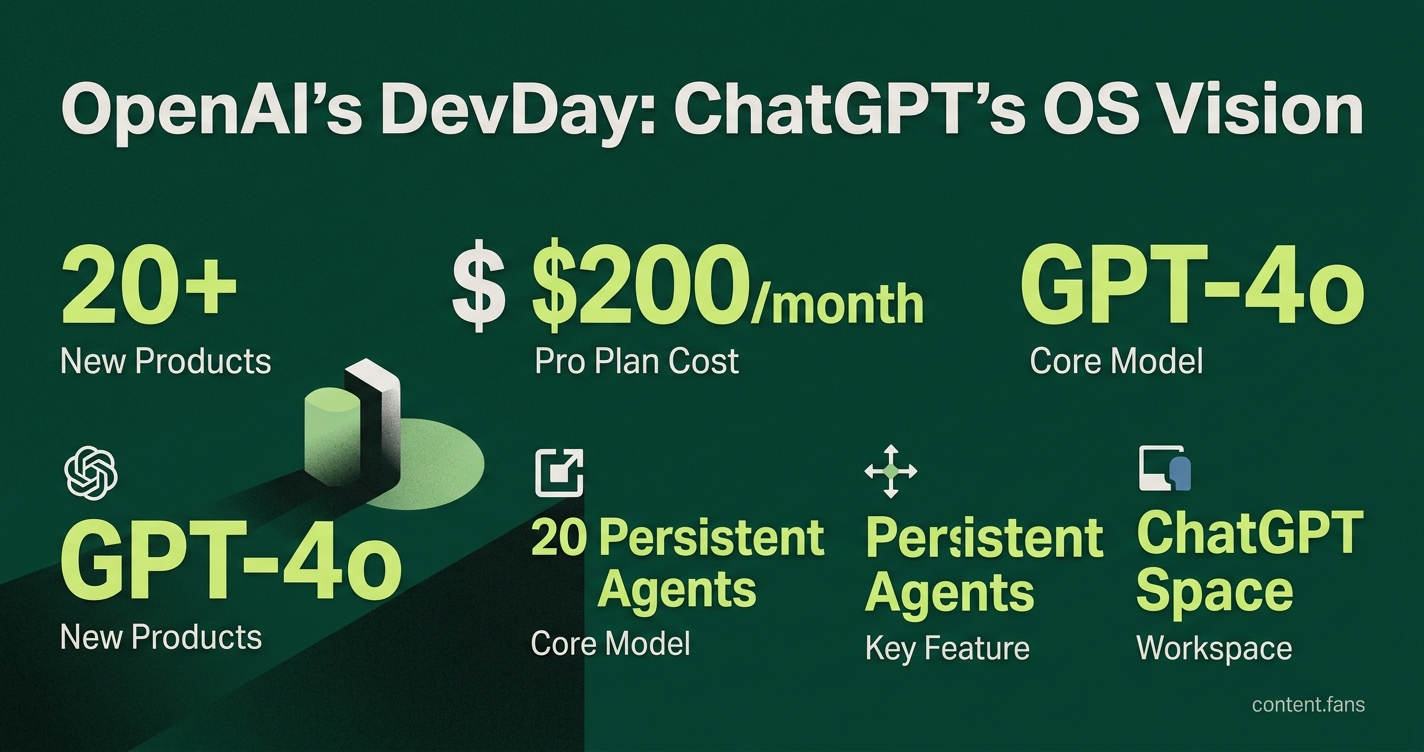
Developers received a host of new capabilities headlined by Dots, which are always-on background agents described as "persistent agents with connected apps and their own cloud computer." Other major reveals included ChatGPT Space, a collaborative workspace for teams and agents, and the Decisions API for high-speed task classification. The event also introduced an expanded Agents API with remote computer control, and deeper integrations with partner applications.
- Major launches at a glance:
- Dots: Persistent background agents tied to user accounts.
- ChatGPT Space: Live, collaborative documents for people and agents.
- Decisions API: A preview of fast classification and routing tools.
- GPT-4o: An upgraded foundational model.
- $200 Pro Plan: Enhanced tier with advanced capabilities.
Pricing shake-up and capacity tiers
OpenAI also restructured its pricing, introducing a new $200/month Pro tier aimed at heavy developers and researchers. This plan includes enhanced inference speed, expanded usage limits, and access to advanced features. In a move analysts see as targeting power users, OpenAI has positioned this tier for users who need significantly more capacity than the standard plans. Free plans will continue to be available but will lack access to persistent agents and the complete ChatGPT Space feature set.
Early testing and reliability notes
While live demonstrations of the new models showed impressive speed, early tests revealed some reliability issues. Reviewers noted workflow interruptions from permission pop-ups, dropped messages in ChatGPT Space, and intermittent browser access failures within Dots. OpenAI acknowledged these problems as "expected for a public beta" and committed to providing regular updates to address them.
Competitive framing: ChatGPT as the interface layer
Industry analysts interpret this strategy as an ambitious attempt to own the "top of the stack" - the interface where work is initiated. This move creates direct competitive friction with Microsoft Copilot, which vies for the same productivity layer, and threatens Google with user "intent leakage" as people perform tasks within ChatGPT instead of traditional search. The strategy also faces hurdles from platform gatekeepers like Apple, as platform owners can limit third-party assistants. With a substantial user base, OpenAI has a significant audience to test its new paradigm, though final pricing for key features like Space and the Decisions API remains unannounced.
What is OpenAI's new "Dots" feature and how does it work?
Dots are persistent, always-on agents that come with their own cloud computer and connected apps. Unlike traditional chat interactions that end when you close the window, Dots continue running in the background, capable of completing tasks autonomously. OpenAI has positioned them as collaboration-centric agents - meaning they're designed to work alongside humans and other agents rather than simply respond to prompts. The company has also indicated that additional capabilities are planned for future releases. Early descriptions characterize Dots as having their own persistent environment where they can maintain state across sessions and integrate with external applications.
How does ChatGPT Space differ from existing document tools?
ChatGPT Space represents OpenAI's entry into collaborative workspaces - described officially as a "shared workspace for people and agents." Unlike conventional document editors, Space is built around the concept of living documents that can include research, images, charts, and contributions from both humans and AI agents. The product includes Pages - collaborative documents that serve as persistent canvases for work. Space is specifically designed for working with Dots, suggesting tight integration between the agent and document layers. This positioning directly challenges existing productivity suites by embedding AI collaboration at the architecture level rather than as an add-on feature.
What is the Decisions API and who is it for?
The Decisions API is a developer-facing tool currently in limited preview that enables fast classification, routing, and choosing agent actions from predefined answers. Rather than generating open-ended responses, this API is optimized for systems that need quick decisioning logic - essentially allowing developers to build deterministic branching and action selection into agent workflows. OpenAI's framing suggests this targets use cases where speed and reliability matter more than creative generation, such as customer routing, workflow automation, and agent orchestration. The API appears designed to complement rather than replace generative endpoints, giving developers more granular control over how AI systems behave in production environments.
Why did OpenAI introduce a $200 Pro tier and what does it include?
OpenAI's $200/month Pro plan targets heavy individual and professional users who consistently exceed existing usage limits. The tier includes enhanced speed capabilities alongside expanded usage limits, increased research capacity, and access to advanced features including Dots. The pricing strategy reflects a deliberate market segmentation by intensity of use: developers and researchers running compute-intensive workloads are asked to pay for higher capacity tiers. The move has been characterized as "aimed directly at heavy users" - particularly those using advanced features for code generation and long-running tasks who found lower tiers insufficient.
What does "ChatGPT as operating system for work" actually mean?
OpenAI's strategic positioning describes ChatGPT as becoming a "control plane for work" rather than a literal replacement for Windows or macOS. The vision involves ChatGPT coordinating across apps, files, code, agents, and workflows on top of existing device platforms - essentially capturing the user intent layer that decides what happens next. This approach enables starting tasks on one device and continuing on another across different platforms. However, this creates direct competitive tension with major platform owners: Microsoft faces challenges to Copilot's centrality in enterprise workflows, Google confronts potential disintermediation of search and browser defaults, and Apple must defend its device-level assistant control. Becoming the default work layer remains challenging without structural control of hardware and OS defaults, as platform owners maintain significant influence over third-party integrations.