
White House Approves $9B for AI Chips, Anthropic Eyes Classified NSA Deal
Serge Bulaev
The White House has approved about $9 billion for advanced AI chips, mainly for use by U.S. spy agencies. This may be the largest chip purchase for intelligence in recent years. At the same time, the AI company Anthropic appears to be working on a secret deal with the NSA, though details are unclear. Experts suggest these moves point to a shift toward using commercial AI technology in government missions, but there are still questions about security, oversight, and how future contracts might be managed. Some rules and policies around chip use and export controls may change as a result of these deals.

Recent reports confirm the White House approves significant funding for AI chips for U.S. spy agencies, representing a substantial intelligence hardware investment in recent memory. Concurrently, AI startup Anthropic is reportedly finalizing a classified contract, likely with the NSA. Analysts view these developments as a strategic pivot, with the intelligence community increasingly relying on commercial foundation models and cloud-based chips instead of bespoke supercomputers, all while navigating strict security protocols.
What the funding figure covers
The administration has reportedly approved substantial funding for next-generation AI accelerators for use by the National Intelligence Program. While specific budget lines remain classified, this figure represents a significant investment in hardware acquisition over research grants according to industry reports. Though vendors remain undisclosed, procurement trends and security waivers point toward established manufacturers with clearance for sensitive government projects. This spending is complemented by enhanced enforcement, with new funding aimed at strengthening chip export controls.
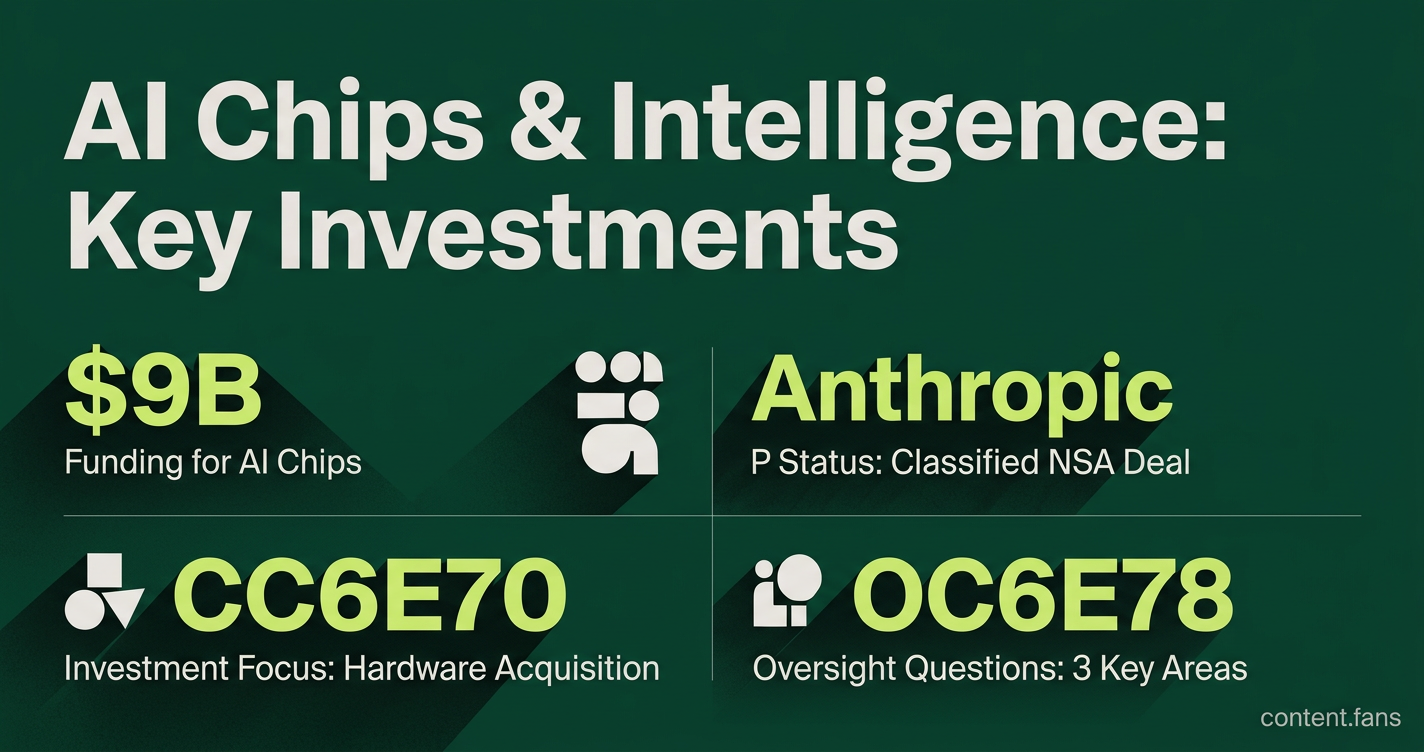
This initiative involves a major hardware purchase for intelligence agencies, shifting national security toward commercial AI. Simultaneously, AI developer Anthropic is expanding its classified work with the Pentagon, signaling a deeper integration of private-sector AI models into sensitive government and military operations.
Anthropic's classified foothold
Despite headlines about an "NSA contract," available information points to existing Department of Defense engagements. A Lawfare analysis confirms Anthropic's Claude model is already active on classified networks via Palantir's Maven Smart System. Furthermore, the Pentagon's Chief Digital and AI Office (CDAO) has reportedly awarded the company a significant prototype contract according to industry reports. Any NSA work may be integrated into these existing defense agreements rather than being a separate contract. Anthropic also faces significant compliance challenges, including a Defense policy requiring vendors to accept "any lawful use" clauses, sparking internal debate about the ethical boundaries of AI in surveillance and warfare.
Oversight pressures are mounting
The substantial investment and novel contracts have drawn immediate scrutiny from Congress, with aides focusing on three key oversight questions:
- How will intelligence agencies effectively test and red-team these advanced models before deployment?
- Will acquisition offices provide unclassified spending summaries for public accountability?
- How will export controls be enforced to prevent the illegal transfer of these classified-grade chips?
This concern is amplified by evolving regulations. Under the AI Diffusion Rule framework, regulators now treat the transfer of AI model weights with the same scrutiny as physical chip exports, aiming to prevent security loopholes, as noted by the University of Sydney's United States Studies Centre (link).
What happens next
Moving forward, Congressional budget committees are demanding a classified report from the Director of National Intelligence detailing the full lifecycle costs of the chip program. Experts anticipate that a significant portion of the funding could be spent this fiscal year on commercially available chips that already meet security standards. Meanwhile, any Anthropic deal involving the NSA will likely be channeled through existing defense contracts, limiting public visibility. Together, these events define the intelligence landscape: substantial spending on AI hardware combined with groundbreaking contracts that force a reckoning between commercial tech ethics and national security imperatives.
What exactly is the AI-chip package approved by the White House?
The White House has authorized substantial funding to acquire advanced AI chips exclusively for the U.S. intelligence community. Rather than appearing as a single budget line, the funds are woven into broader categories such as AI R&D, high-performance computing (HPC), and Intelligence Community modernization accounts. Public sources do not display a distinct "intelligence-agency chip budget", so the figure is best interpreted as the total envelope for hardware that will accelerate classified analytics, satellite-data processing, and AI-enabled surveillance.
Is there really an "NSA deal" with Anthropic?
Current public reporting points to Pentagon-level classified use, not a stand-alone NSA contract. According to Lawfare, Claude is already deployed on classified networks through Palantir's Maven Smart System and is producing proposed targets (reportedly for Iran-related operations). Separately, the Pentagon's Chief Digital and AI Office (CDAO) has reportedly awarded Anthropic a significant prototype agreement according to industry reports. These facts confirm classified military use, but no primary source in the stack names the NSA as the contracting agency.
How does the federal government actually oversee AI tools used in classified environments?
Oversight is layered, not centralized:
- Agency-level testing and red-teaming: Frontier models undergo review before deployment and periodically thereafter.
- Security accreditation: Every system must earn network and enclave approval inside classified spaces.
- Human-in-the-loop rules: Analysts or officers must review all high-consequence outputs.
- Contractual controls: Classified agreements include mandatory logging, data-handling clauses, and audit rights.
- Legal/regulatory cross-checks: Existing laws on privacy, export control, and procurement integrity apply - even when a project is top-secret.
Why is this move significant for the tech industry?
The reported funding request appears aimed at helping U.S. intelligence agencies secure advanced AI chips, data-center capacity, and cooling infrastructure; it does not by itself establish a general policy that hardware is a strategic national asset or authorize classified partnerships for AI startups. According to industry reports, CAISI (the U.S. AI Safety Institute) has run numerous pre-deployment evaluations with firms like Google, Microsoft, and xAI. The clearance pipeline - facility clearances, personnel clearances, and isolated cloud enclaves - has become a competitive moat that only a handful of companies can meet. Expect venture-capital term sheets to start rewarding "Fed-ready" startups at premium valuations.
Could these deals erode public transparency?
Yes and no. Procurement details remain opaque because they sit inside classified budgets. However, model-evaluation findings and contractor red-lines are emerging in public forums. Anthropic's public objection to "any lawful use" clauses - which would permit mass domestic surveillance or fully autonomous weapons - has already surfaced in Lawfare and policy hearings. Analysts should watch for Congressional classified briefings and GAO audits (such as GAO-24-107332) as the primary venues where spending and compliance questions may be aired without exposing sources or methods.