
Social Platforms Steal Search from Google, Redefine Marketing in 2026
Serge Bulaev
Social platforms like Instagram, TikTok, YouTube, and Reddit may now handle more searches than Google, with many people starting their product research and questions there. Evidence suggests users trust content from real people and creators more than brands or AI alone, so brands are focusing on authenticity and clear, open information. Many buying decisions appear to start inside social feeds, and brands might shift their efforts to match this trend by using content that feels human and transparent. Metrics for success now seem to include saves, shares, and mentions by creators, rather than just website clicks. Overall, trust and visible human involvement may matter more to both users and search algorithms than polished advertising.

A fundamental power shift is underway as social platforms increasingly compete with Google for search traffic, redefining marketing for 2026 and beyond. This transfer of authority from marketers to platforms that control search, discovery, and credibility forces brands to prove their value with radical transparency. As algorithms perform more cognitive work, success now depends on social-first SEO and visible human authorship, with creators serving as the ultimate seal of approval.
Social platforms replace search
Search is no longer synonymous with Google. Billions of daily queries now flow through Instagram, TikTok, YouTube, and Reddit. According to industry reports, Instagram processes a significant portion of daily searches and YouTube handles substantial search volume. With a growing number of buying decisions originating in social feeds, user behavior has evolved from keywords to conversational questions answered by short-form video. This trend is led by Gen Z, many of whom start searches on social platforms, representing a significant shift from traditional search behavior. Even Google acknowledges this shift by indexing public social content as a primary ranking factor.
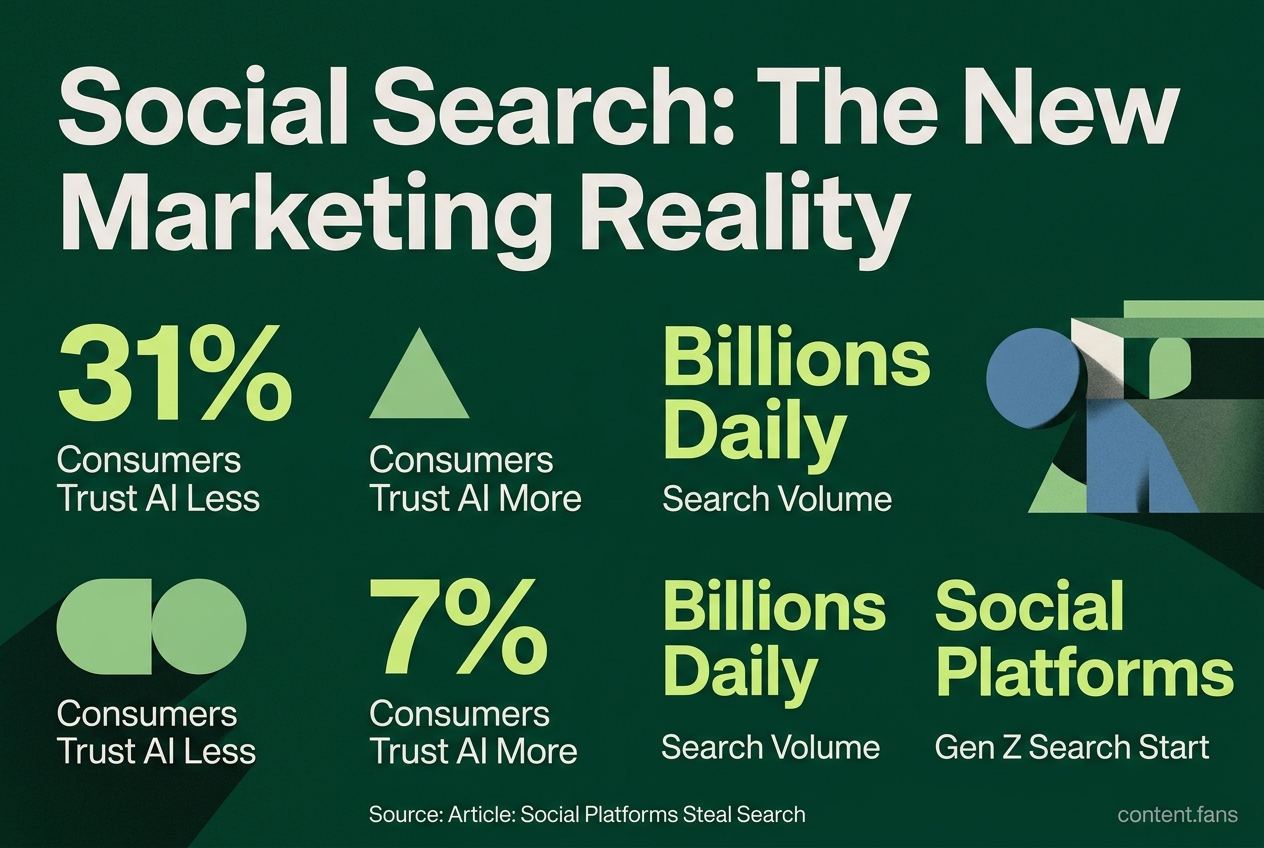
Social platforms are overtaking traditional search by providing visual, creator-driven answers to user queries. Instead of keyword-based text results, users now prefer authentic video reviews and recommendations on platforms like TikTok and Instagram, where they can see products in action and get answers from trusted human sources.
Creators as the algorithm's trust layer
In an AI-driven world, human credibility is the new currency. AI search engines actively seek human trust signals before citing a source, mirroring consumer behavior: according to recent research, only 7% of consumers say visible AI-generated marketing makes them trust a brand more, while 31% say it makes them trust the brand less. Additionally, a significant majority of consumers wish marketers wouldn't use AI daily. Consequently, algorithms prioritize content with real people, verifiable expertise, and unedited experiences. Creators have evolved from mere amplifiers to essential "trust carriers." AI models weigh social proof - what real users say about a product - more heavily than a brand's own marketing, making authentic creator partnerships critical for visibility.
Strategic Shifts: How Brands Are Adapting
According to Deloitte Digital, winning in this new landscape requires a focus on micro-touchpoints over monolithic campaigns. Successful brands are deploying three core tactics:
- Human Authenticity: Reflecting audience demand for "real and relatable" content, brands are prioritizing employee- and user-generated content that showcases unedited opinions, behind-the-scenes work, and even minor flaws.
- Radical Transparency: To combat the "trust recession," companies are embedding verifiable proof points directly into their content. This includes blockchain-traced sourcing, open pricing models, and explicit disclosures about AI usage, all designed to be easily shared on social media.
- Answer Engine Optimization (AEO): Instead of traditional SEO, teams now focus on AEO. This involves structuring content with concise explanations, schema markup, and visible expert bios so that AI assistants can quote it directly as a definitive answer.
Practical trust signals consumers look for
To build credibility with both users and algorithms, brands must integrate tangible trust signals. According to industry reports, incorporating these elements leads to significantly increased engagement for AI-summarized content. Key signals include:
- A detailed author bio with verifiable credentials.
- A clear statement explaining how AI was used and how a human verified the output.
- Publicly accessible editorial guidelines.
- Screenshots of authentic customer or employee testimonials.
- Traceable sourcing data for products and claims.
Metrics shift with the new discovery path
As the user journey fragments, success metrics must evolve. With Google Search still featuring 86% human-created articles and many TikTok users researching products directly on the app, click-through rates are evolving due to AI discovery layers but remain relevant. Forward-thinking brands now prioritize on-platform KPIs like saves, shares, and creator mentions. Deloitte advises focusing on granular "micro-conversions" - a saved post, a shared video, or a quoted answer in an AI chat. These actions are stronger indicators of purchase intent and can be mapped to revenue through sophisticated attribution and social listening models.
As platforms increasingly think for their users, the path to relevance is clear: provable facts outperform polished promises, and the most powerful citation will always be human.
How are social platforms competing with Google as search interfaces in 2026?
A significant portion of buying decisions now start on Reddit, TikTok, Instagram or YouTube while traditional search patterns evolve. Gen Z and Millennials prefer visual proof, authentic reviews and conversational answers over traditional blue links. Instagram processes substantial daily search volume, TikTok increasingly competes with Google for product questions, and YouTube serves as a go-to place for final validation before checkout. Google has responded by indexing public Instagram posts and short-form videos, acknowledging that social content now feeds AI answers in ChatGPT and Perplexity.
Why do creators act as the ultimate trust signal for AI citations?
AI models cite sources that show verifiable human credibility, not brand self-promotion. According to recent research, many shoppers trust human-authored content more than AI output when making purchase decisions. Algorithms therefore prioritize social proof, creator storytelling and platform-native reviews because these signals prove real experience. Brands that feature expert author bios, clear editorial guidelines and transparent AI-usage statements see significantly higher engagement in AI-summarized search results.
What is "Answer Engine Optimization" and why does it replace traditional SEO?
AEO is the practice of structuring entities (people, brands, expertise) and conversational content so that TikTok, Instagram and AI assistants quote you first. Ranking factors have moved from keyword density to on-platform actions - saves, shares, watch-time and comment sentiment act as primary ranking signals. Marketers now optimize for visual, voice and photo discovery instead of text SERPs, and the brands winning are those that answer exact questions in 15-60 second videos with captions and metadata that machines can parse.
How can brands prove value when platforms handle most of the "thinking"?
Success hinges on raw authenticity and radical transparency that algorithms cannot fake. Tactics include:
- Employee-generated and user-generated content to replace polished ads
- Blockchain-backed traceability to disclose sourcing and labor practices
- Co-creation campaigns that invite customers to design products
- Clear ROI dashboards showing micro-conversions from social search to sale
These human layers create the trust differential that AI can't manufacture and customers still pay for.
Which platform should brands prioritize for social search in 2026?
Match platform to purchase stage:
- TikTok for trend-driven discovery and how-to queries
- YouTube for long-form reviews that lock in the final decision
- Instagram for shoppable posts that close checkout inside the app
- Reddit for authentic, peer-reviewed recommendations
Allocate budget proportional to the significant portion of discovery already happening on social, yet receiving a smaller share of marketing spend, and rotate creative every 7-14 days to stay visible in algorithmic feeds.