
Pinterest's AI Moderation Still Misses Extremist Content After 2 Years
Serge Bulaev
Pinterest introduced AI tools to help moderate content and spot misinformation, but outside reports suggest the system still misses extremist material and sometimes bans normal users by mistake. The AI may misidentify art or fail to catch some AI-generated images, and it appears that pro-Islamic State content can still be found. Stricter rules for disclosing sponsored posts are now enforced, with strong penalties for not following them. Experts say the AI system has some promise but needs better human review and ongoing improvements to work well.
Two years after deploying AI to police its platform, Pinterest's AI moderation is still failing to remove extremist content. While the company touted early metrics showing significant reductions in policy-violating material, independent analysis and user reports suggest a system that is both ineffective against harmful posts and prone to error, incorrectly flagging benign content.
What the new AI system actually does
Pinterest's AI content moderation struggles due to several interconnected issues. The system is less effective against content stripped of metadata and text-based violations in non-English languages. Furthermore, it has difficulty interpreting nuanced visual contexts, like art, and its performance is hampered by reduced human review capacity.
Pinterest's moderation pipeline utilizes a dual-scan approach, combining computer vision with metadata analysis. Uploaded images and videos are hashed and cross-referenced against a model trained to identify visual cues associated with hate speech, graphic violence, and health misinformation. Pins exceeding a specific confidence threshold are automatically removed or flagged with a warning. A secondary classifier identifies synthetically generated media, powering the platform's "Gen AI" label and filter.
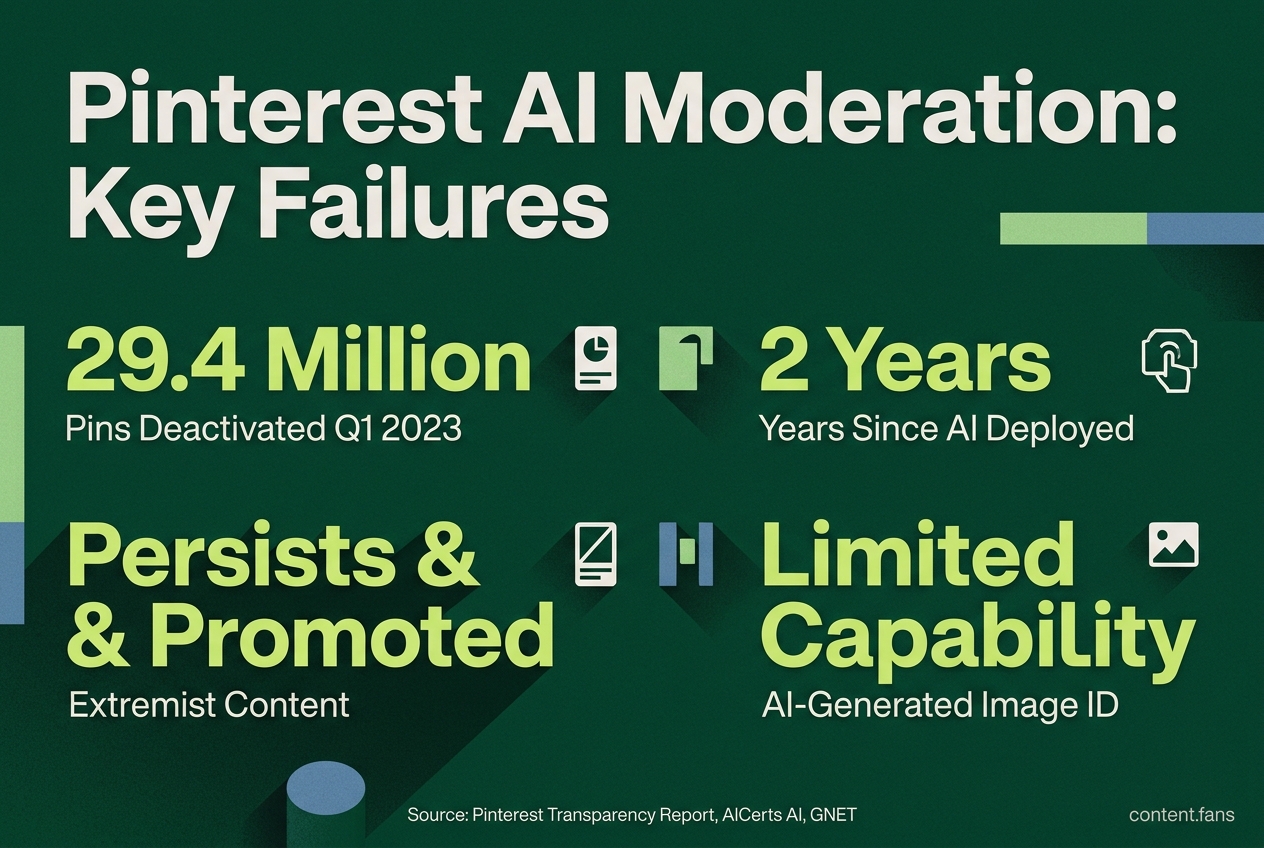
This automated system is responsible for tens of millions of deactivations quarterly; in Q1 2023, Pinterest deactivated 29,396,667 Pins for adult content, per its official Transparency Report [1]. AI Trace [3] cited this figure but did not originate the report.
Mixed results two years in
Despite the system's scale, its performance has been inconsistent. Research findings indicate that vision language models have limited capabilities to identify AI-generated images and attribute artists, as documented in an arXiv paper titled 'Artificial Intelligence and Misinformation in Art'. These errors are corroborated by numerous user reports on forums like Reddit, where creators share experiences of having their accounts wrongfully banned without clear recourse. Critically, research from the Global Network on Extremism and Technology confirms that pro-ISIS content not only persists but is actively promoted by the platform's recommendation algorithm, driving millions of views to extremist boards.
According to moderation experts cited by AICerts AI, such false positives are highly damaging, eroding creator trust more severely than spam. The system's binary classifier is particularly vulnerable to failure when processing texture-heavy AI style transfers or when metadata is lost during uploads from other platforms.
Stricter sponsored content disclosures
In parallel with its AI moderation efforts, Pinterest has enforced stringent new disclosure rules for all sponsored content, including Idea Pins. As outlined by AuditSocials, creators must follow five mandatory steps to remain compliant:
- Activate the native Paid Partnership label.
- Tag the sponsoring brand in the same field.
- Add an on screen text or verbal disclosure in the first frame.
- Reveal affiliate links even without direct payment.
- Disclose gifted products as material connections.
Failure to include any of these elements results in immediate content removal. Repeat violations can lead to a 30-day suspension or the permanent loss of monetization features. The Federal Trade Commission holds both creators and brands liable, making these disclosures a legal imperative.
How Pinterest compares with rival platforms
Pinterest's challenges reflect a broader industry issue: AI is currently more adept at image-based detection than text-based analysis. According to industry reports, synthetic media detection tools generally show higher accuracy rates than text-based models. This capability gap helps explain why extremist slogans in Arabic captions evade Pinterest's filters, while more visually obvious violations are caught.
In contrast to Pinterest's closed, automated approach, platforms like X have found success with crowd-augmented systems. X's Community Notes has proven faster and more accurate than many AI-only models. Pinterest's reliance on automation, compounded by a reduced human review team due to staff cuts, leaves it at a significant disadvantage.
Outlook
Industry experts concur that while Pinterest's hybrid model has potential, significant improvements are necessary. Substantial gains hinge on three critical actions: restoring human reviewer capacity, refining the AI classifier to better handle complex images like style transfers, and establishing transparent and effective appeal processes for users.
For creators, the path forward requires diligence. The automated system is unforgiving, so meticulously applying paid partnership labels and front-loading all disclosures is essential to avoid punitive action.