
Report: 4 Ways Content Marketing Fails to Drive Revenue
Serge Bulaev
Many content marketing programs may fail to drive revenue because they do not align articles with the buyer's journey or target topics with search demand. Studies suggest that a lack of distribution and weak tracking of meaningful metrics, like qualified leads or conversion rates, also hold teams back. Experts recommend focusing on buyer-centric topics, improving content promotion, tracking pipeline metrics rather than just traffic, and repurposing strong content to increase impact. Consistent publishing and careful use of AI tools may also help, but results appear best when all steps are tied closely to revenue goals.

Many marketers discover their content marketing fails to drive revenue due to several common, yet critical, strategic gaps. Despite significant investment and consistent publishing, pipeline growth stalls when content isn't tied to sales outcomes. This report examines why programs underperform and provides evidence-based tactics to convert traffic into bookings.
Where the revenue leaks begin
Content marketing programs often fail to generate revenue because the content is not aligned with the buyer's journey and targets keywords with low search demand. A lack of effective distribution and a focus on vanity metrics, instead of pipeline-focused KPIs, are also primary causes of failure.
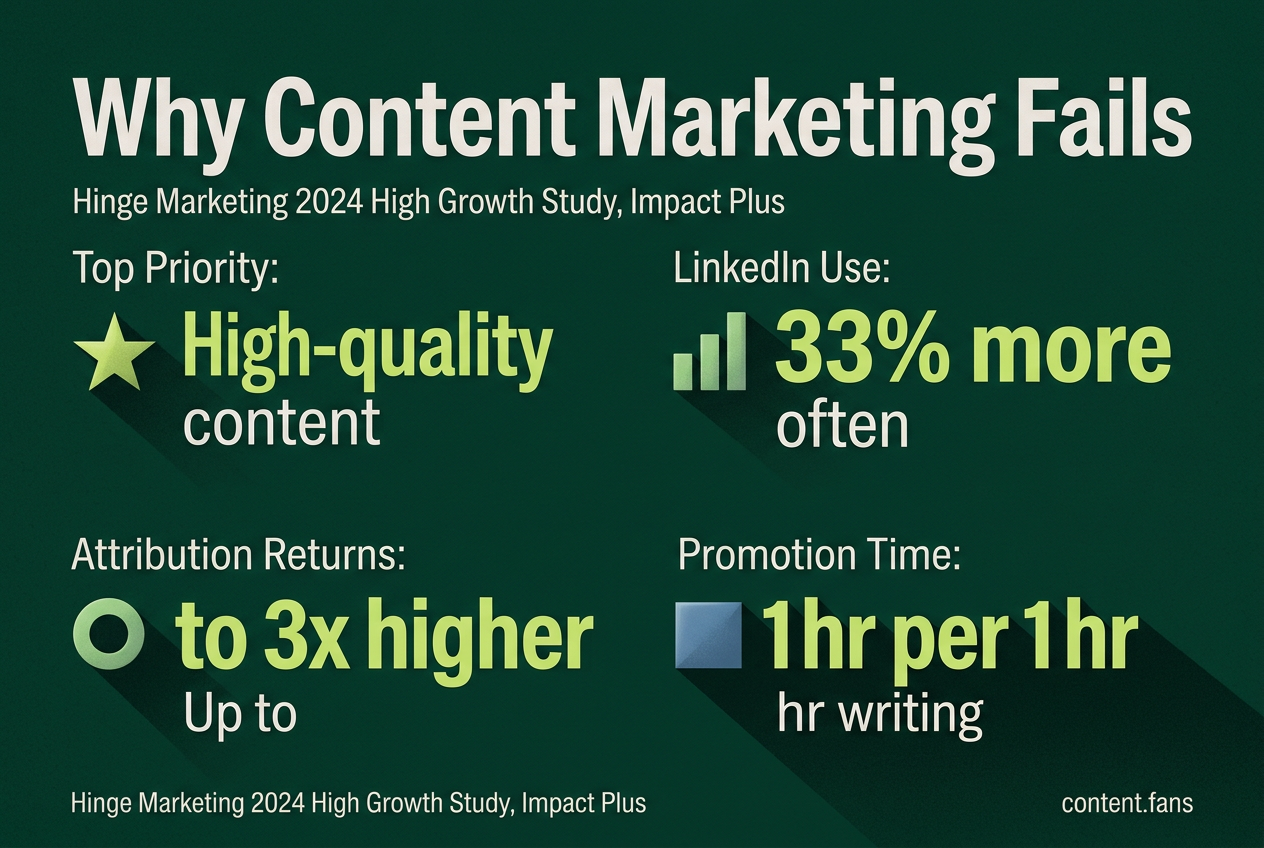
Hinge Marketing's 2024 High Growth Study found that producing high-quality content is the top marketing priority for high-growth firms, with LinkedIn as their top recruiting tool (used 33% more often). When content is not aligned with the buyer journey, it becomes "storytelling, not selling," according to a review by Infinity Mkt.
Search intent is the next hurdle. Industry reports indicate that a significant portion of failed campaigns target topics with no meaningful search demand - a pattern that experts believe lowers potential ROI regardless of writing quality. Even high-intent pieces underperform if they never reach buyers; missing distribution engines are commonly cited as a root cause of content marketing failures.
Metrics that matter in 2025
Industry research indicates a strategic shift toward pipeline visibility, with a growing number of marketers now ranking lead-to-customer conversion rate above raw traffic. Recommended core metrics to measure revenue impact include:
- Qualified lead volume (MQLs or SQLs) influenced by content
- Lead-to-customer conversion rate
- Content-influenced pipeline value
- Content marketing ROI calculated from revenue minus cost
Industry research often cites that single-touch attribution hides the role of early-stage content. Multi-touch or data-driven models reportedly deliver up to 3x higher returns because they credit every interaction across the buyer journey.
Fixes you can deploy this quarter
-
Build buyer-centric topic clusters
Conduct interviews with sales and customer service to surface the ten most-asked cost, problem, and comparison questions. Publish straightforward answers first. Impact Plus research shows cost transparency pieces accelerate close rates. -
Install a lightweight distribution engine
Allocate at least one hour of paid promotion and email amplification for every hour of writing. Marketing experts recommend reserving a portion of the content budget for optimization tests and syndication. -
Track pipeline - not vanity
Set a primary KPI, such as qualified leads or bookings, before writing a brief. Tag URLs so each download or video view can be attributed inside your CRM. -
Repurpose winning assets
Infinity Mkt notes that organizations lacking a repurposing plan burn resources on constant new production. Clip key points from long-form guides into vertical shorts, carousels, and newsletter snippets to extend shelf life.
Always-on publishing cadence
Brand Exposure Studio advises publishing three evergreen pieces weekly plus two short videos to maintain audience expectation and compound search gains. Companies that hit this rhythm reportedly see a 41 percent reduction in paid media dependency after 24 months, according to Hashmeta.
Guardrails for AI assistance
Generative tools can outline drafts or predict headline performance, but experts caution against using them for volume alone. Establish performance-based guardrails and measure any AI-driven lift against conversion metrics.
An effective content marketing strategy therefore hinges on aligning topics with buyer questions, building a simple yet consistent distribution process, and tying every asset to pipeline signals. These data-driven steps can transform content from a cost center into a measurable revenue driver.
Why does most content fail to generate pipeline?
Because it is misaligned with buyer journeys and targets topics that have no real search demand. Industry reports commonly identify the top ROI killers as content that never maps to a funnel stage and articles optimized for keywords no one types. Fix it by building three data-backed personas, listing 10 pains and 5 queries per stage, then publishing three evergreen pieces weekly that answer the "Big 5" questions: cost, problems, comparisons, reviews, and "best" lists. Brands that follow this cadence report 6 % lead-to-customer conversion versus the 1.3 % industry average.
How can we stop wasting budget on random acts of content?
Replace ad-hoc posting with an "always-on" topic ecosystem. Allocate a portion of the content budget to performance analysis: A/B test headlines, CTAs, and under-performing posts every 60 days, then re-publish winners. Companies using this optimization loop cut ** paid-media dependence by 41 % within 24 months** while keeping creative bandwidth focused on pieces that already show traction.
Which attribution model actually proves content revenue?
Skip last-click; use multi-touch or data-driven attribution. Content-influenced pipeline tracks every blog, video, or whitepaper a buyer touches before the deal closes. Organizations with robust MTA achieve 3× higher returns than those relying on vanity traffic metrics.
What KPIs should leadership see instead of pageviews?
Present Qualified Lead Volume (MQLs/SQLs), Lead-to-Customer Conversion Rate, and Pipeline Contribution. These metrics are increasingly recognized as top revenue signals by B2B marketers and directly tie each asset to bookings.
How long until content shows real ROI?
Expect a 12 - 18-month B2B content ROI curve. Stakeholders who abandon efforts at quarter six miss the compounding gains that begin around month twelve. Communicate this timeline up-front and pair it with early pipeline signals (MQL growth, content-assisted win rate) to secure budget continuity.