
VideaAI expands dental AI platform to private practices, rebrands
Serge Bulaev
VideaHealth has rebranded as VideaAI and expanded its dental AI platform to private dental practices, making its FDA-cleared image analysis tools available to independent clinicians. The software is reportedly used by over 90,000 providers and may lead to sharper diagnostics and faster insurance claims, according to early studies. Field data suggests the AI system could help identify more cavities and reduce false findings, with some clinics reporting higher treatment acceptance and improved workflow. While results vary between clinics, the data suggests AI-supported visuals might improve both patient understanding and clinic revenue. However, AI systems still require a licensed dentist for final diagnosis and mainly serve as a support tool rather than a replacement for clinical judgment.
VideaHealth has rebranded to VideaAI and is now offering its widely adopted dental AI platform to private practices. This expansion makes the company's FDA-cleared image analysis technology, already used by over 90,000 clinicians in large dental support organizations (DSOs), available to independent dentists. The platform delivers the same algorithms used by eight of North America's 10 largest DSOs to improve diagnostics and accelerate insurance claim cycles.
Inside the VideaAI feature set
VideaAI is an artificial intelligence platform that integrates with existing dental software to provide real-time analysis of X-rays. It uses color-coded visual overlays to highlight potential caries and periodontal disease, helping dentists improve diagnostic accuracy, streamline charting, and enhance patient communication during consultations.
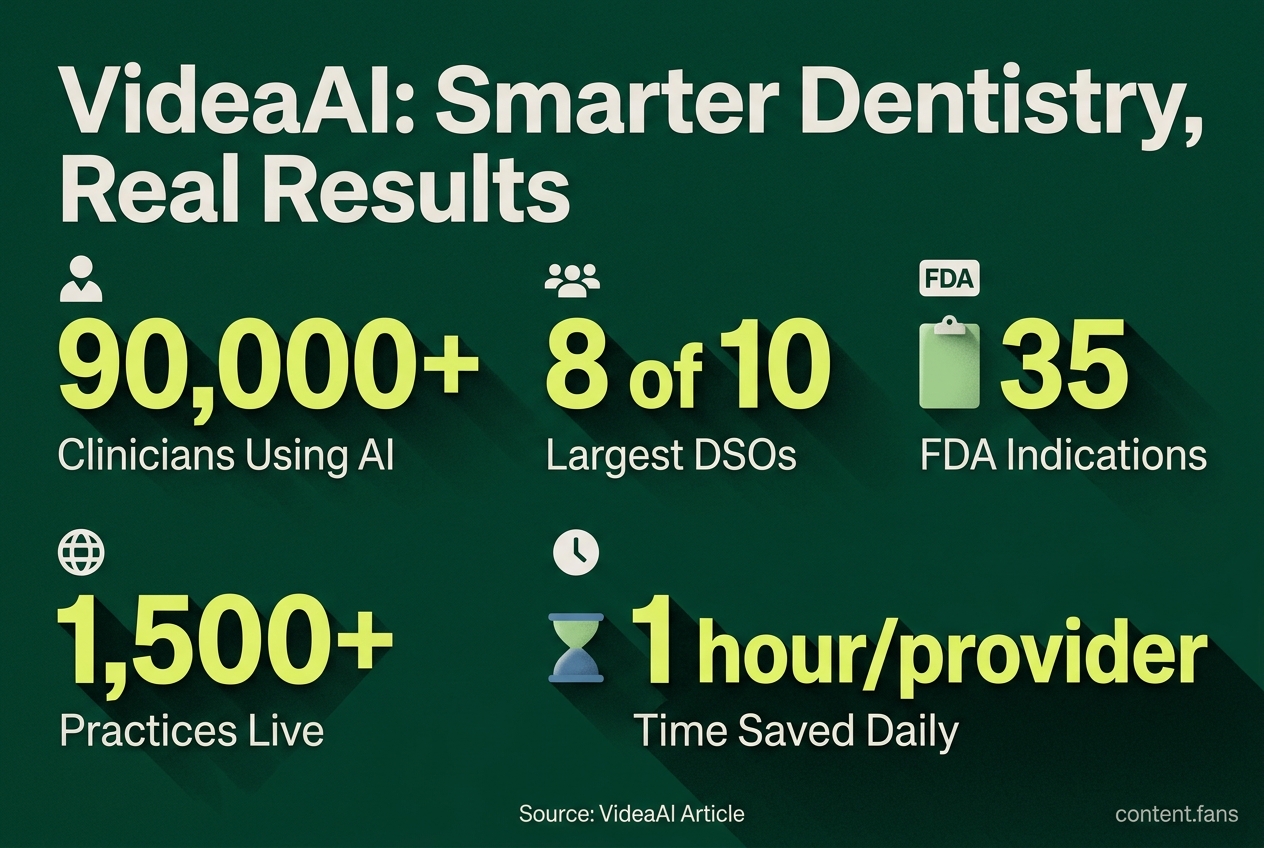
The platform plugs directly into existing practice management and imaging systems, enhancing bitewing and periapical X-rays with real-time analysis. With 35 FDA-cleared indications, VideaAI reports high adoption rates among enrolled offices. Key features include:
- Chairside Detection: Provides instant visual cues for caries and periodontal disease during appointments.
- Automated Documentation: Generates clinical notes and automates charting, which can significantly reduce claim submission time.
- Patient Education Tools: Uses clear, patient-facing slides to visually explain diagnostic findings.
- Improved Consistency: Analytics dashboards help reduce diagnostic variation across common conditions.
- Clinician Training: A built-in review module flags missed lesions to support professional development.
Field data from Heartland Dental demonstrated that using the AI resulted in improved cavity detection and reduced false findings.
VideaHealth Unveils Rebrand and Expands The Most Adopted Dental AI Platform to Private Practices: early field results
Early results from large-scale deployments and private practices indicate significant clinical and financial gains. The platform is now live in 1,500+ practices in less than 10 weeks (Heartland Dental), demonstrating the platform's scalability.
Smaller clinics report similar financial trends. A Lumio Dental case study showed significant improvements in restorative case acceptance and treatment plan value after six months. Operationally, practice managers estimate that dentists save 1 hour per provider per day thanks to automated notes and fewer retakes.
Competitive context and adoption signals
The dental AI market is a competitive and rapidly growing field, with significant expansion according to industry reports. While VideaAI trails competitors like Pearl and Overjet in total FDA 510(k) clearances, its claim as the "most adopted platform" is based on its user base of 90,000 clinicians. The expansion into private practices targets the largest segment of the oral care market, which often lacks access to enterprise-grade IT solutions.
It is crucial to note that under FDA regulations, dental AI operates as a decision-support tool, not a substitute for professional expertise. A licensed dentist must provide the final diagnosis. VideaAI is designed to augment clinical judgment, enhance diagnostic consistency, and streamline documentation.
What prompted VideaHealth to rebrand as VideaAI and target private practices now?
After successfully scaling its platform to 90,000 clinicians, primarily within large DSOs, the company identified a significant opportunity in the private practice market. A rollout across many practices completed in recent weeks validated the model for independent clinicians.
Which chair-side tools will my team actually use?
The core feature is real-time X-ray analysis, where the AI instantly outlines potential issues like caries and periodontal defects across 35 FDA-cleared indications. The system uses color-coded visuals to help patients understand diagnoses. Integrated tools for voice charting, automated notes, and one-click insurance narratives save 1 hour per provider daily.
Will patients really accept treatment more often?
Yes, data suggests a significant impact. According to industry reports, a significant portion of patients are more inclined to approve a treatment plan when AI visuals are used. Early adopters report meaningful improvements in overall case acceptance, with the value of restorative treatment plans increasing substantially when VideaAI's visuals are part of the consultation.
How accurate is the diagnostics compared with an experienced dentist?
The AI is designed to enhance, not replace, a dentist's skill. It helps reduce diagnostic variation among clinicians for common conditions. Data from Heartland Dental's 2,400 doctors showed the AI helped identify significantly more cavities while simultaneously reducing false positives, leading to more consistent and appropriate treatment.
Does it integrate with my existing software?
Yes, the platform is built with open APIs for broad compatibility. It syncs with major practice management systems like Dentrix, Eaglesoft, Curve, and OpenDental, as well as most imaging hardware. The implementation is remote and requires no new server hardware, with the system typically ready for use the morning after a brief installation.