
AI Agent Boom Creates Identity Explosion in 2026
Serge Bulaev
In 2026, managing identity and access for AI agents is becoming a major challenge for businesses. Researchers warn there may be an "identity explosion" as companies try to handle thousands of agent identities needing frequent permission changes. Current systems may not track who authorized risky actions, which suggests gaps in accountability and compliance. Experts recommend using existing security protocols in new ways and adopting practices like mapping all agent identities to responsible owners and logging all actions. These steps may help organizations keep up with evolving rules and avoid bigger problems later.

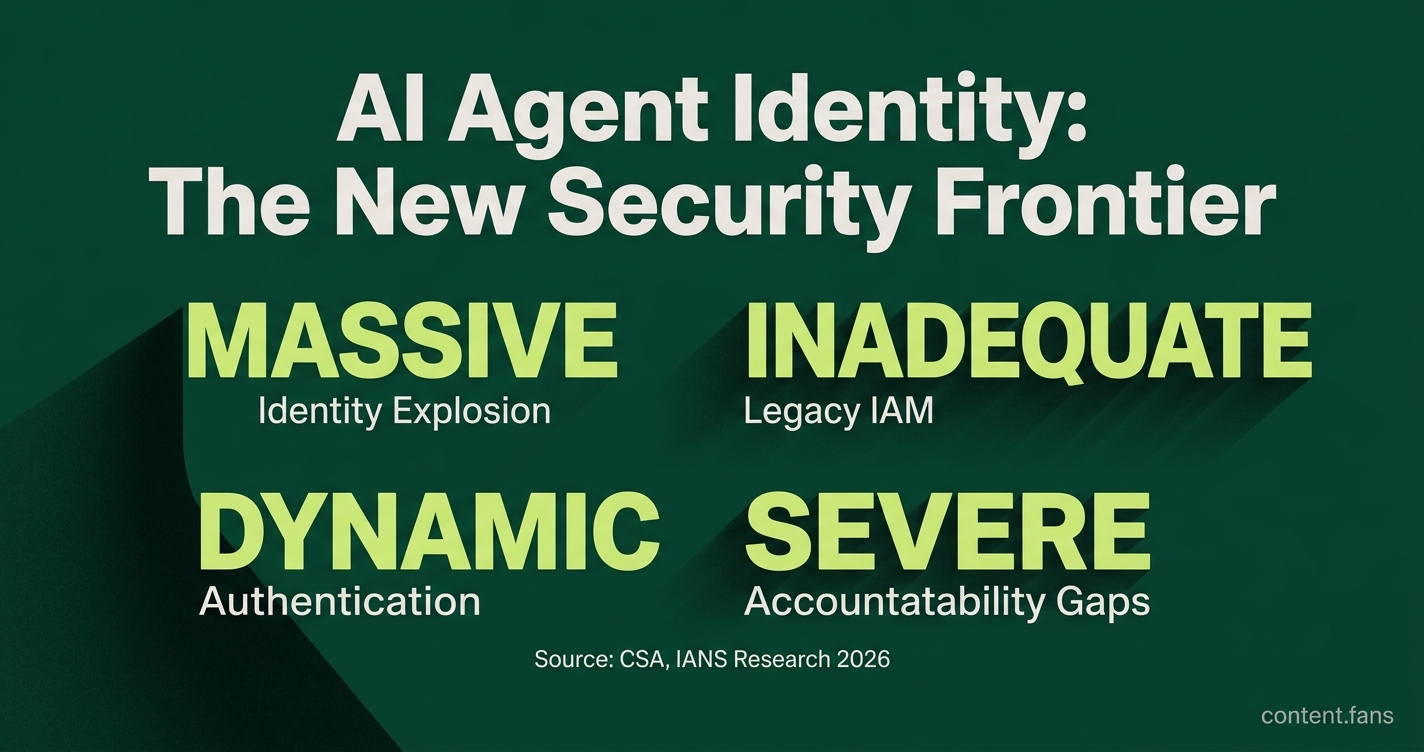
The AI agent boom is creating a massive identity explosion for enterprises, challenging core security principles. The emergence of Agentic IAM marks a fundamental inflection point, as traditional identity frameworks built for human users prove inadequate. Organizations need substantial changes to identity infrastructure and governance to support autonomous agents, but not necessarily a full ground-up rebuild.
Here is what security leaders need to understand about this transformation.
What is Agentic IAM and why does it matter now?
Agentic IAM is a security framework that extends identity and access management to non-human AI agents, treating them as first-class entities. It provides a structured way to manage their authentication, authorization, and audit trails, addressing the unique security challenges they introduce at scale within an enterprise.
This reframing is critical because organizations now face what a CSA survey note calls an "identity explosion," managing significant numbers of agent identities. Each requires a unique authentication profile and dynamic permissions, creating an identity security crisis that legacy IAM systems struggle to handle.
How are authentication and authorization changing for AI agents?
Static role-based access control (RBAC) is inadequate for dynamic agentic systems. AI agents require permissions that change moment-by-moment, demanding fine-grained, context-aware authorization based on their current task. The Cloud Security Alliance warns of widespread reliance on static credentials, fragmented authorization models, limited discovery, and weak traceability. To counter this, industry reports indicate that enterprises are adopting short-lived credentials and token exchange mechanisms like OAuth 2.0 to eliminate risky credential sharing.
What makes delegation and accountability so difficult with autonomous agents?
Accountability breaks down in complex delegation chains. When an agent delegates tasks to sub-agents and tools, the original human user's identity becomes obscured, creating risks that traditional IAM cannot track. IANS Research notes that agents may accumulate permissions broader than the human principal is authorized to hold. This ambiguity creates severe accountability gaps, as traceability to the original delegator is lost - a failure modern compliance frameworks will not tolerate.
Which standards and technologies are enterprises adopting for Agentic IAM?
Instead of creating new protocols, the industry is extending established enterprise IAM standards for agent-specific needs. Key technologies emerging for Agentic IAM include:
- OAuth 2.0/OIDC for delegated access and scoped tokens
- SPIFFE/SPIRE for cryptographic workload identity
- SCIM for agent lifecycle management and provisioning
- Zero Trust controls for continuous verification
According to industry reports, these existing protocols form the foundation for agent identity. Organizations must prepare to support a mix of these standards rather than waiting for a single winner.
What practical steps should security teams take?
Security teams must implement concrete controls to manage the agent identity explosion. A baseline of essential practices includes:
- Inventory all non-human identities - Map every agent, service account, bot, and tool runner to an owner.
- Ban shared human credentials for agent use and replace them with dedicated workload identities.
- Require explicit delegation boundaries so every agent action ties to a human sponsor and approval path.
- Move from role-based to policy-based authorization for high-risk agent actions.
- Instrument audit trails for agent provenance to answer who/what initiated any action and enable rapid revocation.
Leading organizations treat the entire agent identity lifecycle - from registration and policy onboarding to deprovisioning - as a standard operational practice, not a series of exceptions.
Looking ahead
The move to Agentic IAM is more than a technical upgrade; it is a strategic shift in how enterprises define identity. It moves from a human-centric model to one that treats software agency as a core security primitive. Security leaders who embrace this change will build a sustainable advantage, while those who delay risk their infrastructure being overwhelmed by the scale and complexity of autonomous operations.