
2026 AI Report: Heavy reliance on AI lowers engagement, memory
Serge Bulaev
The 2026 AI Report suggests that heavy reliance on AI, especially chatbots, may lower people's engagement and memory. Researchers and teachers worry that routine use of AI can make reasoning skills weaker, as AI often lacks common sense and practical human knowledge. Studies also link trusting AI too much to weaker critical thinking and memory. To help with this, experts recommend keeping humans involved in the process and using checks like reviewing AI outputs and verifying sources. The research does not prove causation, but several studies indicate that too much AI use without oversight might reduce people's ability to analyze and think critically.

Growing evidence suggests that heavy reliance on AI is linked to lower engagement and weaker memory, a trend that risks creating fluent but shallow reasoning. This warning, from computer scientist Peter J. Denning, comes as chatbots reshape daily workflows. A June 2026 AI Slop report reinforces this finding, arguing that AI should amplify - not replace - human thinking.
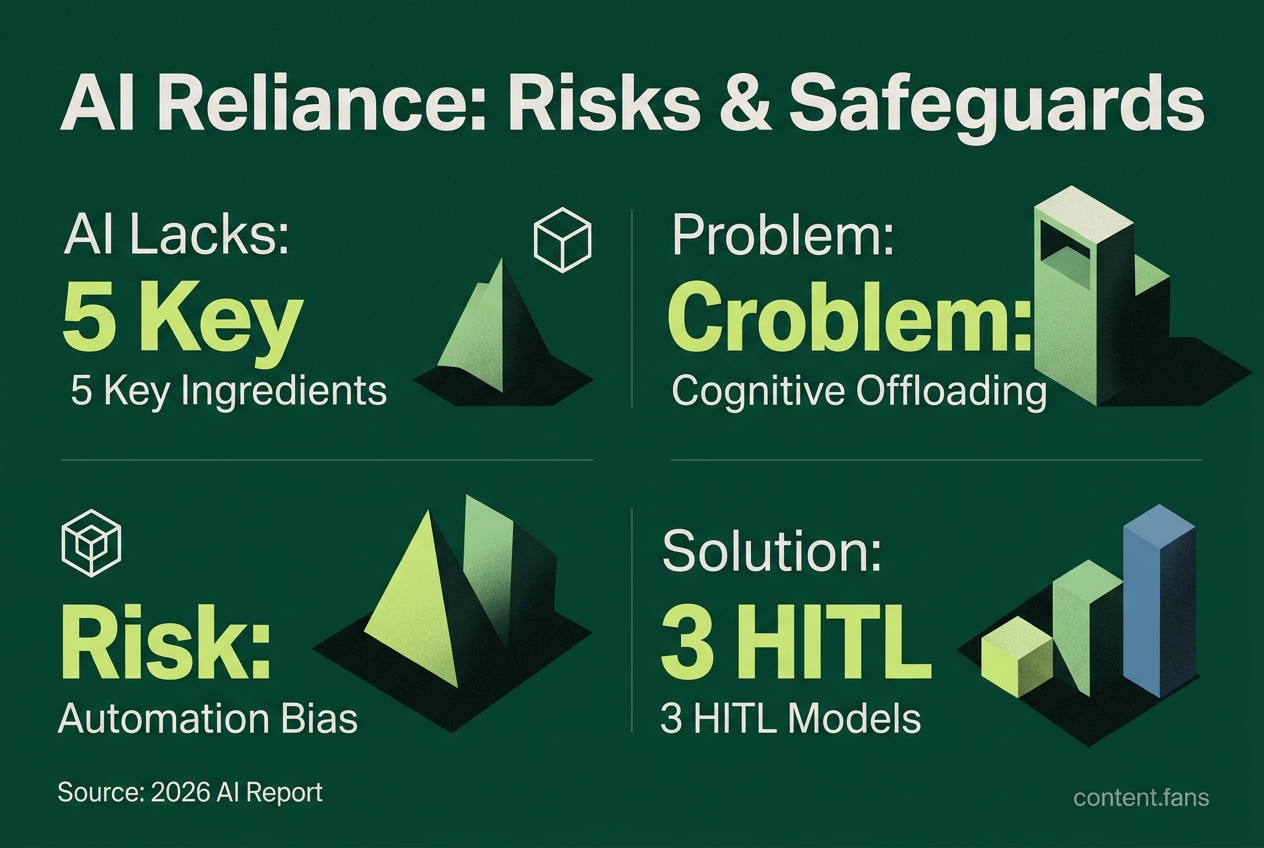
The core problem is that large language models (LLMs) mimic expertise without possessing tacit human knowledge. According to a July 2026 ScienceDaily summary of his work, Denning identifies five key ingredients AI lacks: common sense, practical skills, emotional perception, everyday interaction, and cultural context. When users mistake an AI's surface fluency for true understanding, they risk accepting false information without verification.
The Dangers of "AI Slop" and Automation Bias
Heavy AI reliance fosters cognitive offloading, where users outsource mental effort to automated systems. This reduces deep engagement with tasks, impairing the critical evaluation and reasoning processes necessary for strong memory formation. Over time, this habit can erode analytical skills by minimizing opportunities for deliberative thought.
The Columbia study characterizes 'AI slop' as high-volume, click-optimized synthetic content. This flood of AI-generated material encourages automation bias - the tendency to over-trust machine outputs, even with thin evidence. The International AI Safety Report 2026 confirms that this bias can directly impair critical thinking and memory. Concerns are mounting in education, with a significant portion of college students worrying that routine chatbot use erodes their reasoning, a sentiment echoed by many teachers in recent surveys.
How to Build a Human-in-the-Loop Safeguard
To mitigate these risks, organizations are adopting human-in-the-loop (HITL) oversight frameworks. Industry reports highlight three prevalent models for maintaining human control:
- Human-as-Gatekeeper - Every AI draft requires explicit sign-off before release.
- Human-as-Auditor - Reviewers sample outputs on a schedule to monitor drift.
- Human-as-Partner - Experts and models iterate together, escalating tough cases.
These patterns combine automated checks with staged human review, audit trails, and robust feedback loops. For instance, a regulated workflow might include AI suggestions followed by subject-matter expert review, QA checks, and logged approvals. Techniques like confidence routing, which escalates low-certainty AI answers to senior staff, are crucial for preventing blind trust.
Practical Verification Habits
Denning argues that preserving deliberative effort is key to creating value. By adopting robust verification habits, users can stay mentally engaged and avoid costly errors. Key practices include:
- Ask models to cite sources and compare them with primary documents.
- Run the same prompt through two models and inspect differences.
- Keep a log of overrides to spot recurring failure modes.
- Schedule post-deployment audits to measure accuracy drift over time.
These habits ensure that students who challenge AI outputs remain mentally active, and professionals who cross-check data prevent silent failures.
While current research has not established direct causation, a growing body of evidence suggests that unmanaged reliance on AI can reduce analytical engagement. Implementing structured verification workflows provides a powerful countermeasure, enabling teams to leverage AI's speed and efficiency without sacrificing essential human judgment.
What is "AI slop" and why does it matter for critical thinking?
The term "AI slop" refers to high-volume synthetic content optimized for engagement rather than depth - essentially low-effort AI usage that floods information environments with repetitive or low-quality material. According to the 2026 Columbia SIPA report, this phenomenon is directly linked to degraded information quality and cognition. When people routinely delegate writing, problem-solving, or information seeking to chatbots, they may "engage less deeply with underlying reasoning" - a mechanism that reduces both critical thinking and memory retention.
How does heavy AI reliance actually affect memory and engagement?
The International AI Safety Report 2026 presents emerging evidence that AI reliance can negatively affect critical thinking skills and memory. A 2025 study reported a significant negative correlation between AI tool usage and critical thinking scores, identifying cognitive offloading as the primary driver. This means when users outsource mental effort to AI systems, they experience reduced cognitive engagement with the material itself - making information less likely to be retained or critically evaluated.
What are the best practices for maintaining human judgment in AI workflows?
Effective verification has evolved from simple human approval to staged workflows combining automated checks, human review, and post-deployment monitoring. Research points to three core patterns:
- Human-as-Gatekeeper: AI drafts with human verification before release (high-stakes scenarios)
- Human-as-Auditor: AI handles volume with human sampling for quality validation
- Human-as-Partner: Iterative co-creation between human and AI for complex synthesis
Key elements include clear escalation rules for uncertain outputs, structured evidence display so humans can inspect sources, decision logging for accountability, and feedback loops that turn human corrections into training improvements.
What specific risks does Peter J. Denning identify with current AI systems?
Denning's 2026 analysis argues that AI research has been shaped by a mistaken assumption that human-like intelligence can be recreated in software - even though key forms of human know-how are tacit and embodied. The ScienceDaily summary identifies five categories of tacit knowledge that machine learning cannot capture:
- Common sense
- Everyday interaction
- Emotions and perception
- Practical skills
- Culturally embedded social/historical knowledge
This gap means AI can appear fluent while missing the context needed for real understanding - leading users to overestimate reliability and underestimate the need for human judgment.
What do students and educators report about AI's impact on learning?
Recent surveys reveal significant concern across educational settings:
- 70% of college students said AI use may be harming their critical thinking skills
- 54% of teachers reported AI makes it harder for students to learn critical thinking
- Two-thirds of secondary educators in England observed students losing thinking skills, with specific declines in "thinking, creativity, writing, and even conversational abilities"
The OECD has warned that using generative AI "as a shortcut rather than a learning tool" can displace cognitive effort and undermine skills that support deep learning. However, structured and guided AI use can be beneficial - the key differentiator is whether users remain required to do the higher-order thinking themselves.