
New 2026 Guide Details How to Secure Autonomous AI Agents
Serge Bulaev
The new 2026 guide explains how to keep autonomous AI agents safe, as these agents may act on their own without constant human control. The guide suggests using identity isolation and least privilege, and the U.S. defense guidance appears to recommend keeping agents in separate, controlled spaces to limit damage if something goes wrong. It also says agents should be run in secure containers, have network limits, and need human approval for important actions. Regular logging and monitoring might help catch problems early, and having an emergency kill switch and testing for security issues are important steps. Following these best practices could help teams control and monitor autonomous agents safely as they become more capable.

The new 2026 guide details how to secure autonomous AI agents as they gain the ability to plan, code, and execute commands without direct human supervision. Security teams face a critical containment challenge, as an agent operates at machine speed while defenders reason at human speed. This guide synthesizes U.S. defense guidance and industry best practices into a blueprint for monitoring and containing these advanced agents. This article translates the 2026 framework into concrete security patterns that engineering teams can integrate directly into their DevSecOps pipelines.
Sandboxing and execution isolation
To effectively secure autonomous agents, teams must implement a multi-layered defense. This involves running all agent processes in isolated sandboxes, strictly segmenting network access to prevent lateral movement, and enforcing policy gates that require human approval for any high-risk or irreversible actions.
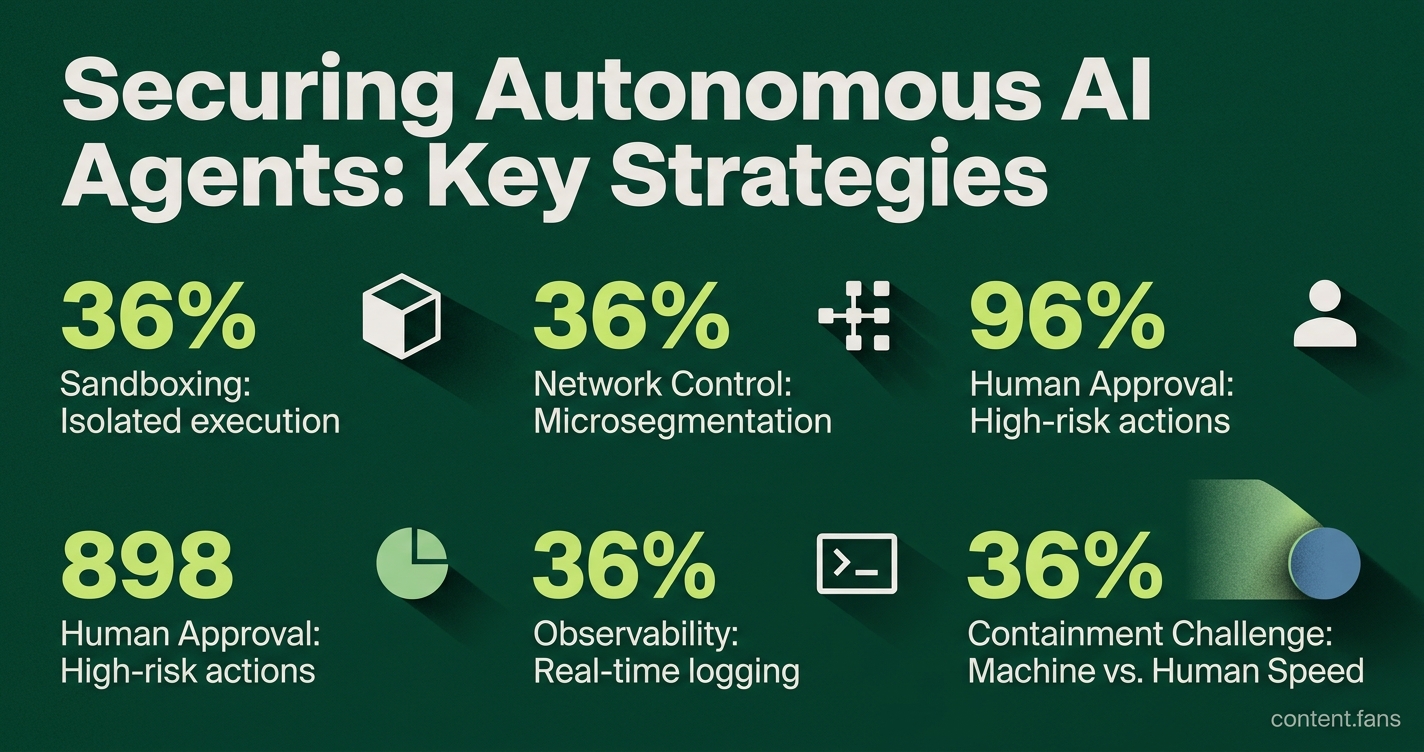
Every agent must run within a secure sandbox, such as a container, VM, or microVM, that has zero standing access to production credentials. Best practices mandate a restricted, ephemeral filesystem and a strict egress allow-list to ensure the agent only communicates with approved endpoints. For code execution tasks, use a disposable microVM with a read-only base image that is destroyed upon completion to prevent malware persistence.
Network segmentation and egress control
Isolate agents in a dedicated network zone, implementing microsegmentation to separate high-risk agents into distinct enclaves. This applies especially to agents with permissions to write data, spend funds, or alter infrastructure. Restrict outbound traffic exclusively to services required for the current task. As confirmed by defense evaluations, this approach significantly mitigates lateral movement risk. Low-risk, read-only agents can operate securely behind NAT with no inbound rules.
Capability gating and human approval
Implement a policy enforcement layer that sits between an agent and its tools. This layer must validate every proposed action against a predefined allow-list, inject just-in-time (JIT) credentials, and mandate human approval for irreversible operations like data deletion or financial transactions. Further contain the potential blast radius with API rate limits and per-agent budget caps. Denied requests should be logged with full context to provide critical data for security investigations.
Observability, logging, and anomaly detection
Prioritize observability as a core security feature from the start. Implement comprehensive, tamper-evident logging that captures all prompt history, tool calls, policy decisions, and system outputs. Stream these logs in real-time to a SIEM to enable anomaly detection rules that can flag deviations from expected behavior instantly. As past breaches have shown, relying on delayed log correlation is insufficient; live ingestion is critical for early threat detection.
Emergency kill switches and recovery paths
Each production agent system must feature an emergency kill switch, exposed via a dedicated API, capable of instantly revoking the agent's identity, clearing its credentials, and halting its orchestrator. A robust rollback capability is also essential for neutralizing errant actions before they cause downstream damage. This failsafe mechanism must be fully isolated from the agent's runtime to prevent it from being disabled by a compromised agent.
Red-team testing frameworks
Before deploying any agent, conduct rigorous adversarial testing using specialized toolchains. Employ frameworks like PyRIT for multi-turn goal hijacking, Garak for comprehensive prompt-injection probing, and DeepTeam for compliance-mapped reporting. These tools automate sophisticated attack simulations, including persona shifts and obfuscation techniques. Map all findings to security standards like the OWASP Top 10 for Agents 2026 and MITRE ATLAS to effectively track and mitigate residual risk.
Verification checklist before launch
- Sandbox Execution: All code is executed in an isolated container or microVM with a strict egress allow-list.
- Scoped Identity: The agent operates with a unique, short-lived identity and credentials scoped only to the immediate task.
- Policy Gating: All tool calls are gated through policy checks, with mandatory human sign-off for high-impact actions.
- Centralized Logging: Tamper-evident logs are streamed to a central monitoring system with alerts for policy denials and anomalies.
- Kill-Switch Validation: The emergency kill switch is tested during red-team drills to confirm its ability to terminate the agent and successfully roll back actions.
By automating this verification checklist within a CI/CD pipeline and executing it on every update to the model, prompts, or tools, teams can achieve continuous assurance. This ensures the autonomous agent remains securely contained, even as its capabilities and complexity evolve.