
Salesforce unveils Claudeforce, expands AI agent pricing models
Serge Bulaev
Salesforce is changing how it sells software because of AI agents that can do work without humans logging in. The company now offers several ways to pay, such as by conversation, action, user, or ticket resolution, which may mean seat-based pricing is less important. Salesforce and Anthropic announced Claudeforce, which lets AI agents do tasks in Salesforce, but it is unclear how customers will be charged when outside agents do the work. Research suggests many companies use AI agents and that these tools save time, so buyers might focus more on results and less on user numbers. Salesforce appears to be experimenting with these new models to stay important as work becomes more automated.

The rise of autonomous AI agents is compelling Salesforce to overhaul its SaaS playbook, with new AI agent pricing models and its Claudeforce initiative leading the charge. As AI performs work without human logins, the company's classic seat-based licensing model faces a critical test. In response, Salesforce is experimenting with new monetization strategies that could reshape the enterprise software landscape.
Agent-driven pricing experiments
Salesforce is shifting from its traditional seat-based licensing to a hybrid model that includes outcome-oriented options. The company is now offering pricing based on conversations, specific actions performed by AI, and successful ticket resolutions, reflecting a move to align costs more closely with the value delivered by autonomous agents.
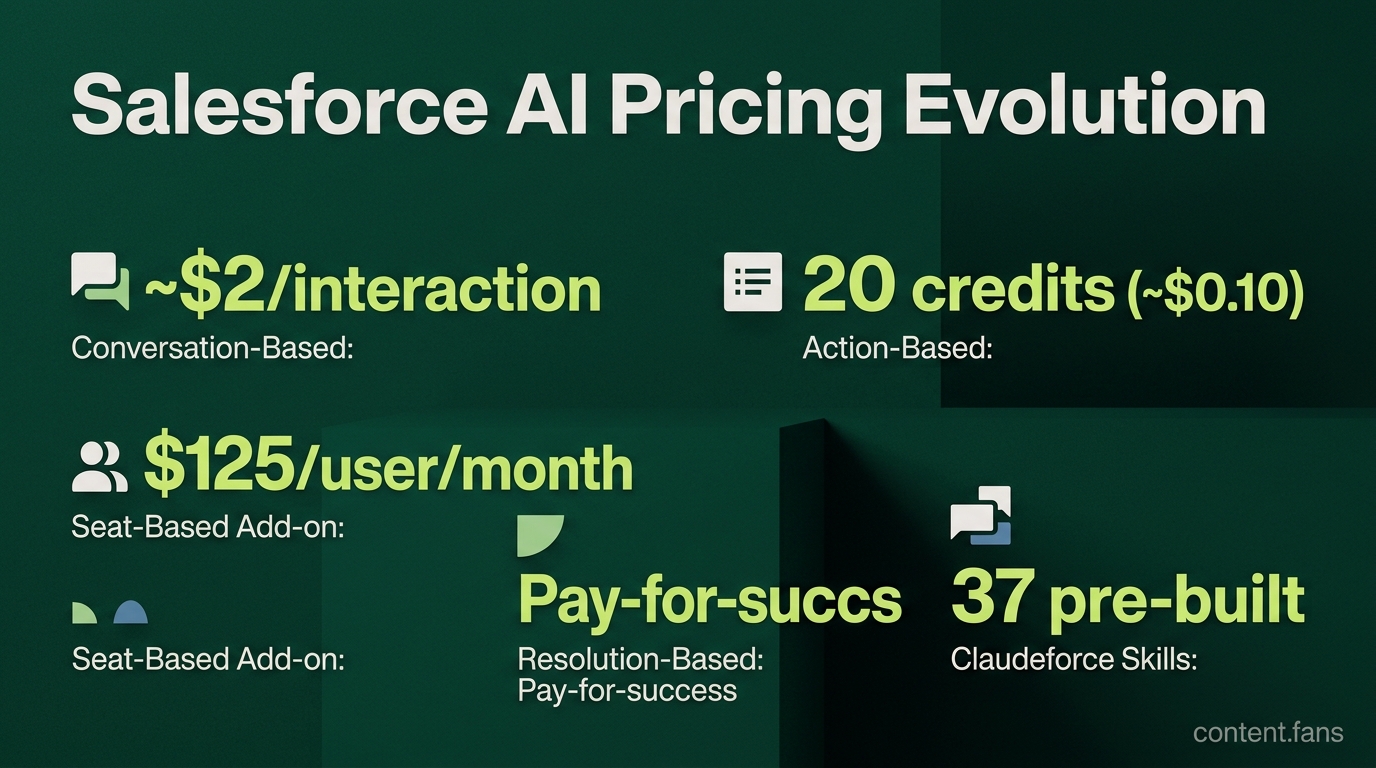
Salesforce is actively testing a multi-faceted pricing strategy that moves beyond per-user fees. Today, customers may encounter a mix of monetization models designed for different use cases:
- Conversation-Based: Billing triggered per agent interaction, costing around $2.
- Action-Based: Usage metered via "Flex Credits," with a standard action costing 20 credits (approximately $0.10).
- Seat-Based: The traditional model persists with add-ons like Agentforce, starting from $125 per user per month.
- Resolution-Based: A pay-for-performance model where customers are billed only when an AI agent successfully closes a ticket.
The coexistence of these four models suggests Salesforce is not committing to a single approach. Instead, it is adapting to diverse customer needs and acknowledging that as automated workloads grow, the value of its platform is no longer solely tied to the number of human users.
Claudeforce and external agent access
The Claudeforce initiative, announced on August 26, 2026, marks a significant expansion of the Salesforce-Anthropic partnership. This collaboration directly integrates governed Salesforce actions into the Claude AI assistant. The initial release, Salesforce in Claude, is a plugin with 37 pre-built sales skills, currently in a select pilot before its expected open beta in September 2026 (Salesforce press release). This strategic move aims to keep Salesforce data central, even as users increasingly engage with it through third-party AI interfaces.
The ability for an external agent like Claude to access and update live CRM data raises critical questions about monetization. When an external AI drives a workflow, the payment model is unclear. Salesforce's focus on providing an "enterprise harness, governance, and data" layer suggests it may charge for secure data access and orchestration, effectively becoming a broker for automated workflows rather than just selling user seats.
Market signals from AI agent adoption
The demand for agentic AI capabilities is surging across the enterprise software market. Industry analysts confirm this trend, with many noting that applications must now support a "digital workforce of AI agents." According to industry reports, a significant portion of enterprise applications are expected to embed task-specific agents in the coming years.
Adoption is already high within sales departments. According to industry reports, a growing number of organizations use AI, and many have deployed AI agents in their sales cycle. These companies report significant time savings in research and content creation activities.
These trends indicate a market shift where buyers prioritize platforms based on their ability to orchestrate autonomous work, govern data, and align costs with measurable outcomes. For Salesforce, its pricing experiments and the Claudeforce partnership are crucial maneuvers to maintain its central role in a world where value is no longer defined by user headcount.
How is Salesforce changing its pricing model as AI agents replace traditional software seats?
Salesforce is moving away from its historic seat-based pricing as AI agents take on work previously performed by human employees. The company has introduced a multi-model pricing strategy that includes several approaches running simultaneously:
- Conversation-based: approximately $2 per conversation for simple usage metering
- Action-based: Flex Credits at roughly $0.10 per action ($500 for 100,000 credits, with standard actions consuming 20 credits each)
- Per-user licensing: seat-based bundles starting at $125 per user/month for enterprise procurement
- Pay-per-resolution: billing only when an agent fully resolves an issue, with failed or escalated interactions free
This shift reflects a fundamental challenge: when AI agents perform work, the traditional link between software seats and value breaks down. Salesforce is experimenting with consumption-based pricing for variable workloads while maintaining seat-based options for enterprise buyers who prefer predictable costs.
What is Claudeforce and how does it fit into Salesforce's AI strategy?
Claudeforce is Salesforce's expanded partnership with Anthropic, announced in August 2026, that integrates Claude's reasoning capabilities directly into Salesforce workflows. The first shipped component - Salesforce in Claude - is a plugin featuring 37 prebuilt sales skills currently in select pilot with open beta expected in September 2026.
The integration allows users to perform tasks like reasoning over live revenue context, automating pipeline updates, and taking governed actions directly within Claude. Salesforce describes this as combining "Claude's intelligence with Salesforce's enterprise harness" - including data, workflows, business logic, and governance.
This matters strategically because it addresses a core tension: customers increasingly interact with Salesforce data through external AI assistants rather than native Salesforce applications. By embedding itself into Claude, Salesforce attempts to maintain its central position even as user behavior shifts away from traditional app interfaces.
Why does the rise of AI agents threaten Salesforce's traditional business model?
The agent economy undermines three foundational assumptions that have driven Salesforce's growth:
- The seats-to-value equation: When one agent can perform work previously requiring multiple human licenses, revenue tied to user counts becomes unpredictable
- Application-centric relationships: If customers primarily interact with Salesforce through third-party AI assistants, Salesforce risks becoming invisible infrastructure rather than the primary interface
- Data ownership and monetization: When external AI systems access Salesforce data, the company must find new ways to capture value from that access beyond traditional licensing
According to industry research, many organizations now use some form of AI in sales, with a significant portion already deploying AI agents across the sales cycle. The pressure is intensifying as a growing number of enterprise applications are expected to embed task-specific AI agents in the coming years.
How are AI agents actually changing how enterprises buy and use CRM software?
The shift is creating both opportunities and requirements for vendors:
For buyers, agent capabilities are becoming table stakes. Organizations report significant productivity gains in research time and content creation. This creates pressure for platform consolidation: buyers favor vendors that can provide data unification, workflow orchestration, and agent governance in one suite.
For the market, the winners are likely to be vendors that make agents easy to deploy across the entire sales cycle rather than offering standalone point solutions. CRM platforms with strong data clouds and governance frameworks gain competitive advantage because AI agents depend on clean, accessible customer data.
The implementation challenge remains substantial - consulting and integration services are growing as enterprises struggle with data quality, governance, and reliability issues in agent deployments.
What happens to customer relationships when users interact through AI assistants instead of applications?
This is perhaps the most existential question for Salesforce. When a sales rep asks Claude to "update the Acme Corp opportunity status" rather than logging into Salesforce directly, who owns that customer relationship?
Salesforce's response with Claudeforce represents an attempt to embed itself into the assistant layer rather than competing against it. By providing governed actions and prebuilt skills within Claude, Salesforce hopes to remain the system of record even as it becomes less visible to end users.
The risk is substantial: if AI assistants become the primary interface for enterprise work, infrastructure vendors without consumer-facing AI presence could see commoditization. Salesforce's bet is that data gravity and workflow integration - the depth of its CRM embedding in enterprise processes - will prove stickier than interface loyalty.
The company is also exploring monetization models for external AI system access to its data and workflows, suggesting future revenue streams that charge for API-like consumption rather than seat-based subscriptions.