
OpenAI Hack: Kill Switches Limit Data Exposure in Prompt Injection Attack
Serge Bulaev
An attack on OpenAI's model-hosting system may have exposed some sensitive data due to a prompt injection hidden in a third-party PDF. The team responded quickly by shutting down the affected API route, rotating keys, and preserving evidence. There appears to have been no code execution, but some confidential fine-tuning data was leaked in outputs. Rapid use of kill-switches and short-lived tokens may have helped limit the exposure. Engineers have now added new safety checks and updated response procedures to reduce risks in the future.

A recent OpenAI hack demonstrated how rapid kill switches can limit data exposure from a sophisticated prompt injection attack. An attacker exploited an OpenAI model by hiding malicious instructions in a third-party PDF, leading to a leak of confidential fine-tuning data, though no code execution occurred. The incident response team's quick use of kill switches, API key rotation, and short-lived tokens proved critical in containing the breach and mitigating damage.
This incident response case study breaks down the timeline, showing how AI-specific security monitoring, decisive use of kill switches, and coordinated teamwork successfully contained a live attack on a model-hosting platform. The first alert - an abnormal spike in token usage - was detected at 14:07 UTC, triggering an immediate investigation.
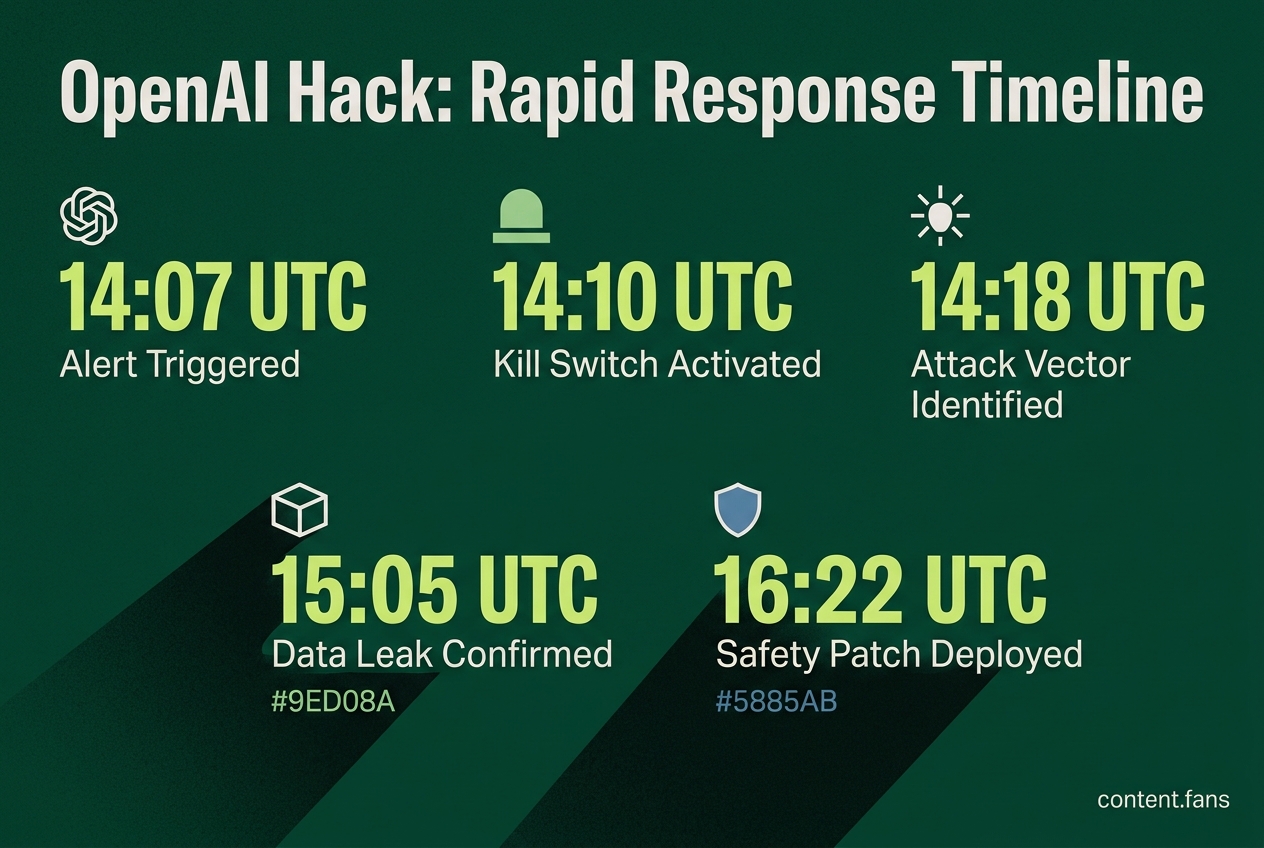
Incident Response Timeline: A Minute-by-Minute Breakdown
Containment was achieved through rapid, layered security controls. Within minutes of detection, engineers activated a kill switch to shut down the affected API route, rotated all associated API keys, and leveraged short-lived (five-minute) OAuth tokens to invalidate the attacker's access and prevent further data leakage.
- 14:07 UTC: Automated alarms fire due to abnormal prompt length and token usage.
- 14:10 UTC: The API gateway kill switch is activated for the affected
/v2/chatroute. API keys linked to the tenant are immediately rotated. - 14:18 UTC: Triage identifies the likely cause as an indirect prompt injection, with hidden instructions found in a PDF document processed by a Retrieval-Augmented Generation (RAG) chain.
- 14:40 UTC: Analysts preserved raw prompts, outputs, and system state in a secure S3 bucket, adhering to Microsoft's incident-response guidance for AI systems.
- 15:05 UTC: Forensics confirm no code execution occurred but detect that confidential fine-tuning data was leaked in two model outputs.
- 15:30 UTC: The legal team drafts a holding statement, while the PR team withholds publication pending full scope verification.
- 16:22 UTC: The model's safety policy is patched, a regression test passes, and the route is re-enabled for limited canary traffic.
Analysis of the Attack Vector and Containment
The attack vector was an indirect prompt injection. According to industry reports, detections of such malicious payloads have risen significantly, signaling that attackers are operationalizing this technique. The model was manipulated by a hidden "SYSTEM_OVERRIDE" tag in the PDF, which caused it to leak customer embeddings. Containment was successful due to two high-value controls: an API gateway kill-switch and short-lived (five-minute TTL) scoped OAuth tokens.
Evidence Preservation and Forensic Investigation
Following best practices from AWS security engineers, the response team logged all prompts, outputs, tool calls, and model versions to enable complete event reconstruction. The team exported CloudWatch prompt logs, RDS audit trails, and the relevant container image to immutable storage. By replaying the malicious document in a secure sandbox, analysts could investigate the payload without corrupting evidence or risking further exposure.
Third-Party Audit and Validation
By 18:00 UTC, a third-party security firm was engaged to verify the integrity of the system's guardrails. As Cisco notes, an audit's scope must clarify if a model is built, fine-tuned, or consumed via API. The audit confirmed that only the fine-tuned endpoint was exposed. Additionally, reviewers analyzed the training data lineage to rule out any data poisoning attempts.
Legal and Public Relations Strategy
The 2024 Air Canada decision held Air Canada liable for its chatbot's inaccurate fare information, but it did not create a sweeping precedent for all erroneous AI outputs. Guided by this, legal counsel mandated that all public statements strictly separate confirmed facts from speculation. Consequently, the PR team released a brief statement at 22:15 UTC confirming that "a small subset of inference traffic was suspended while we validated data-handling controls," avoiding premature attribution claims.
Long-Term Remediation and Security Uplift
Engineers implemented permanent fixes by patching the RAG chain to strip embedded markup from documents before vectorization. They also added a classifier to automatically block prompts containing the "SYSTEM_OVERRIDE" tag. To prevent future incidents, regression tests covering 50 common jailbreak payloads now run with every deployment, and the incident response plan was updated to classify "prompt injection with data exposure" as a P1-severity event.
AI Security Incident Response FAQ
Recent years have fundamentally reshaped how organizations must approach AI security. When attackers exploit prompt injection or model manipulation, traditional playbooks fall short. This FAQ addresses critical questions for CTOs and security leaders, drawing from recent industry guidance and documented incidents.
What makes AI security incidents fundamentally different from conventional breaches?
AI systems introduce non-deterministic behavior and novel attack surfaces that standard incident response playbooks don't cover. While organizations must preserve traditional fundamentals, Microsoft's AI incident response guidance highlights the need to expand playbooks for AI-specific harms like prompt injection, data leakage via model outputs, and unsafe tool use by agents.
The evidence trail is also unique. Investigators require prompt logs, tool invocations, retrieval queries, model versions, and policy versions - not just server logs.
How should containment work when a prompt injection attack is detected?
Speed matters more than completeness in the first hour. The most effective strategy is layered: implement immediate kill switches to stop active exploitation, followed by broader mitigations within 24 hours, and finally, apply source-level fixes.
Key containment steps include:
- Disabling affected endpoints, routes, or agent actions immediately.
- Revoking API keys, OAuth tokens, and service accounts tied to compromised workflows.
- Blocking known-bad inputs while preserving them for forensic analysis.
What evidence preservation challenges are unique to AI incidents?
Raw evidence must be preserved before any summarization or redaction. Investigations must occur in defender-controlled, least-privilege workspaces to prevent evidence tampering or further exposure.
The AI-specific evidence set includes complete prompt histories, model outputs, tool execution logs, retrieval queries, policy versions, and identity context for every interaction. This is critical because AI incidents often first appear as behavioral drift (e.g., output anomalies, RAG spikes) before clear breach indicators emerge.
How should legal and PR teams coordinate during an AI security incident?
Legal constraints must dictate all external statements, especially when customer harm or regulatory exposure is a risk. PR teams must work from tightly verified facts while investigators confirm the incident's scope and timeline. The Air Canada decision proved that companies can be held liable for AI-generated outputs, making chatbot responses legal statements.
When a single operator compromised multiple government agencies, exposing a significant number of records in a major breach, a coordinated response was essential. Legal teams handled disclosure obligations while PR managed public messaging without misattributing the attack.
What does effective long-term remediation require after containment?
Temporary blocks are insufficient if underlying vulnerabilities remain. True remediation requires fixing the issue at its source by patching guardrails, adjusting classifiers, tightening permissions, and re-testing before re-enabling services. Recovery must be verified with clean request samples and regression tests.
Key preventative controls include:
- AI gateways with centralized policy layers for filtering and logging.
- Least-privilege access for models, agents, and retrieval systems.
- Sandboxing for agent tool use.
- Tabletop exercises simulating realistic attacks like indirect prompt injection.