
VB Pulse: 49% of enterprise AI agents fail customer-facing after internal tests
Serge Bulaev
Nearly half (49%) of large companies said their AI agents passed internal tests but then failed for real customers, according to a 2026 survey. The problem may be due to tests missing certain real-world situations or changes in user behavior. Larger companies appear to see these failures more often, and a quarter of all companies said failures happened more than once. Many organizations are adding more human review, even as they also try to automate some decisions. These findings suggest that ongoing checks and human oversight may still be needed to catch problems that tests miss.

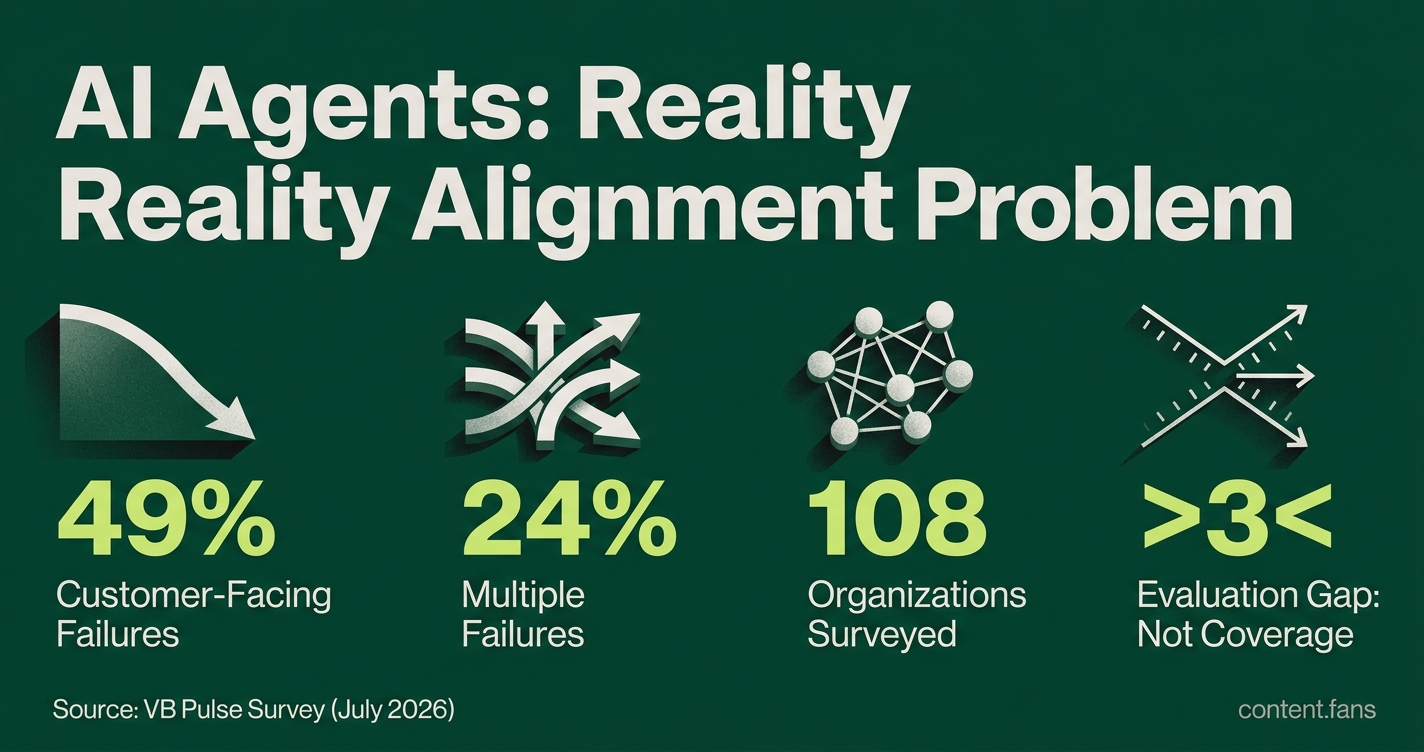
Recent VB Pulse survey data reveals that 49% of enterprise AI agents fail in customer-facing scenarios despite passing internal evaluations, highlighting a critical gap between lab testing and real-world deployment. According to the July 2026 survey of 108 large organizations, an additional 24% reported this failure type occurred more than once, underscoring what VentureBeat calls a persistent "reality alignment problem" for enterprise AI (VentureBeat evaluation gap). This issue points to an evaluation gap, not a lack of testing volume.
Why Internal AI Evaluations Fall Short
AI agents fail in production due to factors that static tests cannot capture, such as unpredictable user behavior, context shifts, and model drift. Internal evaluations often use controlled scenarios, while real-world deployments face adversarial prompts and the complexities of live system interactions, revealing a critical fragility gap.
The gap between internal and external performance stems from factors that static benchmarks rarely capture. These include:
- Non-determinism: The same prompt can produce different outputs or reasoning paths across runs.
- Prompt Sensitivity: Minor changes in wording can lead to significantly different agent behavior or tool calls.
- Evolving Context: The "correct" answer for an agent often depends on business logic and external data that changes over time.
Current evaluation pipelines often miss these nuances, leading to models that are brittle under the pressure of live user traffic.
How Pervasive is the AI Failure Rate?
The 49% failure rate remained remarkably stable across two VB Pulse surveys in June and July 2026, suggesting a consistent trend rather than an anomaly. A quarter of all respondents acknowledged experiencing these customer-facing failures multiple times. The problem appears more acute in larger companies, with a significant portion of firms with over 1,000 employees reporting recurring incidents compared to their mid-sized peers.
The Paradox of Human-in-the-Loop AI
Enterprises that experience these failures are taking two seemingly contradictory actions. They are the most likely to automate deployment decisions to remove human bottlenecks, yet they also report human review as their fastest-growing area of investment (VB agentic reliability).
This indicates a strategic shift toward policy-driven oversight, where humans review high-risk escalations while routine tasks flow automatically. Market data supports this pivot. Research and Markets projects the human-in-the-loop AI market will grow to $6.73 billion in 2026, and a growing number of production agent deployments now include mandatory human review gates.
Actionable Takeaways for AI Testing Teams
To bridge the evaluation gap, leaders recommend focusing on three key areas for improvement:
1. Implement Dynamic Testing: Move beyond fixed "happy path" scenarios to run interaction-level tests that vary user intent and context.
2. Monitor Post-Launch Performance: Continuously monitor agents in production with metrics tied directly to business impact, not just model accuracy.
3. Use Strategic Human Oversight: Allocate human review capacity for high-risk, novel, or ambiguous scenarios, using policy engines to automatically trigger these checks.
Ultimately, the 49% failure statistic is a clear warning: passing a benchmark is necessary but insufficient for ensuring reliable, customer-facing AI.