
Anthropic's 4D Framework Expands AI Fluency for Enterprises
Serge Bulaev
Anthropic's 4D framework (Delegation, Description, Discernment, Diligence) helps companies use AI responsibly by focusing on decision-making and oversight, not just writing prompts. The Fluency course that teaches this model gets strong beginner reviews, with many saying it is clear and practical. Reviewers say the course may feel basic for engineers, but it appears useful for managers and educators. The framework may fit well with risk-based content review policies and industry standards. Learner feedback suggests the main benefit is giving teams a shared way to talk about and manage AI tasks, which might help reduce misuse.

Anthropic's 4D framework - Delegation, Description, Discernment, and Diligence - provides a discipline for professional AI use that prioritizes human judgment over simple prompting. It re-frames the core challenge of AI adoption as deciding which tasks to delegate, creating clear instructions, and maintaining ethical oversight during review. The framework is taught in Anthropic's AI Fluency course, which has earned strong reviews for its practical structure. Its Coursera listing shows a 4.8/5 rating from learners who praise its focus on strategy over prompt tricks, noting that as AI accelerates review cycles, human oversight must adapt in parallel.
Reception and adoption
Anthropic's 4D framework is a model for responsible AI integration focused on four key actions: Delegation, Description, Discernment, and Diligence. It teaches professionals to strategically assign tasks, provide clear context, critically evaluate AI outputs, and maintain accountability, shifting the focus from prompt engineering to holistic oversight.
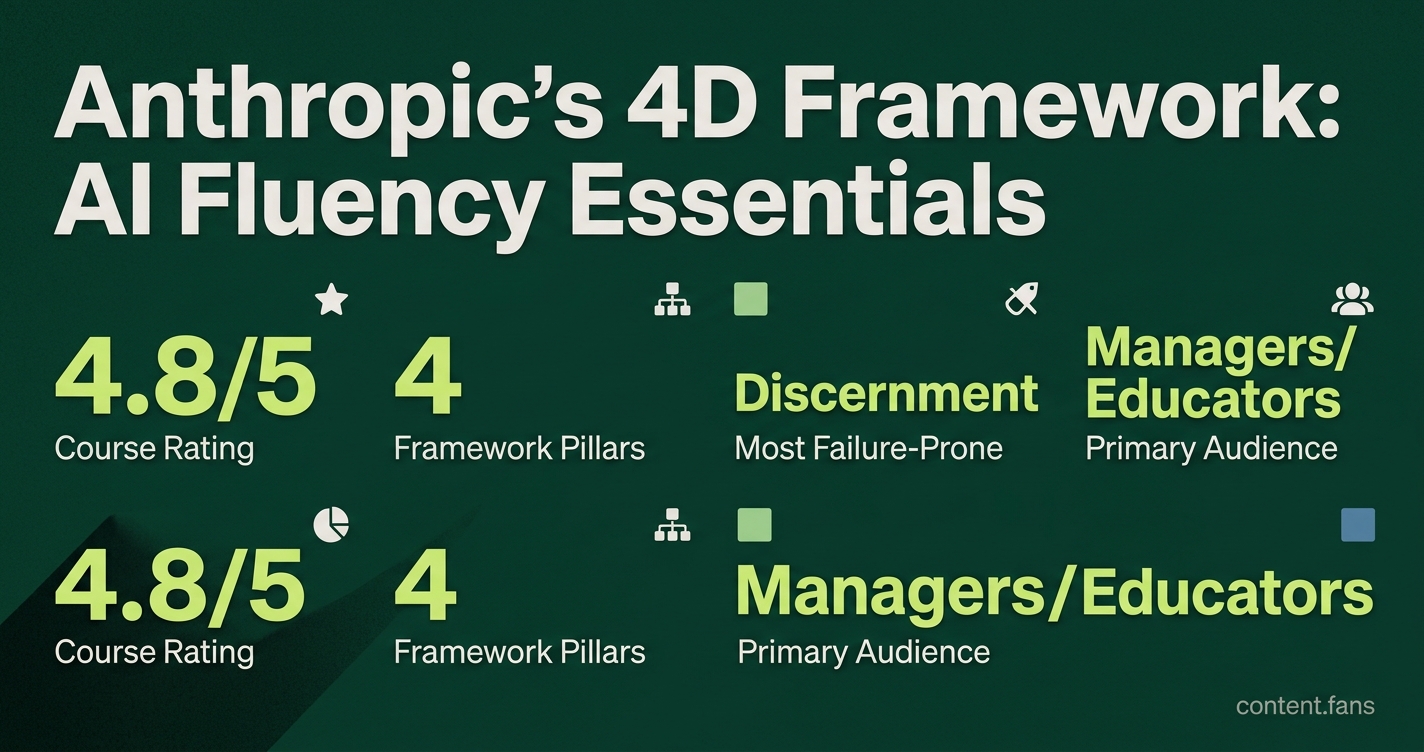
The course receives praise from independent reviewers as "the rare beginner AI course that teaches judgement instead of tricks," though some engineers find it basic. Many learners have provided positive feedback, with its primary audience being managers and educators.
The verbs at a glance
- Delegation - decide if the task should be AI, human, or hybrid
- Description - give the system unambiguous instructions and context
- Discernment - inspect output, spot errors quickly, and reject low-quality work
- Diligence - document oversight, disclose AI use, and stay accountable for impact
Course authors emphasize Discernment as the most failure-prone step. Because AI can generate content almost instantly, the risk of overlooking errors increases. The course offers a practical rule to combat this: if you cannot find at least one flaw on the first read, read the output again.
Role in content governance
The 4D framework aligns well with emerging content governance and review standards, which often use risk-based tiers for AI-generated content. For instance, policies requiring stricter human approval for high-stakes legal, medical, or reputational content can use the 4D model directly. In this context, Delegation maps to risk classification, Description to prompt hygiene, Discernment to human-in-the-loop review, and Diligence to creating audit trails and disclosures.
Industry analysts suggest pairing the 4D framework with broader management systems like ISO 42001 or the NIST AI RMF. This combination provides organizations with both high-level process (from ISO/NIST) and practical, day-to-day editorial checkpoints (from the 4D model), creating a comprehensive governance structure.
Early signals of impact
Early feedback indicates the framework's primary impact is cultural. By giving teams a shared vocabulary for discussing and managing AI, it helps reduce misuse even among staff with modest technical depth. This has positioned the 4D framework as a valuable starting point for companies developing AI adoption playbooks across diverse departments like marketing, support, and education.
What is the 4D framework in Anthropic's AI Fluency course?
The 4D framework is a transferable operating discipline built around four verbs: Delegation, Description, Discernment, and Diligence. Unlike traditional AI training that focuses on prompting mechanics, this framework centers on human decision ownership - teaching professionals when to hand work to AI, how to specify what they need, how to judge output quality, and how to maintain ethical accountability. The framework is designed to work whether a human or an AI is producing external-facing work, making it adaptable across changing tool landscapes.
Why is Discernment considered the most failure-prone area?
Discernment - the ability to judge whether AI output is fit for purpose - presents unique challenges because AI has compressed review cycles from a week to a minute. This dramatic acceleration leaves less time for human judgment while demanding more of it. The framework includes a practical safeguard: if you cannot spot at least one thing wrong on first read, read again. This rule acknowledges that overconfidence in AI-generated content is a common failure mode, and that deliberate, structured review is essential for high-stakes decisions.
How does the AI Fluency course differ from typical AI training?
The course has earned strong learner ratings - 4.8/5 on Coursera from over 130 reviews - largely because it avoids "prompt tricks" in favor of judgment and responsible use. Reviewers describe it as "the rare beginner AI course that teaches judgement instead of tricks" and note it gives "language to something I'd been doing for a while." The curriculum was developed with academic experts and focuses on skills for effective, efficient, ethical, and safe AI interaction rather than tool-specific tactics.
What strategic impact does the 4D framework have on enterprise AI adoption?
Organizations using the framework report a shift from capability-first to workflow-first AI strategy. By forcing clear decisions about what to delegate to AI versus what to keep human-led, teams build more sustainable governance. The framework supports this by providing a shared vocabulary that improves adoption and reduces misuse - particularly valuable for managers, educators, and non-technical professionals who need to set standards without becoming AI engineers.
How does the 4D framework complement broader AI governance standards?
While frameworks like ISO/IEC 42001 and NIST AI RMF provide organizational structure, the 4D framework operates at the individual workflow level. It pairs effectively with enterprise governance by giving practitioners concrete behaviors: documenting what they delegated (Description), maintaining authority to override (Discernment), and owning consequences (Diligence). For teams also navigating EU AI Act requirements, this operational discipline helps satisfy documentation and human-in-the-loop obligations.