
4D Framework Guides Enterprise AI Adoption for Safe, Ethical Use
Serge Bulaev
The 4D framework (Delegation, Description, Discernment, Diligence) may help professional teams use AI in a safe and ethical way by focusing on human judgment. Executives reportedly use this approach to decide which tasks AI should handle, how to set up those tasks, and when people need to be involved. Course ratings and reviews suggest there is growing interest in using these methods to adopt AI responsibly. The framework appears to help non-technical staff fit AI into their work while making sure people stay accountable. It also highlights the need for careful review and clear records so mistakes and risks are caught early.

The 4D Framework - Delegation, Description, Discernment, and Diligence - offers a structured guide for enterprise AI adoption, helping professional teams navigate complex generative AI workflows. This discipline centers on human judgment over prompt tricks to determine which tasks an AI can safely handle, how to brief the model, and when human intervention is critical.
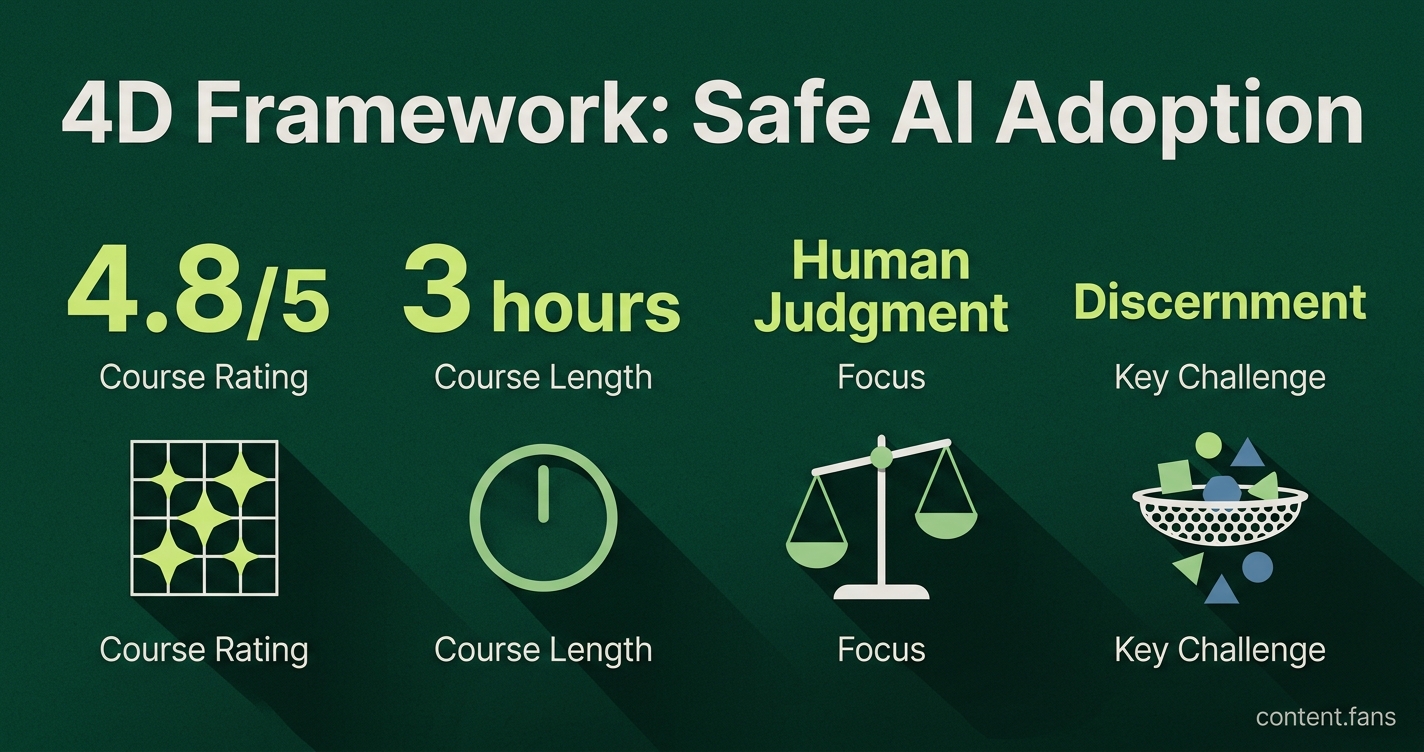
Growing interest in this systematic approach to responsible AI is evident in learner ratings. The free, three-hour "AI Fluency: Framework & Foundations" course, which teaches the framework, holds a 4.8 out of 5 rating on Coursera, based on public course analytics.
Why companies train on the 4D framework
Companies adopt the 4D framework to give non-technical teams a reliable method for integrating AI into their workflows. It replaces complex prompt engineering with practical decision-making rubrics, focusing on risk assessment, clear task definition, and maintaining human accountability for all AI-assisted outputs.
Independent reviewers call the training program "unusually well structured for corporate learning material," noting that it emphasizes workflow integration and ethical ownership for non-technical staff AI Fluency course review. Highlighting this focus on selective, not maximal, AI use, Anthropic's Kristen Swanson told Business Insider that AI fluency is about knowing "what to delegate and what to do yourself."
Delegation and Description - bounding the assignment
- Delegation: Users assess tasks based on risk and reversibility before assigning them to an AI. For example, routine text formatting is a low-risk task, whereas drafting final policy language is a high-risk one that requires human control.
- Description: This step demands precise instructions, including the scope of data, required tone, and clear success criteria to ensure the model's output is contextually appropriate and aligned with goals.
Discernment - spotting fluent errors fast
Anthropic identifies Discernment as the most common point of failure. Echoing this, guidance from the UK's Information Commissioner's Office stresses that human reviewers must have "the information, authority, capability, and genuine opportunity to ... override AI-influenced outcomes" ICO human review toolkit. To reduce overlooked factual errors, enterprises embed structured rubrics, evidence checkpoints, and time-boxed reviews.
A practical heuristic taught in the course is that if a reviewer sees nothing to correct on a first pass, they should read it again. This encourages the scrutiny needed to catch plausible but invented details that large language models can generate.
Diligence - keeping responsibility human
Diligence, the final step, connects the technical workflow to organizational ethics and accountability. A 2025 BCG oversight paper argues that teams "won't get GenAI right if human oversight is wrong," a stance the 4D framework shares by requiring clear logs of who approved content and why. This ensures human accountability is never abdicated.
According to industry reports, key diligence practices include audit trails that record prompts, sources, and reviewer decisions, proportional checkpoints for higher-risk outputs, kill-switch access for stakeholders with formal responsibility, and continuous reviewer training tied to evolving regulations.
This disciplined approach converts abstract AI ethics into concrete daily controls, which explains why many enterprises adopt the 4D framework as a baseline literacy program to support both speed and safety.
The 4D framework has emerged as a practical operating discipline for organizations navigating AI adoption. Built around four verbs - Delegation, Description, Discernment, and Diligence - it shifts focus from prompting mechanics to human oversight and decision ownership. The framework is taught in Anthropic's AI Fluency course, which has received strong learner reviews averaging 4.3 to 4.9 out of 5 across platforms.
Below are answers to common questions about implementing this framework in enterprise settings.
What makes the 4D framework different from other AI training approaches?
Most AI training focuses on prompt engineering - teaching users how to craft inputs to get better outputs. The 4D framework inverts this. It treats AI as a delegation challenge, not a technical one.
The framework asks: What work should you hand off? How do you describe it precisely? Can you judge whether the result is fit for purpose? And who owns the consequences?
This matters because AI has compressed review cycles dramatically. What once took a week now takes a minute, demanding faster human judgment rather than more sophisticated prompting. The AI Fluency course spends more time on Discernment than on prompt mechanics - a deliberate choice reflecting where failures actually occur.
Why is Discernment considered the most failure-prone area?
Discernment is where subtle errors escape detection. Industry reports identify several reasons:
- Fluency masks inaccuracy: AI outputs that read well are trusted too quickly
- Moral distance: People are more willing to request unethical actions from machines than from humans
- Speed pressure: Compressed timelines reduce careful review
A practical rule from the framework: if you cannot spot at least one thing wrong on first read, read again. This builds in a deliberate pause.
Enterprise best practices now emphasize risk-based review - matching scrutiny level to stakes - and exposing reviewers to evidence beyond the output itself, including sources, confidence signals, and known limitations.
How does the framework address ethical responsibility?
The fourth D - Diligence - centers on human ownership of ethics and consequences. Recent research distinguishes sharply between delegation (assigning bounded tasks while retaining authority) and abdication (handing over judgment completely).
Key ethical requirements emerging from governance literature include:
- Auditability: Documented decision pathways
- Interruptibility: Ability to halt or reverse AI-influenced outcomes
- Contestability: Affected parties can challenge results
- Responsibility accounting: Clear logs of who could act and what they knew
The framework insists that moral responsibility remains irreducibly human - AI systems do not displace accountability, they redistribute it in ways that must be deliberately managed.
Can this framework scale beyond individual users to entire organizations?
Yes. The 4D framework is designed as a transferable operating discipline - it applies equally to humans and to bots producing external-facing work.
Enterprise implementation typically involves:
| Element | Organizational Application |
|---|---|
| Delegation | Clear policies on which tasks require human judgment |
| Description | Standardized briefs and quality rubrics |
| Discernment | Calibrated reviewer training with explicit approval/modify/reject decision points |
| Diligence | Audit trails and feedback loops informing system updates |
The course is explicitly framed for business processes and corporate learning, with Anthropic building a broader AI fluency program for educators and learning leaders.
What practical steps improve human discernment in AI review workflows?
Original source recommendations include competency-based training, operational transparency, human oversight, clear accountability, ethical culture, continuous trust/compliance calibration, and interdisciplinary oversight committees.
The core insight: effective oversight requires humans who are informed, empowered, and accountable - not merely present in the loop.
The 4D framework ultimately treats AI adoption as organizational change rather than technology deployment. Its value lies in giving teams shared language and clear accountability for decisions that are being made faster than ever before.