
Enterprises Cut AI Spend With New Governance, Contract Controls
Serge Bulaev
Enterprises are struggling to control rising and unpredictable AI costs, which may double quickly due to variable pricing. Experts suggest that clear contracts, spending caps, and real-time monitoring can help manage these costs. Good governance appears to include alerts when budgets are nearly reached, tracking spend in detail, and regular reviews comparing costs to results. Firms may use contract protections like rate caps and spend ceilings, and tune technical setups to save more money. Some risks, like unclear billing terms or rapid cost growth without matching business value, suggest current controls might need to be stronger.

Enterprises are struggling to control AI spend as variable pricing models cause costs to spiral unexpectedly. With invoices climbing faster than adoption, finance leaders demand solutions that tie AI expenses directly to business value. This playbook details the proven governance, contracting, and real-time monitoring strategies that leading organizations use to manage unpredictable AI costs effectively.
Insights from "How to Manage and Control Enterprise AI Spend: Practical Governance and Budgeting Playbook"
Organizations reduce AI expenses by establishing clear governance frameworks, negotiating protective contract terms, and implementing real-time cost monitoring. Core tactics include setting hard spending caps with automated alerts, defining precise billing units with vendors, and regularly reviewing ROI to ensure that consumption delivers measurable business value.
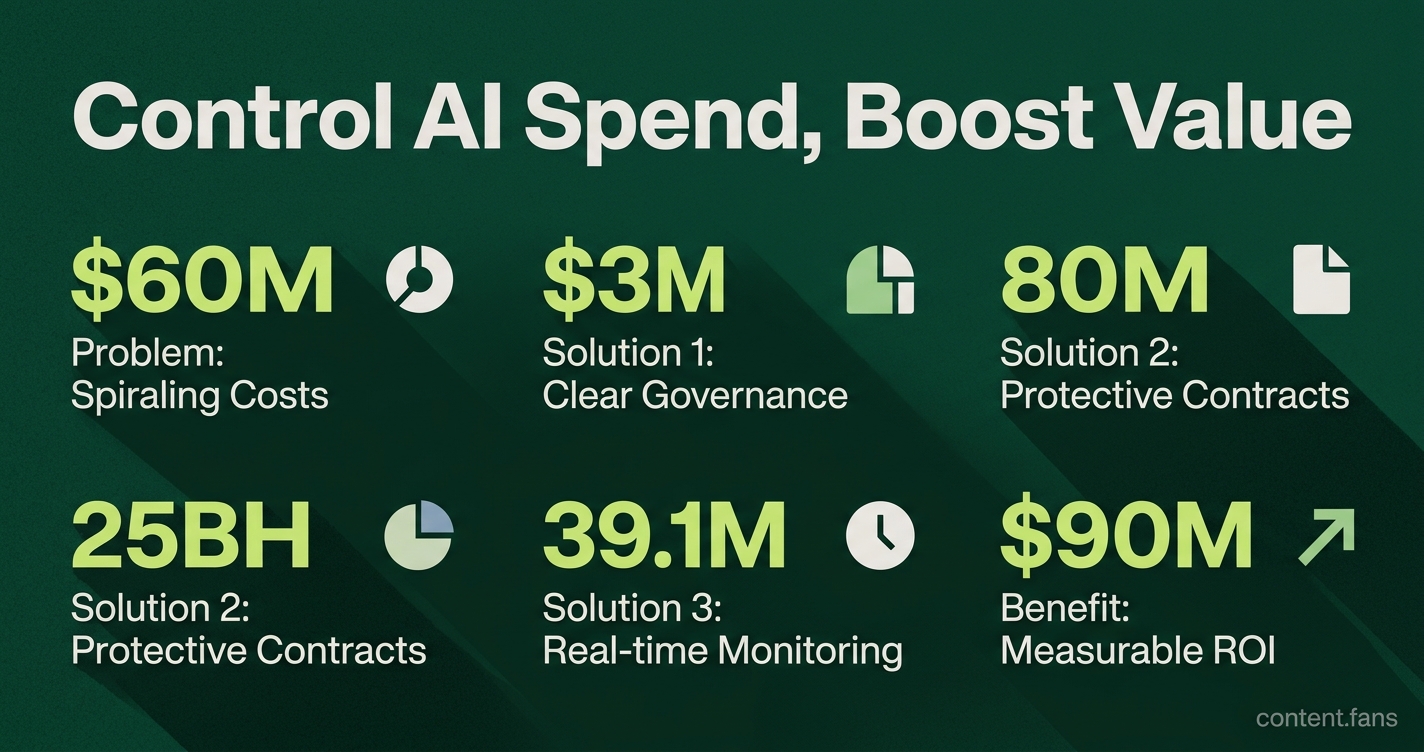
A primary mistake in AI procurement is allowing vendors to dictate billing metrics. To prevent this, every contract must explicitly define the billable unit, the handling of retries, and the authoritative source for usage logs, as detailed in Tropic's analysis of credit definitions. This contractual clarity protects against billing disputes when pricing models change.
Successful AI governance programs commonly incorporate key elements such as:
1. Caps at the employee, team, or workflow level that trigger automated alerts when approaching budget limits.
2. Real-time telemetry that maps spend to business context such as model, endpoint, and customer feature.
3. Regular ROI reviews that compare consumption trends with measurable outcomes like conversion lift or hours saved.
Budget controls and real time monitoring
Granular, action-level telemetry forms the foundation for all other cost controls. Engineering teams now commonly deploy LLM gateways or proxies like LiteLLM and Langfuse to capture real-time data on request costs and latency. FinOps platforms such as CloudZero then map this telemetry to financial accounts, enabling immediate anomaly detection and accurate showback. With this visibility established, organizations can enforce strict consumption caps. A common and effective policy is to automatically pause an API key or workflow upon reaching a monetary threshold, which prevents the six-figure budget overruns that once appeared only on month-end invoices.
Contract guardrails that reduce downside risk
Although vendors often retain pricing leverage, modern negotiation playbooks insist on protections analogous to utility contracts. Key contractual guardrails include:
- A hard rate cap on per-token or per-request pricing for the contract term
- Rollover of unused committed spend instead of use-it-or-lose-it quotas
- Written notice and customer consent before any change to metering logic
- Audit rights that let buyers reconcile vendor logs with their own telemetry
- Price-reset clauses that match any future public rate reductions
Practitioners emphasize that combining a ceiling on the unit price with a cap on total annual spend is critical for mitigating financial risk when AI usage scales unexpectedly.
Cost optimization levers beyond governance
With visibility and caps in place, engineering teams can focus on workload optimization. High-leverage technical strategies include prompt caching, which can halve costs for repetitive queries, along with workload right-sizing and intelligent model routing. This involves directing complex prompts to powerful models while routing simpler tasks to more cost-effective alternatives. Simultaneously, legal and procurement teams must rigorously assess ROI. True cost accounting, which deducts expenses like prompt maintenance from productivity gains, provides a realistic view of net benefit and reinforces the necessity of periodic value checks.
Risk signals to track each quarter
Monitor these critical risk signals quarterly to maintain financial control:
- Opaque credit or token definitions in renewal drafts
- Rapid cost growth without proportional outcome gains
- Shared API keys that blur cost attribution across teams
- Agentic loops that spawn child calls beyond governance reach
- Retroactive invoice adjustments that exceed contract tolerances
The presence of two or more of these indicators signals an urgent need to tighten existing governance, spending caps, or audit procedures.
How are enterprises structuring AI budgets to prevent runaway spending?
Enterprises are treating AI consumption as a distinct budget category with the same discipline applied to cloud FinOps. This means creating separate AI cost centers rather than burying expenses in general IT or software budgets. Organizations are instrumenting usage telemetry from day one, allocating spend to specific business owners, and establishing regular reviews of ROI and pricing assumptions. The key shift is moving from treating AI as a software detail to managing it as a controlled financial instrument with hard thresholds and departmental accountability.
What technical controls help enforce AI spending limits?
The most effective approach combines hard caps with automated kill switches. Leading practice in 2026 involves setting token or monetary limits per API key, team, or user group, with automatic pauses when thresholds are hit. Real-time monitoring tools like LiteLLM and Langfuse provide request-level visibility, while FinOps platforms such as CloudZero enable executive reporting and cross-team allocation. Pre-overage alerts when approaching consumption limits are becoming standard, replacing the retroactive invoice surprises that plagued early AI adopters.
How should companies negotiate AI vendor contracts differently than traditional SaaS agreements?
AI contracts require a consumption-and-risk framework rather than standard software licensing terms. Essential provisions include hard rate caps on unit price increases and total annual spend growth, precise definitions of billable tokens and measurement methodologies, and price-reset rights that align costs with published market rates when vendors lower pricing. Short commercial terms with review checkpoints are increasingly common because AI pricing models evolve faster than traditional software markets. Organizations should also negotiate rollover provisions for unused committed volume and audit rights to inspect raw usage logs and validate invoices.
Why do pilot programs matter for AI cost control?
Small-scale pilots with defined KPIs and clear success metrics prevent broad rollout of expensive capabilities before value is proven. This approach lets organizations instrument actual usage patterns, test metering accuracy against vendor promises, and validate architectural choices before committing to enterprise-wide deployment. Pilot programs also create the usage data and adoption evidence needed for stronger contract negotiations at renewal, shifting leverage from vendor projections to documented internal metrics.
What architectural decisions can materially reduce AI consumption costs?
Model routing, prompt caching, and workload right-sizing represent the highest-leverage optimization tactics. Routing simpler queries to smaller, cheaper models while reserving premium models for complex tasks can cut costs substantially without performance degradation. Prompt caching reduces expenses significantly for repetitive workloads by storing and reusing previous responses. Batch processing rather than real-time inference, and careful infrastructure right-sizing for inference workloads, also contribute to meaningful savings. These technical optimizations work best when combined with governance policies that make cost-awareness part of engineering culture, not just finance oversight.