
Alterion Unveils Helix to Govern AI Agents in Real Time
Serge Bulaev
Alterion has launched Helix, a tool that may let companies watch and control their AI agents in real time. Helix works inside the company's own system, which appears to help with privacy and data rules, especially for industries like finance and healthcare. The vendor says Helix can find and manage different agents, follow rules across cloud systems, and act fast if needed, but these claims come from the company and may need outside testing. Experts suggest this kind of real-time oversight could be useful where strong audit trails are already required. However, there are no independent comparisons with other tools, so some performance details might not be fully proven yet.

Alterion has launched Helix, a new platform designed to govern AI agents in real time, providing enterprises with the ability to monitor, measure, and control autonomous systems as they operate. Operating as an intelligence layer within a customer's own environment, Helix provides deep visibility into every prompt, tool call, and decision. It integrates with Alterion's Draco control plane to give security and compliance teams granular control over agent behavior.
How Helix Reasons About Risk
A core architectural feature of Helix is its in-tenant deployment model. All prompts and proprietary data remain within the customer's environment, never crossing into a shared SaaS layer - a critical design choice detailed in the PR Newswire launch announcement. This approach strongly appeals to regulated industries where data residency is a key purchasing factor. Its policy engine ingests security policies and enforces them as rules across diverse environments like AWS, Azure, GCP, LangChain, and CrewAI, enabling centralized control over agent sprawl.
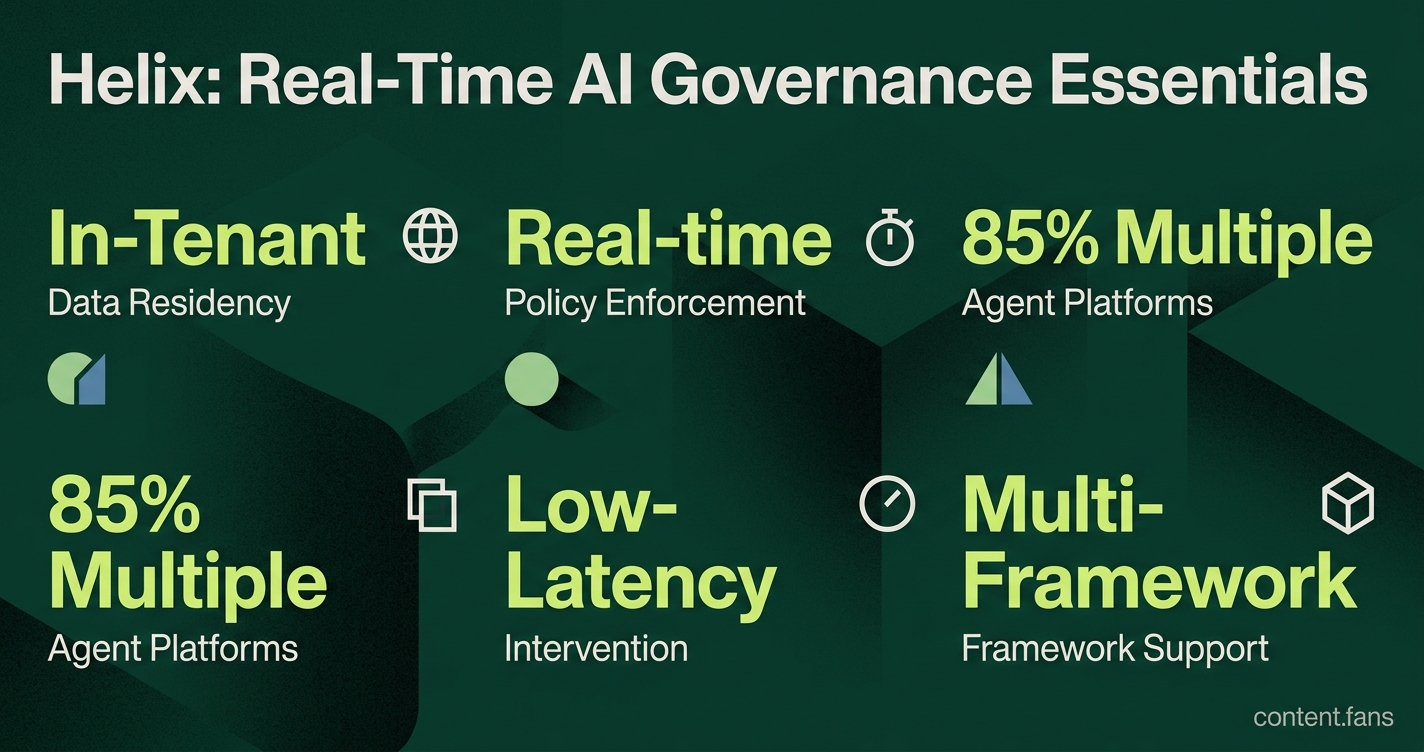
Helix is an AI governance platform that provides real-time oversight and control for autonomous AI agents. It operates inside a company's own systems to monitor agent behavior, enforce security policies, and intervene when necessary, ensuring compliance and preventing undesirable actions without exporting sensitive data.
Standout Capabilities
- Real-time Policy Enforcement: Evaluates policies on every step an agent takes.
- Comprehensive Agent Discovery: Identifies both sanctioned and "shadow" agents across cloud platforms.
- Low-Latency Intervention: Designed to rapidly halt or redirect agent behavior when needed.
- In-Tenant Data Sovereignty: Keeps all telemetry and proprietary data within the customer's local environment.
- Multi-Framework Support: Compatible with major orchestration stacks like LangChain and CrewAI.
Market Drivers Shaping Demand
Industry analysis for 2025-2026 highlights a significant shift from post-hoc audits to runtime enforcement for AI, driven by agent sprawl and regulatory pressure. Helix aligns with this trend, mapping directly to the runtime control portion of the Enterprise AI Control Plane model described by Boston Consulting Group. With VentureBeat Intelligence reporting that 85% of enterprises use multiple agent platforms, the need for a unified governance solution to combat fragmented oversight is clear.
Where Observers See Immediate Fit
Security analysts identify an immediate fit for runtime governance in sectors with stringent compliance mandates, such as financial services and healthcare. These industries require the strict audit trails that Helix provides. The Cloud Security Alliance notes a significant visibility gap, with only 17% of organizations monitoring agent-to-agent traffic. Helix's session-level logging directly addresses this deficiency, reinforcing the principle that static controls are insufficient for protecting dynamic AI systems.
Competitive Framing and Market Position
Alterion positions Helix by contrasting its architecture with common market patterns. While many competitor tools are SaaS-based and focus on prompt filtering or post-event alerts, Helix provides inline governance inside the customer's boundary. This distinction frames the buying decision as a trade-off: the data sovereignty, low latency, and deep behavioral context of Helix versus the simpler rollout of a SaaS solution. It is important to note that public performance metrics are vendor-reported, and independent benchmarks are not yet available.
What is Helix and why did Alterion build it?
Helix is Alterion's intelligence layer for real-time AI agent governance. It was created to address the failure of traditional security tools to manage dynamic, autonomous AI systems, which many organizations piloting agentic AI cite as a top challenge. Helix provides the necessary oversight for agents that make decisions and use tools independently.
How does Helix work in production environments?
Helix combines small language models with graph neural reasoning to analyze agent intent, behavior, and data usage simultaneously. It works behind Alterion's Draco control plane to discover agents, evaluate policies, and trigger controls without requiring code changes. According to vendor reports, Helix offers high precision in threat and risk detection, strong accuracy in discovering sanctioned and shadow agents, rapid runtime policy decisions, and cost-effective operation compared to general-purpose model inference.
Critically, Helix deploys inside the customer's own environment, ensuring prompts, data, and behavioral context remain secure within the enterprise perimeter.
What makes Helix different from other AI governance platforms?
Three architectural choices distinguish Helix from typical competitors:
| Capability | Helix Approach | Common Market Pattern |
|---|---|---|
| Runtime control | Real-time decisions with inline intervention | Emphasis on monitoring, posture management, or post-event detection |
| Agent intent understanding | Persistent behavioral memory and contextual reasoning over intent | Reliance on logs, rules, or heuristic detection |
| Deployment model | In-tenant operation keeping data within customer environment | SaaS control planes requiring telemetry export |
Helix also provides broad coverage for AWS, Azure, GCP, LangChain, and CrewAI, offering unified governance across fragmented infrastructures.
Why are enterprises concerned about "shadow agents"?
Shadow agents are ungoverned AI systems operating outside of IT visibility, creating substantial unmanaged risk. Research from the Cloud Security Alliance highlights this issue, noting that only 17% of organizations continuously monitor agent-to-agent interactions. This visibility gap allows agents to violate policy through intermediate steps that go undetected. Helix addresses this with automated discovery that Alterion reports can identify a significant majority of shadow deployments.
What types of organizations benefit most from real-time agent governance?
Based on its design, Helix is ideal for three primary organizational profiles:
- Regulated Industries: Sectors like financial services and healthcare require session-level audit logs to meet strict compliance mandates (e.g., ISO 42001, NIST AI RMF, EU AI Act), which Helix provides.
- Enterprises with Data Sovereignty Needs: Organizations handling sensitive data benefit from Helix's in-tenant deployment model, which avoids the compliance risks of SaaS-based governance.
- Multi-Cloud Environments: Companies using multiple agent orchestration platforms need the unified, agnostic governance that Helix offers to manage complexity across their infrastructure.