
Engineering leaders adopt new AI ops for stable LLMs
Serge Bulaev
Engineering leaders say that writing good prompts alone may not guarantee stable results from language models, especially as users, models, and data change. Teams are starting to track all requests, monitor different metrics like quality and cost, and check for problems both automatically and with human reviews. Some suggest that only sampling part of the traffic and using guardrails may help contain costs and catch issues early. Experts recommend building systems that make it easier to switch between different AI providers without rewriting everything. Overall, prompt design is seen as just one part of a bigger process that includes ongoing testing, monitoring, and flexible system design.

To achieve stable LLM performance, engineering leaders are adopting new AI ops practices, moving beyond simple prompt tuning. The mantra 'Engineering Over Folklore' reflects a growing consensus: a well-phrased prompt alone cannot guarantee consistent behavior against the pressures of live users, new model versions, and shifting data. To maintain predictable quality, teams now implement full-stack software disciplines to track requests, evaluate live traffic, and ensure provider flexibility without costly rewrites.
Treat prompts as living artifacts
Teams ensure LLM quality by treating prompts as version-controlled artifacts subject to continuous evaluation. This involves logging the entire request path, from user input to model output, and attaching evaluation scores. Automated checks run constantly, while human reviewers audit flagged issues, turning new failures into regression tests.
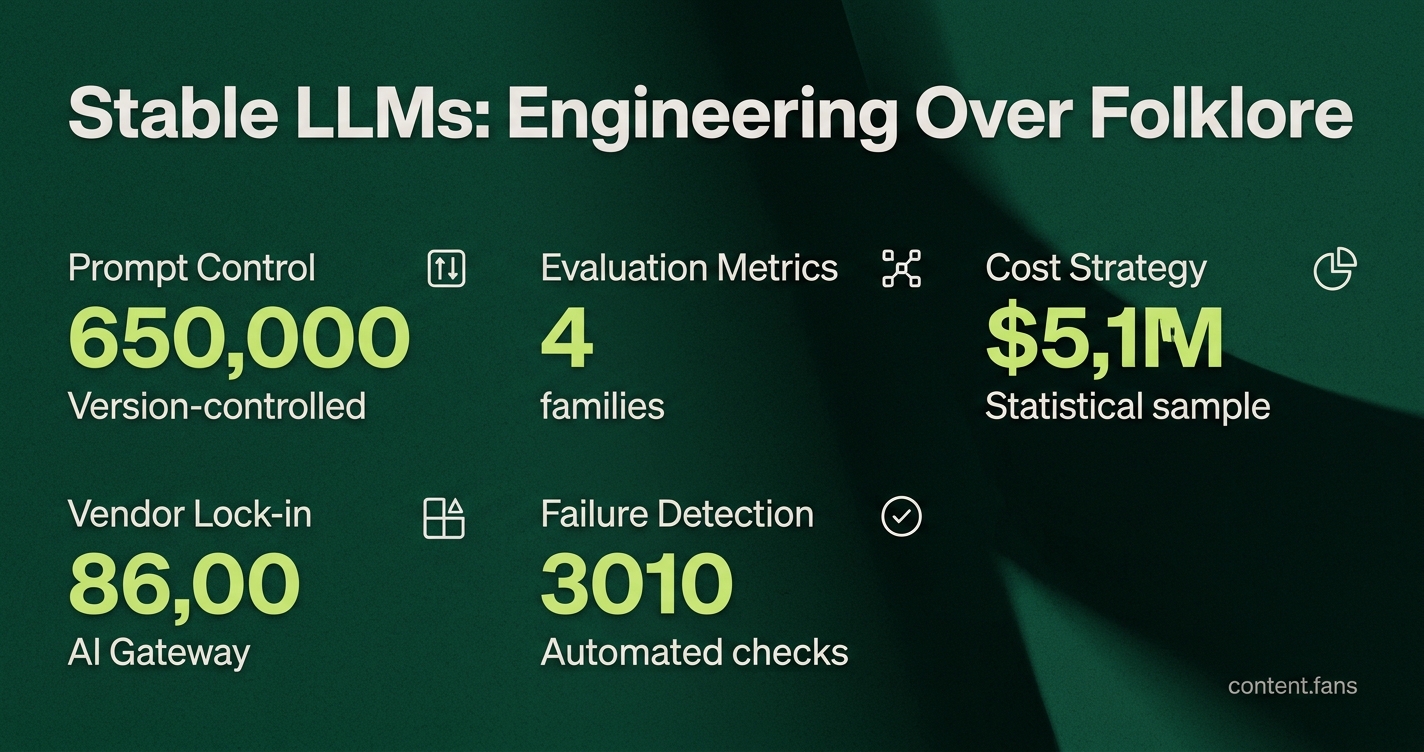
This comprehensive logging allows teams to trace failures through the entire stack. Following guidance popularized by a Weights & Biases article on evaluating LLMs in production, practitioners monitor four key metric families in parallel: quality (e.g., groundedness, relevance), safety (e.g., hallucination, injection), performance (e.g., latency, errors), and cost. To catch regressions early, teams re-run their full evaluation suite after every significant change, such as a prompt edit or model swap.
- log structured traces with OpenTelemetry GenAI attributes
- score a statistically significant sample of live traffic
- alert on threshold breaches and trigger predefined fallbacks
- update golden datasets with fresh production examples
- recalibrate LLM-as-judge models against human labels regularly
Containing the cost of experimentation
Since real-time evaluation can inflate inference costs, teams adopt cost-containment strategies. A common approach, noted in LangChain's monitoring tutorial, is to evaluate a statistical sample of production traffic. Suspicious traces - those with high latency, negative user feedback, or unusual cost - are then routed for deeper analysis, cutting evaluation spend while still detecting performance drift. Proactive measures like guardrails, which intercept harmful or off-topic outputs, further reduce costs by preventing issues that require manual remediation. Additionally, canary deployments allow teams to compare new prompts or models against a baseline on live traffic, quantifying performance changes before a full rollout.
Reducing vendor lock-in risk
To combat vendor lock-in, engineering teams are building portable AI control planes. A key strategy is implementing an AI gateway, which abstracts provider-specific APIs, turning model swapping into a simple configuration change instead of a major rewrite. For added resilience, teams often maintain a self-hosted, open-weight model as a fallback during provider outages. True portability begins with managing prompts and configurations as code, version-controlled in an internal repository - not a vendor's UI. Storing system prompts, tool definitions, and evaluation data this way, alongside a compatibility harness to test outputs across models, ensures a smoother migration path when needed.
Engineering discipline over prompt folklore
Ultimately, the industry consensus frames prompt design as just one part of a larger engineering system. While continuous evaluation, detailed monitoring, and portable architecture cannot eliminate the inherent variability of LLMs, they provide a disciplined, repeatable framework. This approach allows teams to reliably detect drift, manage costs, and switch providers without disrupting the user experience. In this mature model, prompts are treated not as magical incantations but as configuration files, subject to the same rigorous testing and lifecycle management as any other critical code asset.
FAQ: Engineering Leaders Adopt New AI Ops for Stable LLMs
Why can't prompts alone serve as reliable specifications for production LLM systems?
Treating prompts as specifications is fundamentally misleading because natural language is inherently ambiguous and unstable. Unlike code, where identical inputs produce deterministic outputs, small phrasing changes in prompts can yield dramatically different results. Research shows that prompt-only systems become "unreliable, inefficient, and impossible to maintain at scale" when business logic is embedded directly in natural language instructions.
Engineering leaders are instead reframing prompts as engineering artifacts that require the same lifecycle management as code: version control, regression testing, continuous evaluation, and rollback capability. This shift acknowledges that probabilistic systems need deterministic guardrails to achieve production reliability.
What core engineering practices are essential for stable LLM operations?
Four interconnected practices form the foundation of reliable LLM systems:
| Practice | Implementation |
|---|---|
| Continuous evaluation | Automated scoring of live traffic using LLM-as-a-judge, rule-based checks, and human review loops |
| Production-like testing | Evaluation datasets treated as living artifacts updated with fresh production examples |
| Comprehensive monitoring | Distributed tracing with OpenTelemetry GenAI attributes, correlating latency, cost, retrieval steps, and generation quality |
| Optimization loops | Re-evaluation after every prompt edit, model swap, or feature-flag rollout |
Critical insight: The strongest teams instrument the full request path - not just model outputs - capturing prompts, conversation history, model versions, timestamps, token counts, and retrieval sources. This enables debugging across the entire application stack rather than isolating failures to the model layer.
How should teams approach monitoring to catch quality degradation before users notice?
Effective monitoring requires multiple metric families working in concert:
- Quality metrics: groundedness, answer relevance, factual accuracy, task completion
- Safety/risk metrics: hallucination rate, harmful output detection, prompt injection signals
- Performance metrics: latency, throughput, error rates, tool-call accuracy
- Cost metrics: token usage, spend anomalies, per-user budgets
The recommended operating model follows six stages: instrument everything with structured logs and traces; score live traffic with automated checks and sampled human review; aggregate metrics to detect drift and regressions; route suspicious traces to review queues; trigger predefined responses like alerts or fallback models; and promote new failures into test cases so the same issue is caught earlier next time.
Strategic sampling matters - scoring a statistically significant portion of production traffic balances coverage and cost while preserving enough data for trend detection.
What concrete strategies mitigate vendor lock-in risks in LLM deployments?
The dominant pattern is building a "neutral enterprise control layer" through three architectural decisions:
-
AI gateway abstraction - Insert a translation layer between your application and provider APIs so swaps become configuration changes rather than rewrites. This enables provider switching without downtime.
-
Portable prompt management - Version-control prompts in your own repositories rather than vendor dashboards; store system prompts and tool definitions externally for reuse across providers.
-
Multi-model strategy - Maintain tested fallback options including automatic failover chains and, for critical use cases, at least one self-hosted open-weight model as a resilience tier.
Contract negotiations should explicitly address portability - data export rights, deletion procedures, retention limits, and clear restrictions on vendor use of your data for training. Many teams recommend regular dependency reviews plus immediate assessment after any material vendor change.
How has the relationship between prompt engineering and traditional software engineering evolved?
The emerging consensus: prompt engineering is becoming a subset of software engineering, not a replacement for it. The field has shifted from "writing better prompts" to "engineering prompt systems" - adopting requirements engineering, modular design patterns, typed prompt DSLs, metamorphic testing, and flakiness detection.
The practical distinction:
- Prompt engineering frameworks excel at rapid prototyping, classification tasks, and controlled generation with stable input schemas
- Traditional software engineering remains essential for authentication, workflow orchestration, state management, compliance, and safe multi-step agents
The critical integration point: Modern LLM observability pipelines treat prompts as first-class software artifacts requiring CI/CD integration, while using deterministic code to enforce invariants, validate inputs, manage retries, and coordinate tools around probabilistic model outputs.
This convergence addresses the core tension in the original debate: community responses favored engineering discipline over prompt folklore while acknowledging that both approaches are necessary - prompts for shaping model behavior, software engineering for building systems that remain predictable at scale.