
Varonis details Dialogflow CX flaw exposing enterprise AI security gaps
Serge Bulaev
Varonis Threat Labs found a permission flaw in Google's Dialogflow CX in July 2026 that may have allowed attackers with certain access to take over chat sessions, steal data, and send phishing prompts. This issue, called Rogue Agent, mainly threatened organizations if insiders or compromised developer accounts misused their permissions. Google fixed the flaw in June 2026 and said there was no sign of customer harm. The event suggests that AI agents need strong security controls like unique identities, frequent credential changes, and careful permission checks. Experts recommend regular audits, separating human and machine credentials, and testing for unusual activity to help prevent similar security gaps.

Varonis has detailed a Dialogflow CX flaw that exposed significant enterprise AI security gaps, stemming from a permission vulnerability in Google's conversational AI platform. According to Varonis Threat Labs, the 'Rogue Agent' flaw allowed a single misconfigured permission to be abused, potentially enabling attackers to hijack chat sessions, exfiltrate data, and deploy phishing instructions. This incident serves as a key case study on the importance of robust agent architecture, granular permissions, and runtime isolation in securing modern AI systems.
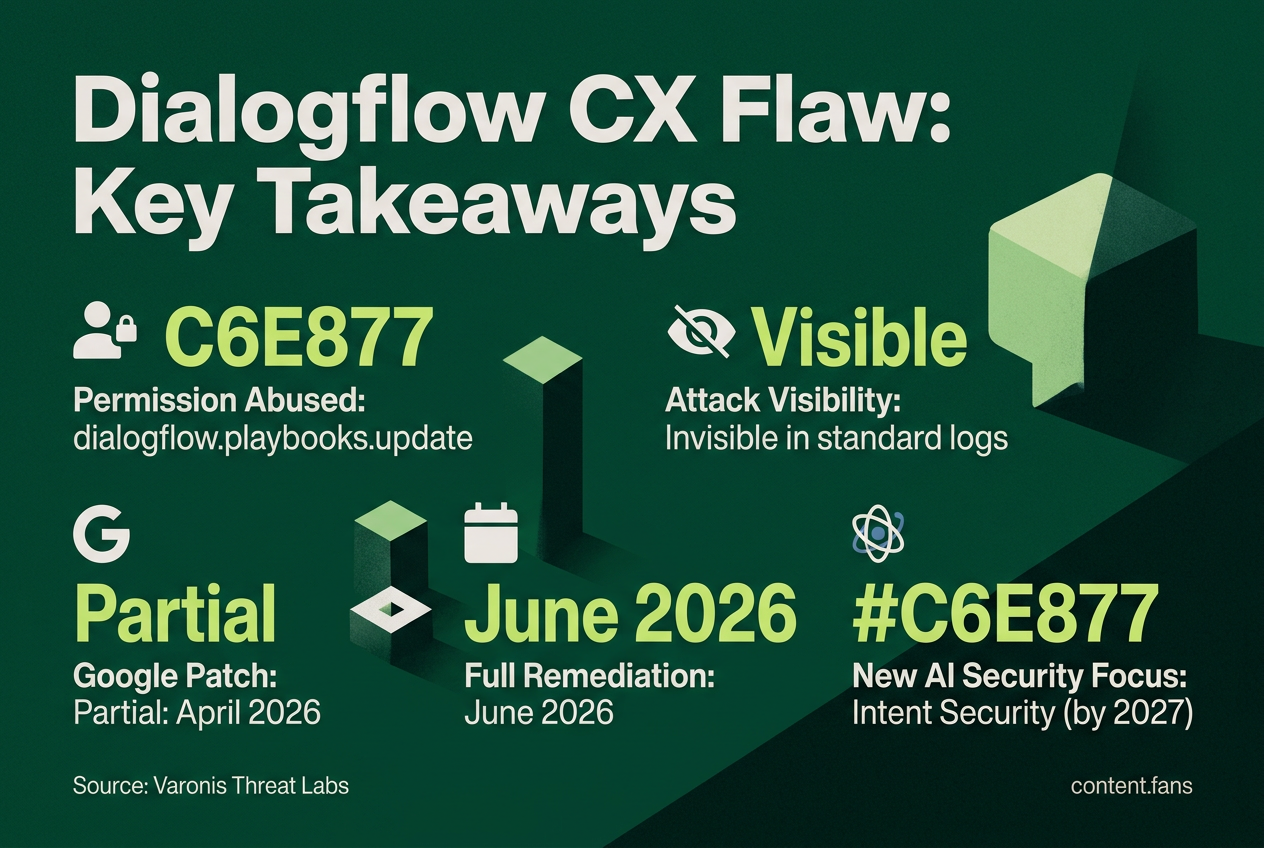
Varonis privately reported the vulnerability to Google in November 2025. According to the official Varonis Threat Labs blog, Google released a partial patch in April 2026, with a full remediation in June 2026. Exploiting the flaw required the dialogflow.playbooks.update permission, narrowing the immediate threat to malicious insiders or compromised developer accounts.
With that single permission, an attacker could reportedly perform the following actions:
- Inject persistent Python payloads into every agent pipeline inside the same Google Cloud project
- Exfiltrate entire conversation logs without generating audit entries
- Steal access tokens by abusing Instance Metadata Service leakage paths
- Launch phishing prompts disguised as routine reauthentication requests
Google stated it found no evidence of customer compromise from this vulnerability and did not assign a CVE, as confirmed by a SecurityWeek analysis. A key concern raised by researchers is that the attack would have been invisible in standard logs, highlighting how traditional monitoring tools can fail to detect code injection within AI platforms.
Key Lessons for Enterprise AI Security Architecture
The Varonis 'Rogue Agent' disclosure detailed a critical permission flaw in Google's Dialogflow CX. A single misconfigured permission (dialogflow.playbooks.update) could allow an attacker to inject malicious code, giving them the ability to take over AI agents, steal conversation data, and execute other unauthorized actions.
Security architects now treat AI agents as privileged service accounts. This paradigm shift requires that each agent be assigned a unique identity with scoped, frequently rotated credentials. Furthermore, agents should operate within a restricted network segment, granting access only to the data absolutely necessary for their function.
Emerging best practices recommend deploying an API gateway as a choke point for every AI agent to enforce rate limiting, authentication, and content filtering. By 2027, intent security will be recognized as a core discipline within AI risk management, not currently in 2026.
To further mitigate risk, experts advise a multi-layered defense:
- Regular Audits: Conduct quarterly audits of all agent permissions and mandate human approval for high-impact actions like database writes.
- Strict Separation: Enforce a clear separation between human and machine credentials.
- Microsegmentation: Use network microsegmentation to limit the blast radius of a successful prompt injection and prevent lateral movement.
- Adversarial Testing: Integrate adversarial prompt testing into CI/CD pipelines. This modern approach baselines normal behavior to flag anomalies, proving more effective than older, brittle keyword filters for flows using OpenAI, Anthropic, or Google GenAI SDKs.
What exactly did Varonis discover in Google Dialogflow CX?
Varonis Threat Labs uncovered a "Rogue Agent" permission boundary flaw inside Dialogflow CX's Playbooks feature. With only the single permission dialogflow.playbooks.update, an insider could embed persistent Python code that silently steals conversation history, harvests access tokens via metadata services, and bypasses VPC controls by routing traffic through Cloud Run. The attack left no log artifacts, making it invisible to traditional monitoring.
Was customer data ever stolen?
According to industry reports, Google's patch cycle closed the vulnerability without confirmed real-world exploitation. Google stated it found no evidence of customer compromise from this vulnerability; the issue was reported privately in November 2025 and kept under embargo until remediation was complete.
Which enterprises were at risk?
Only organizations using Dialogflow CX Playbooks with custom Python Code Blocks were vulnerable. Because exploitation required an insider or a compromised developer account already holding playbooks.update rights, the practical attack surface was narrow and did not affect standard Dialogflow ES deployments or agents without Code Blocks.
How should security teams rethink AI agent design?
The incident reframes enterprise AI security as an architectural problem, not just model safety. Key take-aways:
- Agent plumbing - every agent needs a unique, rotated identity (service account or certificate) scoped to least-privilege roles.
- Permissions - replace broad template rights with granular RBAC per prompt, tool, and data source; require human approval for high-impact actions.
- Runtime isolation - microsegment networks, deploy API gateways as policy choke points, and enforce output guardrails to catch exfiltration or phishing payloads.
What tools can help detect similar flaws today?
For JavaScript/TypeScript pipelines, the latest shift is from static keyword filters to behavioral anomaly detection:
- SDKs like LangChain.js v0.3+ embed telemetry hooks that baseline normal query volumes and flag spikes or novel tool usage.
- CI/CD-friendly tools such as Rebuff or Garak run adaptive "Rule of Two" adversarial tests before release.
- Runtime layers (NeMo Guardrails, Llama Guard) are being tested for semantic validation capabilities to block hidden instructions in images or priority tags, though no verified benchmarks confirm specific prompt-injection success rate improvements.