
AI shifts to "efficiencymaxxing" as inference costs loom large
Serge Bulaev
AI teams are starting to focus more on "efficiencymaxxing," which means getting more output for each dollar spent, instead of just tracking how many tokens are used. This shift may be happening because running big AI models is getting more expensive as subsidies end, so companies need to use resources more wisely. Experts report that most of a model's energy use now comes from inference, and new methods appear to be making this step cheaper. Businesses are tracking new metrics like cost-per-million-tokens and ROI-per-token to watch spending. By using smarter routing and cheaper models, companies might keep quality high while reducing costs, and by 2026, about 40 percent of business apps may include specific AI agents to help with tasks.

The AI industry is undergoing a significant strategic shift toward "efficiencymaxxing" as rising inference costs and expiring provider subsidies force a re-evaluation of operational priorities. This move from tracking raw token volume to maximizing output per dollar is becoming critical for commercial survival, with industry reports suggesting an approaching "AI infrastructure reckoning" centered on cost optimization. As large models become more expensive to run, operators must extract maximum value from every token.
Why the focus shifts from training to inference
The shift from training to inference stems from economic and technical realities. Inference now constitutes a significant portion of an AI model's energy consumption, making it the primary target for cost-cutting. As provider subsidies for large models diminish, businesses must optimize inference to maintain profitability and sustainability.
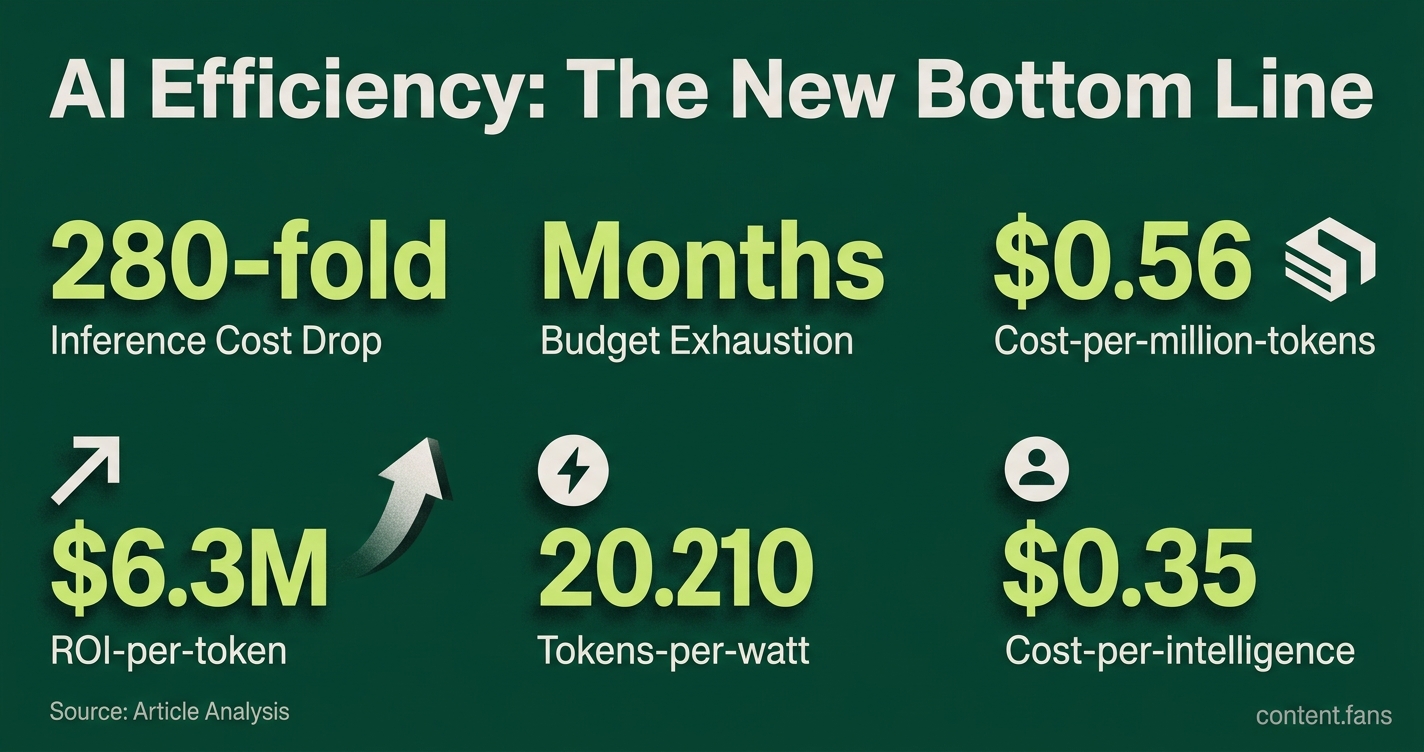
Recent research underscores this trend, revealing that inference is responsible for a substantial portion of a model's total lifecycle energy. Deloitte reports inference costs have dropped 280-fold over the last two years, signaling that optimization efforts are effective. Consequently, architects are prioritizing techniques like Mixture-of-Experts (MoE) routing, FP8 quantization, and KV-cache optimization. Development cycles are also shrinking, with newer models achieving strong performance at significantly lower cost per token.
Emerging business metrics
To manage these new economic realities, businesses are adopting a new suite of key performance indicators (KPIs). While public case studies on "revenue per million tokens" are not yet widespread, internal dashboards now frequently feature metrics like "cost-per-intelligence" and "ROI-per-token." The financial risks of unmonitored AI usage are significant; companies have reportedly exhausted their annual AI budgets in months. This has prompted companies like Cursor to abandon flat-rate pricing in favor of credit-based models tied directly to the consumption of powerful frontier models.
Key metrics now being monitored by practitioners include:
- Cost-per-million-tokens (baseline budgeting)
- ROI-per-token (finance teams)
- Tokens-per-watt (sustainability groups)
- Cost-per-intelligence (product analytics)
Multi-model routing as the default stack
Intelligent multi-model routing has emerged as a primary cost-control strategy. Industry reports suggest that this approach can significantly reduce total AI spending while retaining most of the quality of top-tier models. However, experts caution that these savings must be calculated net of any quality-related costs, as expenses from manual corrections or task retries can quickly negate the initial gains.
Enterprise adoption patterns
The trend toward efficiency is shaping enterprise adoption. Industry research suggests that a growing number of enterprise applications will embed specialized AI agents for specific tasks. These agents typically operate with bounded autonomy, requiring human intervention for high-stakes decisions. Furthermore, AI workloads are increasingly moving to the edge, with quantized language models now running on phones and on-premise servers. This shift reduces cloud dependency and lowers costs associated with token usage. Ultimately, "efficiencymaxxing" is becoming a core competitive discipline that requires a strategic mix of cheaper models, cost-centric KPIs, and an infrastructure redesigned for inference economics.
What is "efficiencymaxxing" and why is it replacing "tokenmaxxing"?
"Efficiencymaxxing" represents a fundamental shift in how AI teams measure success - moving from bragging about raw token consumption to maximizing output per dollar spent. As models have become increasingly token-hungry and labs have pulled back on subsidies, operators can no longer afford to burn tokens indiscriminately. The new priority is value per token rather than volume alone, with teams now competing on metrics like "revenue per million tokens" that directly tie AI usage to business outcomes.
How are companies actually measuring AI efficiency?
While "revenue per million tokens" gained attention at industry discussions as an emerging KPI, most enterprises currently track cost-per-million-tokens for budgeting and ROI per token for value demonstration. The practical reality is that with frontier-adjacent model costs dropping to approximately $0.10 per million input tokens by early 2026, the immediate challenge is controlling runaway consumption rather than maximizing revenue per token. Many companies have learned this the hard way through untracked aggressive usage that quickly exhausts budgets.
What practical steps should enterprise teams take to optimize AI costs?
Teams should implement three core strategies:
- Adopt multi-model routing - Intelligent routing tools like OpenRouter and LiteLLM typically reduce costs by 50-80% through AI-powered task classification
- Track new efficiency metrics - Monitor cost-per-intelligence and tokens-per-watt alongside traditional performance measures
- Implement task-appropriate model selection - Route simple tasks to smaller models and reserve frontier models for complex reasoning, yielding substantial savings while maintaining high-quality performance
What are the risks of ignoring this efficiency shift?
The consequences are immediate and measurable. AI coding companies like Cursor demonstrate the danger - despite high subscription revenue, their average cost of $94.50 per million tokens for frontier models often exceeds what users pay. Without efficiency discipline, AI features become loss leaders rather than profit drivers. Additionally, inference now dominates AI energy consumption, making per-query optimization critical for sustainability as absolute energy use continues to climb significantly year-over-year.
How is this trend reshaping AI infrastructure decisions?
The "efficiencymaxxing" movement is driving a physical migration of AI workloads from centralized cloud data centers to edge devices, on-prem servers, and consumer hardware. Quantized LLMs can now run inference on standard laptops and phones with acceptable performance, enabling architectures that reduce both latency and data center costs. This shift is complemented by the rise of Agentic AI - industry forecasts suggest a significant portion of enterprise applications will embed task-specific AI agents in the coming years, up from a small percentage today - which requires efficient orchestration of multiple models rather than reliance on single monolithic systems.