
OpenAI, Google Supplied AI Models to Alibaba, Baidu Subsidiaries
Serge Bulaev
OpenAI and Google have supplied AI models to Singapore branches of Chinese companies like Alibaba, Baidu, and Tencent, according to a Financial Times report. This was allowed because U.S. export rules focus on companies inside China, not their overseas subsidiaries. These Singapore branches may still send results back to their Chinese parent companies. New U.S. rules are trying to close this loophole, but enforcement appears to remain difficult. Experts suggest that while these new paths may slow China's access to the latest AI models, they have not fully stopped it.

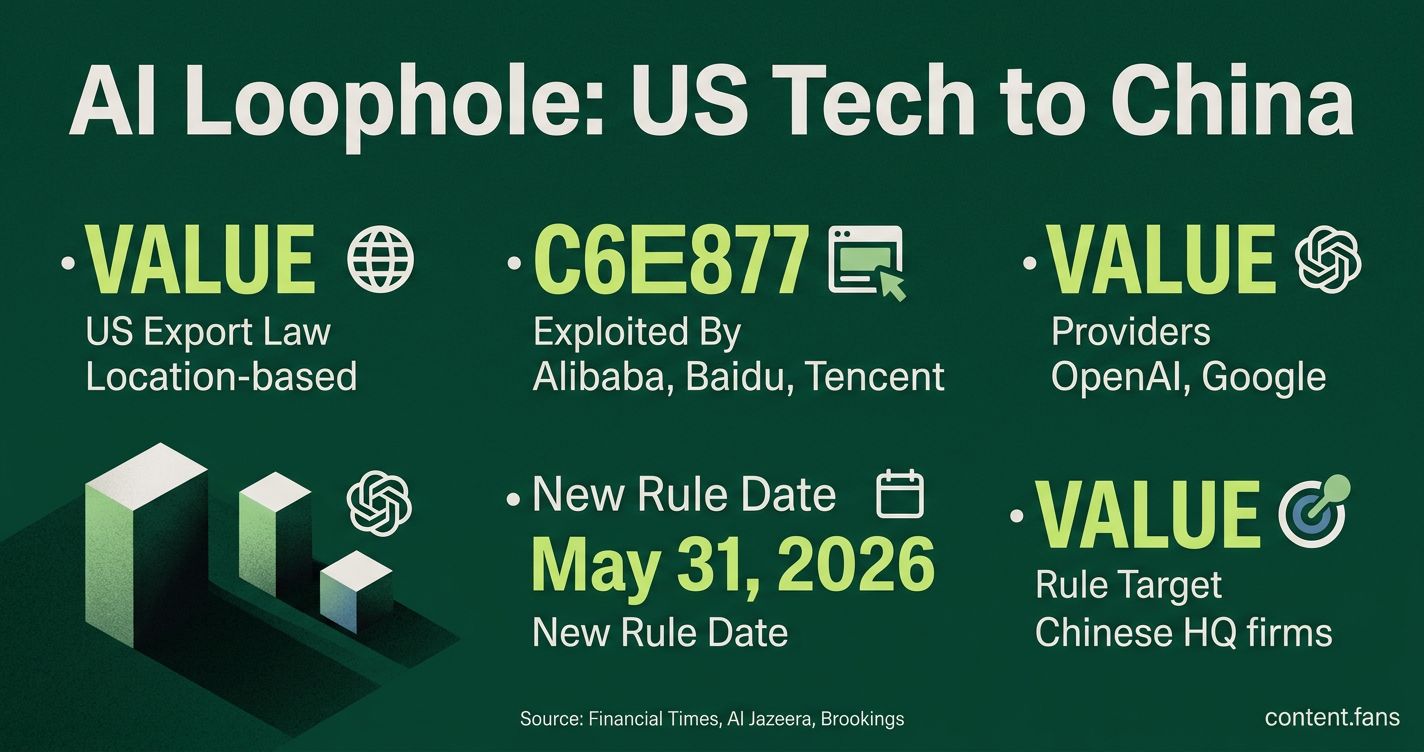
A Financial Times investigation reveals that OpenAI and Google supplied powerful AI models to the Singapore subsidiaries of Chinese tech giants like Alibaba, Baidu, and Tencent. This practice exploits a loophole in U.S. export controls, which target companies inside China but overlook their foreign-registered affiliates.
This arrangement carries significant implications, as data and insights can be transferred to parent companies on the Pentagon's Section 1260H list. This analysis examines the mechanics of this corporate loophole, the providers' compliance measures, and Washington's ongoing efforts to close it.
How the Singapore Detour Works
American AI firms can legally serve Singaporean subsidiaries of sanctioned Chinese companies because U.S. export law is location-based. A company registered in Singapore is treated as a Singaporean entity, regardless of its parentage, allowing it to contract for services unavailable to its Chinese headquarters.
Both OpenAI and Google block direct access from mainland China but permit access for Chinese-owned firms registered in jurisdictions with strong legal safeguards. They justify this by relying on Singapore's independent legal system to enforce contracts that are unavailable to the parent companies in China.
To police usage, the providers implement several technical and contractual controls:
- API monitoring to detect suspicious activity, like unusual volume spikes.
- Strict Know-Your-Customer (KYC) protocols during the onboarding process.
- Immediate account suspension for attempts at model distillation (copying the model).
- Logging user activity for potential review by U.S. authorities.
According to the Financial Times, OpenAI has already enforced these rules by suspending an Alibaba-linked account for attempting model distillation and reporting the incident.
Washington's Shifting Rulebook
U.S. regulators have started to address these bypass methods. According to industry reports, regulatory changes have been implemented to address loopholes in export controls. The Bureau of Industry and Security issued guidance on May 31, 2026, clarifying that any enterprise with headquarters in China - even if registered abroad - must now obtain a license to purchase advanced AI chips Al Jazeera report. This rule specifically addresses the "cloud loophole," where firms could rent U.S. computing power through foreign data centers Brookings analysis.
However, enforcement remains a significant challenge. Smuggling tactics, such as using replica servers for inspections and diverting shipments through Southeast Asia, have prompted regulatory responses. The BIS guidance issued on May 31, 2026, closed a loophole for Chinese-headquartered firms, shifting the focus from legal paperwork to physical security.
Strategic Stakes in the AI Race
Policy experts contend that while the subsidiary route may slow China's progress, it has not severed its access to frontier AI models. Despite chip restrictions, research from the Hudson Institute suggests Chinese labs are only months behind their U.S. competitors in large language model capabilities. Simultaneously, both OpenAI and Google are deepening their presence in Singapore, with OpenAI making significant investments for a new AI lab and Google DeepMind establishing a regional research hub CNBC coverage.
Looking ahead, compliance departments face growing uncertainty. Experts warn that future U.S. regulations could retroactively penalize sales to foreign subsidiaries of blacklisted firms by citing the "intent" of export controls. Until clear guidance is issued, companies must navigate the complex terrain between commercial opportunities, shifting regulations, and heightened national security concerns.
How did OpenAI and Google legally supply AI models to Singapore subsidiaries of blacklisted Chinese firms?
U.S. export rules currently target entities by name and location, not by ultimate ownership. Because Singapore subsidiaries of Alibaba, Baidu and Tencent are legally separate entities incorporated in a third country, they can sign cloud contracts with American providers even though their parents appear on the Pentagon's Section 1260H list. Both tech giants apply a "jurisdiction-over-ownership" test: they bar direct access from mainland IP addresses but allow the same models to be used from Singapore-registered companies, believing local courts can enforce usage policies.
What specific safeguards do OpenAI and Google impose on these Singapore deals?
- OpenAI monitors API traffic for distillation or bulk downloading, requires verified company registration, and has already suspended one Alibaba-linked customer after detecting attempts to train a competing model.
- Google relies on behaviour analytics, attribution judgements and reserves the right to cut access if usage breaches its terms.
Both firms reserve the right to terminate accounts without notice and say they share suspicious-activity reports with U.S. authorities, yet the primary gatekeeper role remains with the companies, not the government.
Has Washington closed the third-country loophole for AI software as it did for AI chips?
Partially, but not for cloud models. In June 2026 the Bureau of Industry and Security clarified that any firm headquartered in China needs a licence to buy advanced AI chips abroad, closing the Singapore-subsidiary channel for hardware. No comparable rule exists for downloadable or cloud-accessed models; Congress is debating an "AI Diffusion" licence that could extend similar controls to weights and inference services, but the proposal has not yet reached a vote.
Why does Singapore keep appearing in these transactions?
Singapore markets itself as the "Switzerland of the AI arms race": English-language courts, strict contract law, political neutrality and generous AI subsidies. OpenAI has made significant investments to build its first overseas applied-AI lab there, while Google DeepMind runs a regional research hub in the city-state. Chinese tech giants therefore incorporate subsidiaries in Singapore to gain both legal cover and proximity to cutting-edge Western R&D.
What is the broader strategic risk for the U.S.-China AI race?
Loophole-enabled transfers let Chinese labs stay only months behind U.S. frontier models despite export bans. Intelligence briefings warn that once a model is rented in Singapore, data can still be routed back to Beijing and guardrails can be stripped for military fine-tuning. Analysts fear the current patchwork of company-level safeguards gives Beijing an asymmetric advantage: Chinese firms are barred from buying American chips but can still legally rent American intelligence, undercutting Washington's goal of preserving a compute lead.