
Donohoe Proposes Funding Infrastructure, Skills for Inclusive AI
Serge Bulaev
Paschal Donohoe suggests that the biggest risk with AI is people being left out because they lack electricity, internet, or skills.

Paschal Donohoe argues for funding infrastructure and skills for inclusive AI, framing the technology as a policy choice, not destiny. The TIME article emphasizes that ensuring AI serves the public good depends on sound policy, infrastructure access (electricity, connectivity), and skills, but does not explicitly rank exclusion as the 'greatest risk' over malicious use. His policy approach combines infrastructure finance with targeted regulation to keep opportunities accessible across all sectors and demographics.
The following report maps Donohoe's core recommendations and places them alongside emerging global governance trends.
Infrastructure Gaps Are the Primary Barrier to Inclusive AI
Paschal Donohoe proposes significant public and multilateral investment in foundational infrastructure. He recommends funding reliable electricity and affordable internet connectivity to ensure that AI's economic benefits reach rural, low-income, and developing regions, arguing that digital exclusion is the most pressing AI-related risk to global equity.
Donohoe champions this investment through platforms like the World Bank's Digital and AI Implementation Plan, which aims to provide these foundations to a significant portion of underserved populations. This focus on inclusion aligns with emerging governance frameworks. According to industry reports, the EU AI Act mandates bias testing for high-risk applications like hiring and credit. Similarly, updated AI principles emphasize "inclusive growth," though experts warn that fragmented global enforcement could create compliance barriers for developing nations.
Championing "Small AI" for Local Realities
Instead of focusing on large, resource-intensive frontier models, Donohoe champions "small AI" - practical tools that run on existing devices using local data and languages. This approach empowers frontline workers like teachers and nurses to deploy AI without costly cloud services. Aligning with this strategy, a Maryland pilot program is testing the Khanmigo tutoring assistant with a significant number of students to see if free, accessible AI can close achievement gaps, though its long-term equity impact is not yet known.
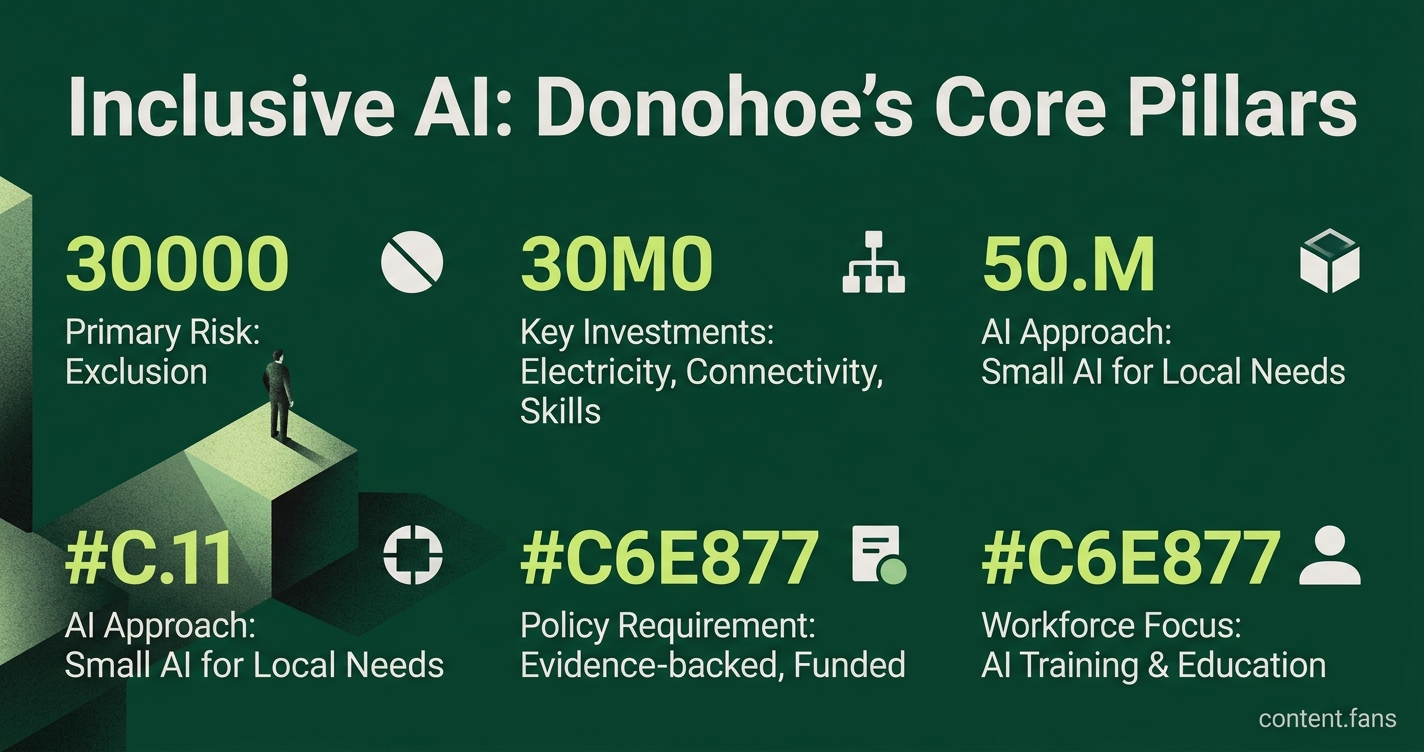
Donohoe's framework rests on seven core policy pillars:
- Treat exclusion as the primary risk
- Invest in electricity, connectivity, skills, regulation, and innovation hubs
- Promote small AI tailored to local data and hardware
- Expand digital access and trusted AI readiness across developing economies
- View AI as a tool for curating knowledge, not replacing creators
- Require evidence-backed, properly funded policies
- Embed AI training in education and workforce programs
Matching Policy with Funding and Skills
Donohoe insists that claims about AI's potential must be "backed up by evidence" and sufficient resources. He confirms that World Bank balance-sheet support is tied to data transparency requirements. In the U.S., federal guidance is promoting AI literacy in university programs, and states like Ohio now require school districts to develop AI use policies. While these mandates can establish a baseline of protection, teacher unions caution that unfunded directives may actually worsen the digital divide.
Recent workforce data presents a complex outlook. While some analyses show reduced hiring for young professionals in AI-impacted fields, other reports indicate that AI is increasing the cognitive demands of jobs as routine tasks become automated. This trend points to a growing skill premium, which could worsen inequality if retraining and upskilling programs do not effectively reach underserved communities.
Ultimately, Donohoe's proposals center on proactive and preventive inclusion. The success of this strategy - blending infrastructure finance, localized "small AI," and evidence-based regulation - will hinge on sustained funding and coordinated global governance as frameworks like the EU AI Act become fully implemented.