
Ukrainian Retailers Automate 70% of Inquiries, Boost Sales With AI by 2026
Serge Bulaev
By 2026, Ukrainian retailers may automate up to 70% of customer inquiries using AI, aiming to provide more personalized shopping and support. Trends show that stores are shifting to app-based loyalty programs, using tools like machine learning and location-based discounts. Early results suggest that these changes might boost sales, increase customer satisfaction, and raise retention rates, but some challenges remain around technology, data quality, and staff concerns. Studies indicate that shoppers who use AI assistants may complete more purchases, though the full impact is still being studied. It appears that gradual adoption of AI tools helps retailers test new ideas without making large changes all at once.

The adoption of AI in Ukrainian retail is set to redefine the industry, with Epicenter, a major home-improvement retailer, targeting the automation of up to 70% of customer inquiries by 2026. This strategic shift towards data-driven engines is already reshaping customer touchpoints as shoppers increasingly expect personalized offers, support, and recommendations. The primary drivers are a surge in mobile loyalty app usage and aggressive corporate goals for automating routine support. Epicenter plans to handle 70% of its customer interactions with AI, using the technology for both support and creating hyper-personalized ad creatives (Interfax).
Grocery Banners Embrace Algorithmic Loyalty
Leading grocery chains are replacing physical loyalty cards with sophisticated, app-based systems powered by machine learning. Silpo has implemented digital invoicing and chatbots as part of its digital transformation, though specific details about paper savings vary across implementations. Auchan Ukraine uses AI for proximity marketing and customer experience enhancement, deploying location-based promotional strategies that aim to boost conversion rates (Deloitte).
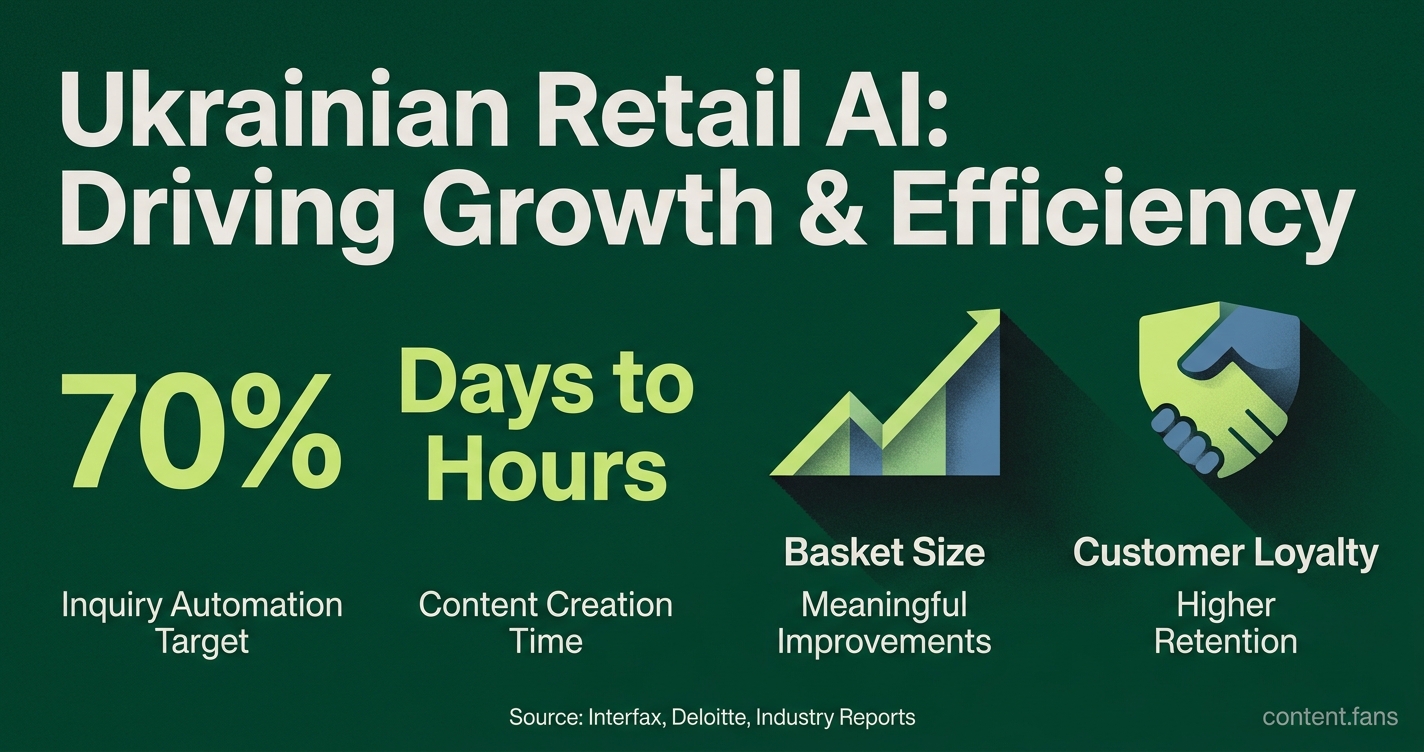
Ukrainian retailers are leveraging AI to deliver hyper-personalized shopping experiences. This includes using machine learning to analyze purchase data for custom discounts, deploying location-based sensors for real-time in-store offers, and generating unique product content, ultimately aiming to increase basket size, conversion rates, and customer loyalty.
Recommendation Engines Show Promise for Basket Growth
Ukrainian retailers are piloting AI-powered co-purchase prediction systems. According to industry reports, retailers testing AI-driven product recommendations are seeing meaningful improvements in average basket size. These systems deliver real-time, basket-specific suggestions rather than generic lists, driving increased traffic to recommended products.
Generative AI Accelerates Merchandising
Retailer VARUS is using generative AI tools like ChatGPT and Midjourney to rapidly create localized product descriptions and diverse image variants, especially for visually driven categories like fresh produce. This approach has drastically cut content creation cycles from days to hours, enabling faster catalog updates and more timely promotions.
Key Metrics Show Gains in Satisfaction and Retention
Early data indicates a strong correlation between AI adoption and improved customer loyalty. Industry studies suggest that retailers with AI-driven omnichannel strategies see higher retention rates. Similarly, research indicates rising customer satisfaction scores following the implementation of AI recommendation systems. Furthermore, AI assistants are reported to boost conversion rates and improve customer retention significantly.
Key Barriers to AI Adoption at Scale
Despite the promise, significant hurdles remain. Industry experts identify legacy IT systems, poor data quality, and weak project governance as primary obstacles, with studies indicating that a significant majority of organizations globally struggle to convert raw data into actionable insights. Workforce concerns regarding AI automation are also prominent, sometimes leading to internal resistance. To mitigate these risks, managers advocate for an incremental rollout - starting with chatbots before moving to more complex systems like predictive pricing - to test and learn without disruptive, large-scale overhauls.
How far has Ukraine progressed in automating customer service with AI?
Ukrainian retail chains are increasingly implementing AI-powered customer service solutions. Industry leaders such as Epicenter have publicly committed to automating a significant portion of customer interactions, with plans to reach 70% automation during 2026, relying on hyper-personalised creatives and AI agents that recognise intent and purchase history.
What does "hyper-personalised" actually look like for shoppers?
- Auchan Ukraine uses AI for proximity marketing, delivering location-based promotions and enhanced customer experiences through their mobile platforms.
- Silpo's loyalty app studies your basket history and shows individual "Smart Offers" - their digital transformation has saved 13 tonnes of paper annually through replacing physical loyalty cards with digital alternatives.
- VARUS uses ChatGPT + Midjourney to create new pack-shots and product stories overnight, so each page feels written only for you.
Across various pilot projects, retailers report meaningful improvements in average basket size and increased visits to recommended products.
Is AI only about marketing, or are operational tasks being automated too?
Marketing gets the headlines, but back-office wins are significant:
- KISSA (Key Intellectual Silpo System Assistant), the AI system within Fozzy Group, helps streamline various operational processes and customer interactions.
- Ukrainian online retailers are testing AI-powered shopping assistants that can help shoppers select recipes and assemble matching baskets, significantly reducing order completion time.
What risks should retailers and shoppers watch in the coming years?
| Risk area | Industry concern | What it means |
|---|---|---|
| Project failure | Many retail AI pilots face challenges | Poor data quality and legacy IT are commonly cited reasons. |
| Data privacy | Growing consumer awareness | Transparent opt-ins become a competitive advantage. |
| Labour impact | Workforce transformation concerns | Upskilling employees for AI-enhanced roles is becoming urgent. |
Which local retailers are moving fastest?
| Chain | Focus area | Key approach |
|---|---|---|
| Epicenter | Customer service automation | Behavioural forecasting & personalised content |
| Auchan Ukraine | In-store customer experience | AI-powered proximity marketing |
| VARUS | Content generation | ChatGPT + Midjourney for rapid merchandising |
| Silpo (Fozzy) | Digital loyalty systems | KISSA (Key Intellectual Silpo System Assistant) |
Sources: Epicenter's automation plans, Silpo's digital transformation.