
Meta's Zuckerberg Unveils AI Policy Push, Links to Infrastructure Spend
Serge Bulaev
Mark Zuckerberg's new AI policy push, called "The Future is for Everyone," argues that giving more people access to AI may be safer than letting only a few control it. The plan suggests making it easier to build data centers, keeping some chip export controls, making it simpler to use data for training, and creating legal rules for model distillation. Experts think Meta's proposed community deals for data centers might work because they offer jobs and local benefits, though some obstacles remain. Critics warn that more access to AI doesn't always mean better safety, and local changes may not fix global risks. Meta's strategy appears to mix open and closed AI models, possibly to balance government concerns and business goals.

Mark Zuckerberg has unveiled Meta's new AI policy push, with the company arguing for government collaboration on artificial intelligence development and deployment. Outlined in a manifesto titled "The Future is for Everyone," the agenda proposes government-lab coordination to prevent unauthorized distillation and calls for tighter access controls, connecting it to Meta's significant AI infrastructure spending plans. The policy links data center expansion with calls for stronger protections against unauthorized use of AI models.
Four headline proposals
• Expedite permits for data centers and energy projects.
• Maintain export controls on the most advanced chips.
• "Reduce friction" on lawful training-data use.
• Strengthen protections against unauthorized model distillation.
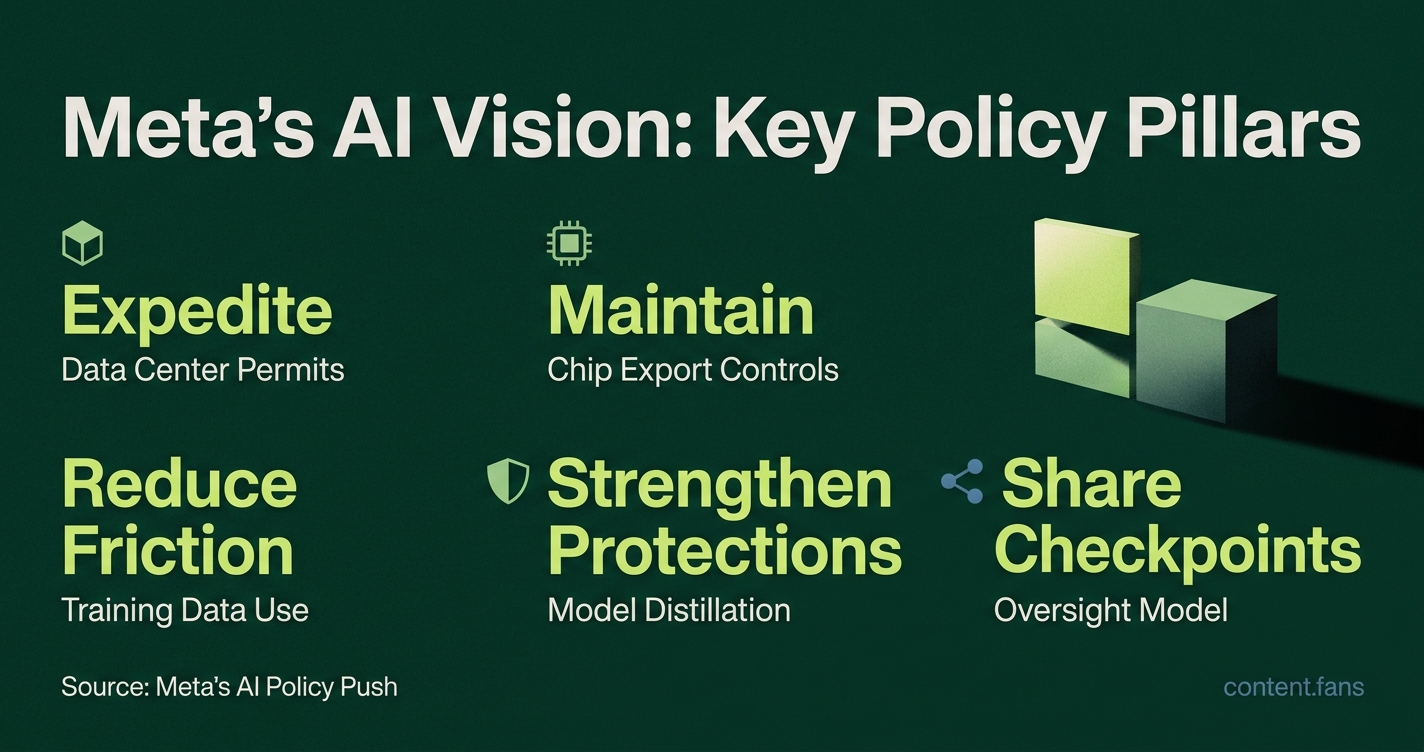
Mark Zuckerberg's AI policy focuses on government-lab coordination, arguing for collaboration between public and private sectors. Key proposals include expediting data center permits via community deals, maintaining specific chip export controls, easing restrictions on training data, and strengthening legal or contractual protections against unauthorized distillation of AI models.
Why faster data-center builds matter
To provide "free or affordable" AI to billions, Zuckerberg argues a massive expansion of computing power is necessary. His About Meta essay presents a community compact promising local jobs, school and public-service investment, and support through a Future Is For Everyone Fund. In an Axios interview, he details a proposed "community compact" to address local energy and water use. Experts suggest these compacts could succeed by linking tax revenue with environmental responsibility, but slow permitting processes remain a significant hurdle.
Training-data friction and distillation
The policy calls on U.S. lawmakers to ease restrictions on AI training data related to copyright, privacy, and export laws. A Forbes report notes Zuckerberg's position that labs must be able to "learn from anything you can observe." The agenda also seeks stronger legal or contractual protections against unauthorized model distillation - the process of compressing large models into smaller, more efficient ones - which Meta considers essential for protecting intellectual property in AI development.
Oversight moves earlier in the pipeline
Instead of pre-release licensing, Zuckerberg proposes a novel oversight model where frontier labs share intermediate "checkpoints" with regulators during the training process. The goal is to identify and mitigate dangerous capabilities before a model is fully scaled. While supporters see this as a balanced approach between open development and secrecy, critics warn of the potential for sensitive checkpoint data to leak.
Critical reception
The policy's focus on government-lab coordination has drawn mixed reactions. Academic critics argue that the approach may not adequately address broader governance challenges in AI development. Some experts also note that while community data center agreements address local concerns, they fail to tackle the global challenge of policing AI misuse, highlighting a potential gap between Meta's infrastructure goals and comprehensive safety oversight.
How the agenda aligns with Meta's roadmap
This policy push aligns directly with Meta's strategic reorganization into "Superintelligence Labs" and its goal of creating "personal superintelligence agents." The company's roadmap includes consumer agents, enterprise services, and direct compute sales. By pursuing a hybrid strategy - releasing some open-source models while keeping its most advanced frontier models proprietary - Meta appears to be balancing regulatory pressures against single-firm dominance with the need to protect its commercial interests.