
Discovery Loop Launches to Automate Science with AI
Serge Bulaev
Jeff Dean and three other top Google researchers have started Discovery Loop, a company that aims to use AI to automate and speed up science. The team wants to build systems that may improve themselves and run many experiments with little human help. Discovery Loop is funded by both venture capital and Alphabet, Google's parent company, which may want to keep a connection to the project. These moves come as Google changes leadership and faces several high-profile staff departures, which might affect the company's stock and direction. Discovery Loop appears to be trying a new way of doing research by mixing openness and startup speed.

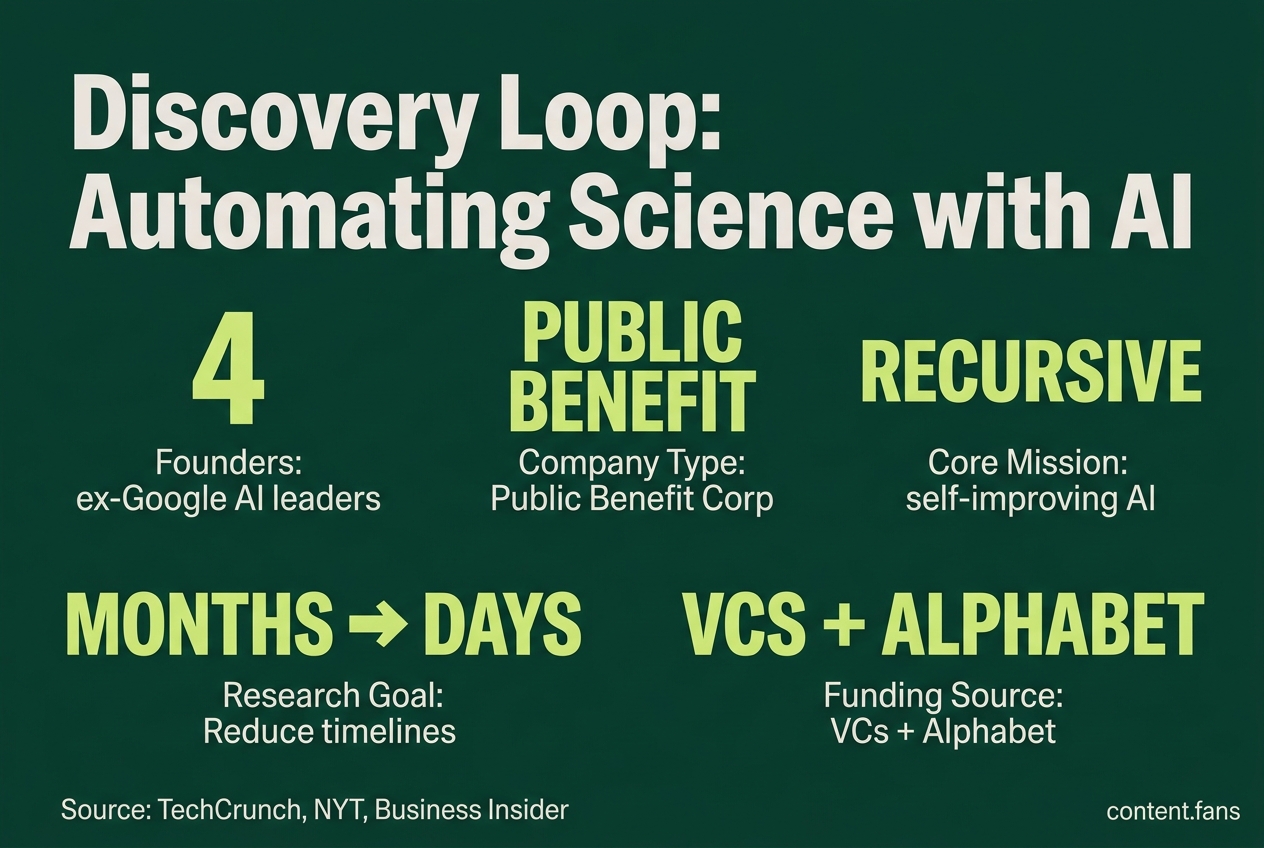
In a major AI industry shift, former Google chief scientist Jeff Dean has launched Discovery Loop, a new research company dedicated to automating science. Dean and three other top Google researchers are forming the public benefit corporation to accelerate discovery through recursively self-improving AI systems.
The move highlights a growing trend of senior AI talent prioritizing the research freedom and equity of a startup over the vast resources of established tech giants.
Who is leaving Google and why
Discovery Loop is a new public benefit corporation founded by former Google AI leaders Jeff Dean, Sanjay Ghemawat, Quoc Le, and Oriol Vinyals. The company's mission is to automate the scientific method by developing advanced AI systems capable of designing, running, and iterating on their own experiments.
Jeff Dean, Google's former chief scientist, is joined by veteran researchers Sanjay Ghemawat, Quoc Le, and Oriol Vinyals. According to TechCrunch, the startup's focus is to build "truly recursive, self-improving superintelligence at scale" where ideation, implementation, and validation could become automatic. TechCrunch describes recursive self-improvement as a closed loop with humans no longer necessary or helpful. This focus on recursive self-improvement, a long-debated concept in the field, forms the core of the startup's mission, as noted by The New York Times.
What Discovery Loop plans to build
The startup's official mission, according to a pitch deck posted by Dean, is to "automate machine learning, science, and engineering to accelerate discoveries and progress." This translates to building AI that can independently design, test, and refine new models, potentially reducing research timelines from months to days. While the goals are reminiscent of past Google Brain projects, Discovery Loop's founders now have full control over the research direction and financial upside.
Where the money is coming from
Discovery Loop has secured its initial funding, though the valuation is undisclosed. According to industry reports, the investment round features a mix of prominent venture capital and a strategic corporate backer. Business Insider reports Alphabet is participating as a founding investor and technical partner, which includes cloud credits. This indicates a strategic hedge: while Google is losing key talent, its parent company retains a financial stake in their future success.
Alphabet's parallel leadership shuffle
Coinciding with the departures, Alphabet announced a major leadership reorganization. Demis Hassabis was promoted to Chair of Google DeepMind and Chief Scientist of Alphabet, while Koray Kavukcuoglu became Senior Vice President of Google DeepMind. Kavukcuoglu now oversees all Gemini development and frontier AI research, reporting directly to CEO Sundar Pichai, according to a company blog post. According to industry reports, this restructuring is seen as an effort to stabilize leadership and reassure investors amid concerns about product delays and talent retention.
A Widening Trend of AI Talent Exits
The formation of Discovery Loop is part of a broader exodus of top AI talent from Google. According to industry reports, a significant number of key contributors to the Gemini project have departed for other companies. These high-profile moves have reportedly rattled investors, highlighting market sensitivity to the flow of top-tier researchers.
By organizing as a public benefit corporation and accepting funding from both VCs and Alphabet, Discovery Loop's founders are charting a unique course. They aim to blend the agility and focus of a startup with the ideals of open, science-driven research, creating a new model for innovation in the AI landscape.
What is Discovery Loop and who founded it?
Discovery Loop is a new public benefit corporation launched by four senior Google AI researchers: Jeff Dean (Google's former chief scientist), Sanjay Ghemawat (long-time Google engineer and senior fellow), Quoc Le (Google Brain co-founder), and Oriol Vinyals (Google DeepMind research leader). The startup marks a significant departure from corporate AI research, with Dean leaving Google after 27 years to pursue this independent venture. The company is structured specifically to operate outside the constraints of a major tech corporation while maintaining a mission-driven focus on accelerating scientific discovery through artificial intelligence.
What is recursive self-improvement and why is Discovery Loop pursuing it?
Recursive self-improvement refers to AI systems that can improve themselves with little or no help from humans - essentially using AI to build more powerful AI. Discovery Loop has explicitly stated this as a core research direction, alongside its broader mission to "automate machine learning, science, and engineering to accelerate discoveries and progress". The approach is considered high-risk, high-reward: if successful, it could dramatically accelerate AI capabilities, but it also represents one of the more ambitious and potentially consequential frontiers in artificial intelligence research. The company plans to use AI to "initiate and iterate thousands of experiments simultaneously", partially automating the research process itself.
Who is investing in Discovery Loop and how is Google involved?
The startup's initial funding round has been secured from multiple sources. Business Insider reports that Alphabet is a founding investor and cloud partner, while TechCrunch notes the company received financial support from "a number of different sources, including Google's parent company Alphabet." This creates a notable dynamic: Google is simultaneously losing its chief scientist and investing in his new venture. The seed round pricing has not been publicly disclosed.
How does this fit into the broader trend of AI researcher departures from Google?
Discovery Loop represents the most prominent example of a growing pattern: senior AI researchers leaving established tech giants to form VC-backed independent labs. According to industry reports, Google has lost a significant number of key AI researchers in recent years. These departures have reportedly rattled investors and raised questions about Google's competitive position in AI. Fortune noted that researchers are increasingly optimizing for startup equity upside and mission control rather than long-term corporate tenure. The trend suggests a fragmentation of AI talent across more nimble, founder-led organizations.
What organizational changes is Google making in response?
Concurrent with these departures, Google announced significant leadership restructuring: Demis Hassabis transitioned from DeepMind CEO to Chair of Google DeepMind and Chief Scientist of Alphabet, while Koray Kavukcuoglu was promoted to Senior Vice President of Google DeepMind, reporting directly to Sundar Pichai. Unlike Hassabis, Kavukcuoglu does not hold the CEO title. He now oversees Gemini model development, Frontier AI research, and the Gemini app and developer teams. These moves, announced August 5, 2026, were framed as strategic but coincided with concerns about product delays and talent retention.