
Enterprises Pivot to Hybrid Cloud for AI, Data Governance in 2026
Serge Bulaev
Many organizations are moving away from using only public cloud and are choosing hybrid cloud setups for better control over costs, security, and AI data governance. Reports suggest that about 73 percent of enterprises may now use hybrid cloud, and this shift appears linked to gaining business value, not just saving money. Hybrid setups help companies keep sensitive data secure and meet legal rules, especially with increasing use of AI. Studies indicate that certain workloads are better kept private, while public clouds are used for flexible, short-term needs. Good data governance, like classifying data and monitoring for risks, is gaining importance as more companies use a mix of cloud environments.

Enterprises are increasingly pivoting to hybrid cloud for AI and data governance, with many organizations moving away from public-cloud-first strategies toward customized architectures. This shift addresses complex demands for cost control, security, and workload optimization in a maturing market.
Why are enterprises moving away from public-cloud-first strategies?
Enterprises are adopting hybrid cloud to gain control over unpredictable costs, enhance security, and meet stringent data governance and sovereignty rules. This model allows them to place workloads in the optimal environment - public or private - based on specific cost, compliance, and performance requirements, moving beyond a one-size-fits-all approach.
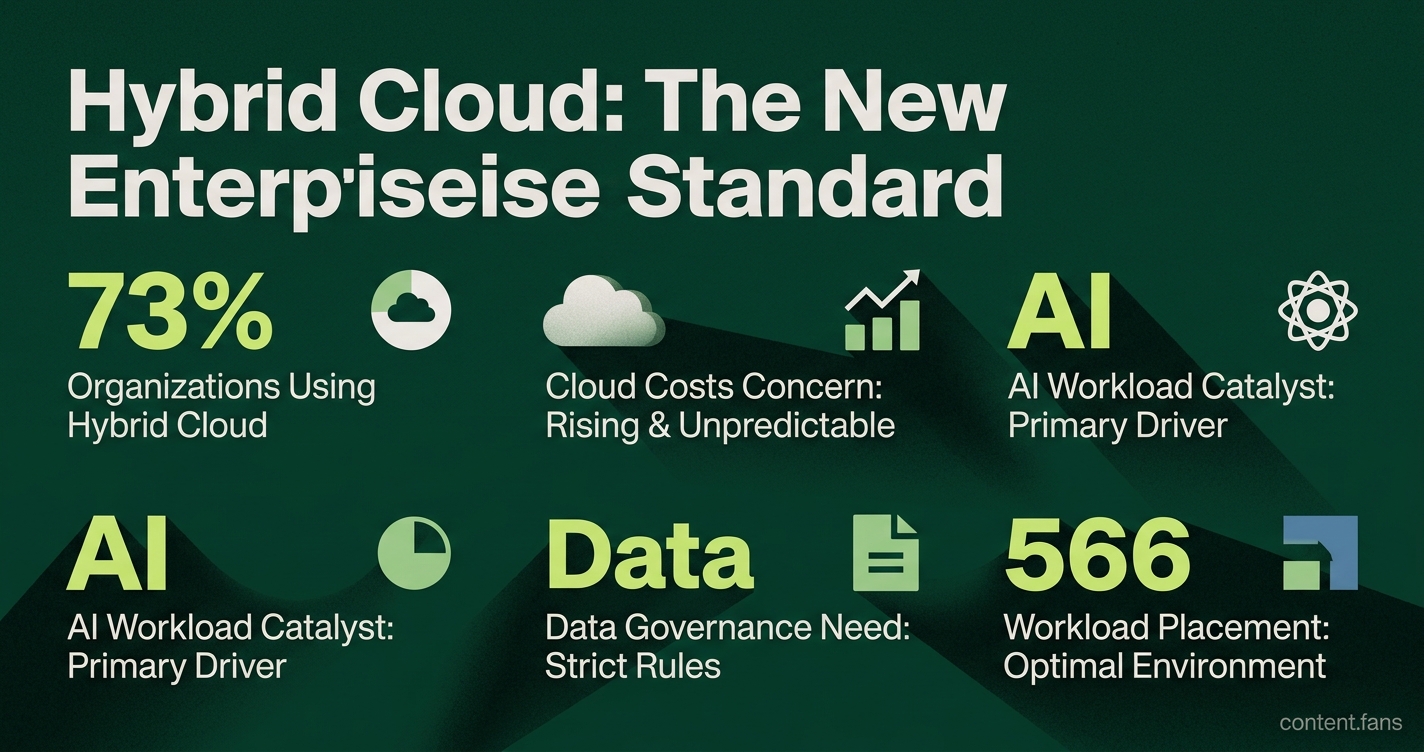
The move away from universal public cloud strategies stems from unexpected challenges in cost and control. The Flexera 2026 State of the Cloud Report confirms this trend, finding that 73% of organizations now use hybrid cloud, making it the dominant enterprise model.
The key drivers behind this reassessment include:
- Rising and unpredictable cloud costs - egress fees, data transfer charges, and "micro-charges" that accumulate on steady workloads
- Security and compliance requirements that demand greater control over IT assets
- AI data governance needs that require careful workload placement
- Data sovereignty regulations that mandate specific jurisdictional controls
This reflects a change in perspective where cloud is viewed as "an operating model" rather than a single destination, with placement decisions driven by workload needs, not by default.
How does AI specifically impact hybrid cloud architecture decisions?
AI workloads are a primary catalyst for hybrid cloud adoption, as they create a unique mix of infrastructure requirements. These include massive compute power for training, strict data residency rules, and rigorous governance for AI models and their outputs.
Key architectural patterns emerging in 2026 include:
| Workload Type | Typical Placement | Rationale |
|---|---|---|
| Sensitive training data & model artifacts | Private/sovereign environments | Regulatory compliance, intellectual property protection |
| Elastic training bursts | Public cloud GPUs | Cost-effective access to specialized compute |
| Production inference (regulated) | Hybrid: on-premises or sovereign cloud | Latency control, auditability, data residency |
| Non-sensitive inference | Public cloud | Scalability, managed services |
IBM emphasizes that a hybrid model is essential for ensuring "sensitive data, workloads and AI artifacts remain within defined jurisdictions." This is achieved by embedding centralized controls like "encryption, identity governance, access controls and continuous monitoring" across the entire estate.
When does hybrid cloud deliver better total cost of ownership?
A hybrid cloud's total cost of ownership (TCO) advantage depends entirely on workload patterns. A true TCO calculation, as defined in CloudZero's 2026 analysis, must include often-hidden expenses like egress fees, engineering time, and compliance tooling, not just raw compute and storage costs.
Public cloud typically wins when:
- Workloads are bursty, experimental, or uncertain in demand
- Speed to deployment matters more than long-term optimization
- Data movement can be minimized
Hybrid cloud often wins when:
- Workloads run 24/7 with predictable utilization
- Data gravity makes egress expensive
- Existing on-premises infrastructure can be leveraged
- Compliance requirements would require costly additional tooling in public cloud
This economic reality is driving significant investment. The Research and Markets Hybrid Cloud Market Report 2026 projects the market will grow from $127.07 billion in 2025 to $149.94 billion in 2026 and expand to $291.37 billion by 2030, confirming that enterprises are embracing this financial model at scale.
What governance changes do IT leaders need to implement?
Effective hybrid cloud governance in 2026 requires centralized policy with distributed execution. This aligns with industry findings showing that organizations now prioritize value delivered to business units over pure cost savings as a top metric for cloud success.
Critical governance updates include:
- Establish workload placement frameworks to classify data by sensitivity, residency, and performance needs before migration.
- Implement AI-specific policies for the complete model lifecycle, including training, deployment, and access permissions.
- Adopt unified observability to monitor pipelines, model performance, security events, and costs across all environments.
- Enforce FinOps discipline to track and optimize spending across the entire hybrid estate.
What should IT leaders do now?
To navigate this transition successfully, IT leaders should focus on strategic analysis before migration:
- Inventory and classify all workloads based on data sensitivity, residency rules, utilization patterns, and data gravity.
- Calculate a realistic TCO that includes all operational overhead, such as egress fees, compliance tools, and specialized staffing.
- Design for data sovereignty by default in AI systems to avoid costly and complex retrofitting of controls later.
- Select vendor partners who offer consultative expertise in building tailored, hybrid architectures, not just standardized lift-and-shift migrations.
Ultimately, the pivot to hybrid cloud is not a retreat from innovation but a maturation of enterprise strategy. It signifies a move toward a more precise, value-driven approach that aligns technical architecture with specific business outcomes, marking a significant evolution from the public-cloud-first era.