
M&A Rebounds: 160 Enterprise Software Startups Could Be for Sale in 2026
Serge Bulaev
Many enterprise software startups may be up for sale in 2026, as IPOs remain rare and AI draws most new venture capital. Reports suggest global deal values have risen, with technology as the busiest sector. Buyers appear to favor companies with strong recurring revenue, unique data, and clear AI features. There may be more interest in AI-focused businesses, while older software firms could face lower valuations. Founders might need to highlight their AI strengths and consider different types of deals, since the market shows some uncertainty.

The market for enterprise software M&A is rebounding, with an estimated 160 enterprise software startups potentially for sale in 2026. This trend is fueled by scarce IPO opportunities and a venture capital landscape heavily skewed toward AI, forcing many founders to consider M&A as their primary exit strategy.
This M&A resurgence is backed by significant capital. A BCG report shows global deal value has increased substantially in recent periods. In this active market, PwC's midyear outlook reveals that buyers are prioritizing companies with embedded workflows, proprietary data, and clear AI monetization. This creates a "barbell" market where large strategic buyers target major platforms and smaller tuck-ins, leaving mid-market firms to face intense scrutiny.
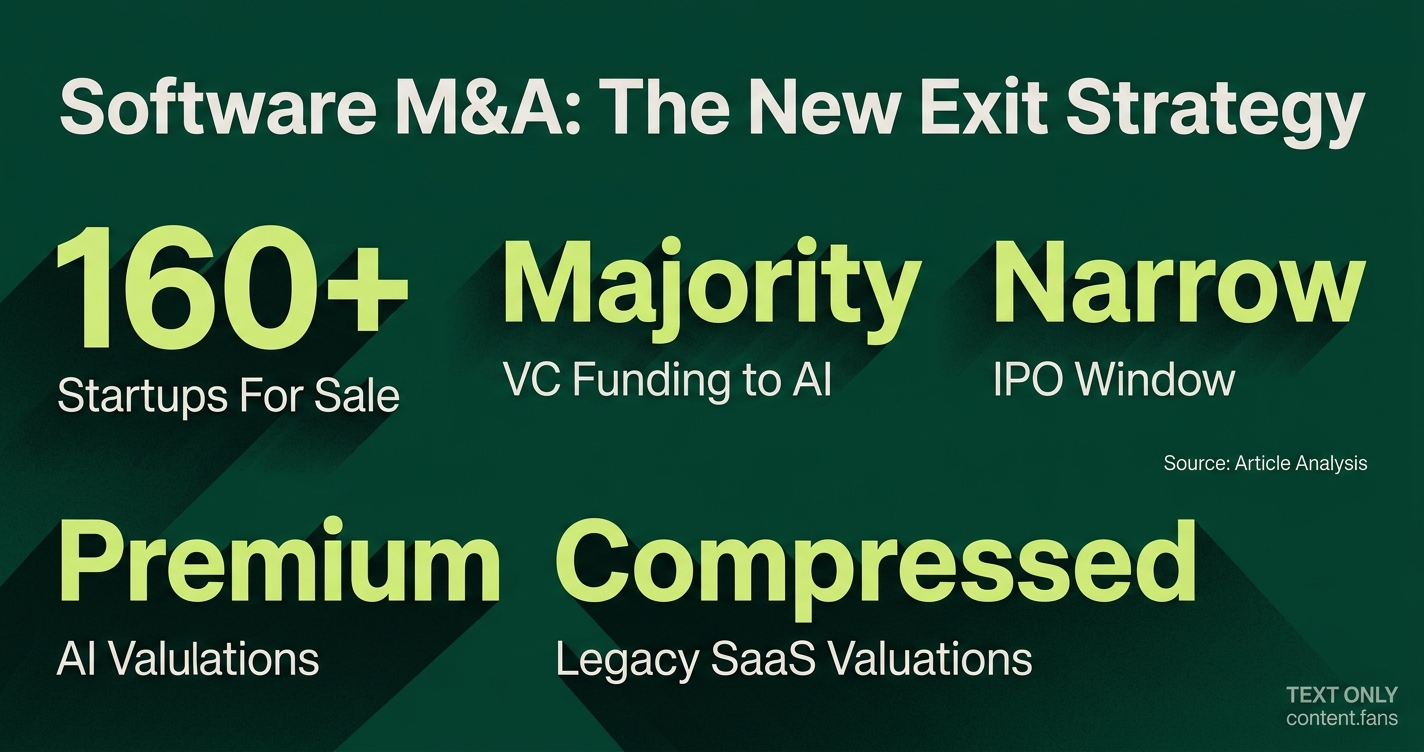
Key Drivers Behind the 2026 Software M&A Surge
A convergence of market forces is driving the potential sale of over 160 enterprise software startups. Limited IPO opportunities, a sharp concentration of venture capital into AI, and pressure on non-AI firms to find an exit are the primary catalysts for this wave of M&A activity.
- Narrow IPO Window: With public market exits still difficult, M&A has become the default path. Industry reports show a significant portion of enterprise software exits now involve VC-backed buyers, underscoring the shift away from public listings.
- Concentrated Venture Capital: AI is consuming the lion's share of funding. Silicon Valley Bank reports that a substantial majority of U.S. enterprise software VC funding is now going to AI startups, leaving less follow-on capital for other software categories and pushing them toward acquisition.
- Demand for AI Capabilities: Strategic buyers are looking to acquire, not build. FE International confirms that acquirers prefer to purchase existing AI models, proprietary data, and specialized talent to accelerate their roadmaps.
- Bifurcated Valuations: A clear divide has emerged. According to PwC, AI-native companies continue to attract premium valuations, while legacy SaaS firms are seeing their multiples compress under market pressure.
Top M&A Deal Themes in Software for 2026
Active dealmaking in 2026 is clustering around several key themes:
- AI Infrastructure and Security: Major cloud security acquisitions highlight the growing priority of securing cloud infrastructure in the AI era, though specific deal terms vary across transactions.
- Real-Time Data Pipelines: Strategic acquisitions in the data streaming space demonstrate the importance of integrating real-time data capabilities into AI and analytics platforms.
- Vertical Workflow Specialization: Recent deals in business process outsourcing show the value of combining intelligent operations with deep, industry-specific expertise.
- Private Equity Take-Privates: Major take-private transactions signal strong, ongoing interest from financial sponsors in mission-critical platforms with stable revenue streams.
Key Diligence Factors for Software Acquisitions in 2026
Acquirers are rigorously assessing the following factors before making an offer:
| Factor | Why It Matters in 2026 |
|---|---|
| Recurring Revenue Quality | Acquirers demand strong fundamentals, focusing on high net retention rates and healthy gross margins to ensure sustainable growth. |
| Proprietary Data Access | Exclusive data sets are critical for training superior AI models and creating a long-term competitive advantage. |
| Deep Workflow Integration | Being deeply embedded in customer operations significantly reduces churn and creates natural opportunities for cross-selling. |
| Proximity to AI Infrastructure | Companies whose tools support core compute, storage, or security are aligned with major enterprise AI spending priorities. |
| Capital Efficiency | In a market with uncertain exit timelines, companies with high burn rates are viewed as risky and may face valuation discounts. |
Strategic Advice for Founders Considering a Sale
Founders weighing a sale in the current market should focus on these near-term strategies:
- Integrate Practical AI: Focus on adding lightweight AI features that demonstrably improve your core product, rather than pursuing costly, speculative AI platform plays.
- Quantify AI Value: Prepare diligence materials that prove monetization. Use customer case studies to show a clear revenue lift or cost savings directly linked to your AI features.
- Identify Strategic Buyers: Map potential acquirers based on their goals. Platform players often seek data and security assets, while private equity sponsors prioritize predictable cash flow.
- Explore Flexible Deal Structures: Be open to alternatives beyond a full cash buyout. PwC notes that staged acquisitions, minority investments, and other creative arrangements are becoming common as buyers look to mitigate risk.