
SpaceX Files S-1, Targets $75B Raise at $1.75T Valuation
Serge Bulaev
SpaceX has filed for a public offering, aiming to raise $75 billion at a $1.75 trillion valuation. The company says it wants to become multiplanetary and is investing heavily in projects like Mars settlement and artificial intelligence. Elon Musk's compensation may depend on big milestones, such as reaching a $7.5 trillion valuation and having a million people living on Mars, but the timeline for these is uncertain. Most of the recent spending has gone to the AI division, and future profits may depend on growth in satellites, rockets, and AI. The filing also warns of risks and does not promise when projects like Mars colonies or space data centers might make money.

The SpaceX S-1 filing for its landmark initial public offering is public, detailing an ambitious plan for what could be one of the largest IPOs in history at a valuation targeting approximately $2 trillion. The prospectus positions SpaceX as a vertically integrated conglomerate combining rockets, satellite internet, and a newly incorporated AI division. The filing states SpaceX's mission is to build the systems and technologies necessary to make life multi-planetary, with some commentary also referencing Musk's broader phrasing about extending consciousness to the stars.
A Civilizational Mission Tied to Concrete Financials
The filing is public and the IPO is expected to be enormous, with industry reports pointing to a roughly $2 trillion valuation target. The prospectus outlines visionary goals, including colonizing Mars and building a powerful AI division, while explicitly tying CEO Elon Musk's compensation to achieving ambitious market cap milestones.
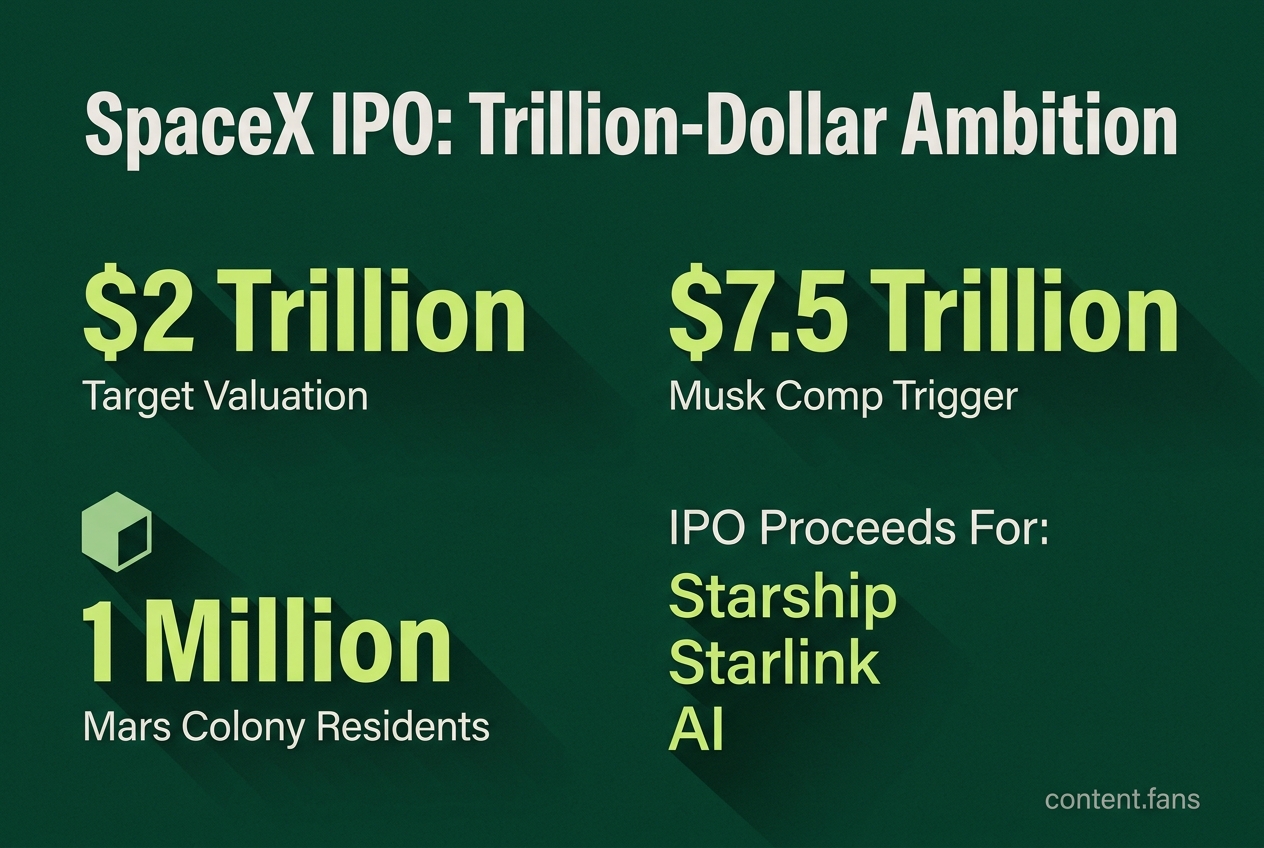
Available reporting indicates Musk's performance-based pay package could be worth a substantial amount if fully vested, with major awards tied to achieving a $7.5 trillion market cap and establishing a permanent Mars settlement of one million residents. The source indicates the package is tied to major market-cap and Mars-colony milestones, with employment required at the time of achievement and the award split into multiple tranches, fundamentally tying near-term capital decisions to the long-term Mars plan.
Key triggers for Musk's compensation include:
- Multiple tranches linked to valuation and operational milestones
- A Mars colony threshold of one million inhabitants
- Full vesting requires achieving ambitious market cap targets
A Strategic Pivot to AI Infrastructure
The filing reveals a significant strategic focus on artificial intelligence, which is framed as a primary future revenue driver. After merging with xAI, the AI division received a significant portion of capital spending according to industry reports. The prospectus projects a massive total addressable market for AI services, substantially larger than that of launch and satellites. This reframes the company as an AI infrastructure play, according to analysis covered by industry outlets.
How SpaceX Plans to Spend the IPO Proceeds
The substantial IPO proceeds are earmarked to accelerate three capital-intensive bets simultaneously:
- A significant portion for expanding Starship production and building orbital refueling depots essential for Mars missions.
- A substantial allocation to scale and harden the Starlink satellite constellation, enabling direct-to-cell services.
- A meaningful investment for AI compute infrastructure, including planned orbital data centers.
Unpacking the Valuation
At the reported valuation targets, SpaceX would debut as one of the largest U.S. companies, with a valuation potentially exceeding many established tech giants. However, according to industry reports, the company's revenue projections suggest premium valuation multiples that significantly exceed other tech companies.
| Metric | SpaceX IPO target | Tesla | Amazon | |
|---|---|---|---|---|
| Revenue | Industry estimates vary | $135 B | $360 B | $640 B |
| EV / Revenue multiple | Premium to peers | 4× | 5× | 3× |
This premium valuation implies investors must bank on exponential growth. Industry analysts describe this as optimistic pricing, which assumes SpaceX can achieve substantial revenue growth while maintaining strong profit margins.
Governance, Control, and Investor Risks
Governance remains a key consideration for institutional investors. The S-1 filing outlines a dual-class share structure that ensures Elon Musk retains control through super-voting shares, with significantly more voting power for insiders versus public shareholders. Industry reports suggest this structure could impact valuation. Market observers note that if demand is soft, there may be flexibility in the offering size and valuation structure.
Ultimately, the SpaceX IPO asks public investors to fund a multi-decade, speculative vision with substantial capital. The filing candidly presents the company's grand narrative and its associated risks, without promising when its most ambitious projects - from Mars colonies to orbital data centers - will become profitable. The market's reception will reveal whether Wall Street is ready to buy into a mission to the stars.