
Nvidia reports $81.6B quarter, boosts dividend 2400%
Serge Bulaev
Nvidia reported record revenue of $81.6 billion for the quarter, up about 85 percent from last year, mostly from its Data Center business. The company boosted its dividend by 2400 percent and authorized an $80 billion share buyback, moves that may show confidence in future earnings. Nvidia reorganized its business into Data Center and Edge Computing units, which might help investors better understand where demand is coming from. Management said supply issues could limit short-term growth, even though demand for AI chips remains strong. The company expects next quarter's revenue to be around $91 billion, but some uncertainty remains, especially about supply and future opportunities.

Nvidia reported a record $81.6B quarter, driven by surging AI infrastructure demand that has propelled the company's growth. The chipmaker's revenue soared 85% year-over-year, with its Data Center segment contributing nearly 92% of the total, as reported by CNBC.
CEO Jensen Huang described the growth as "parabolic," a result of hyperscalers competing for compute power to enable "agentic AI," according to a Fortune transcript. Looking ahead, the company forecasts approximately $91 billion in sales for the next quarter, a figure that excludes new compute revenue from China.
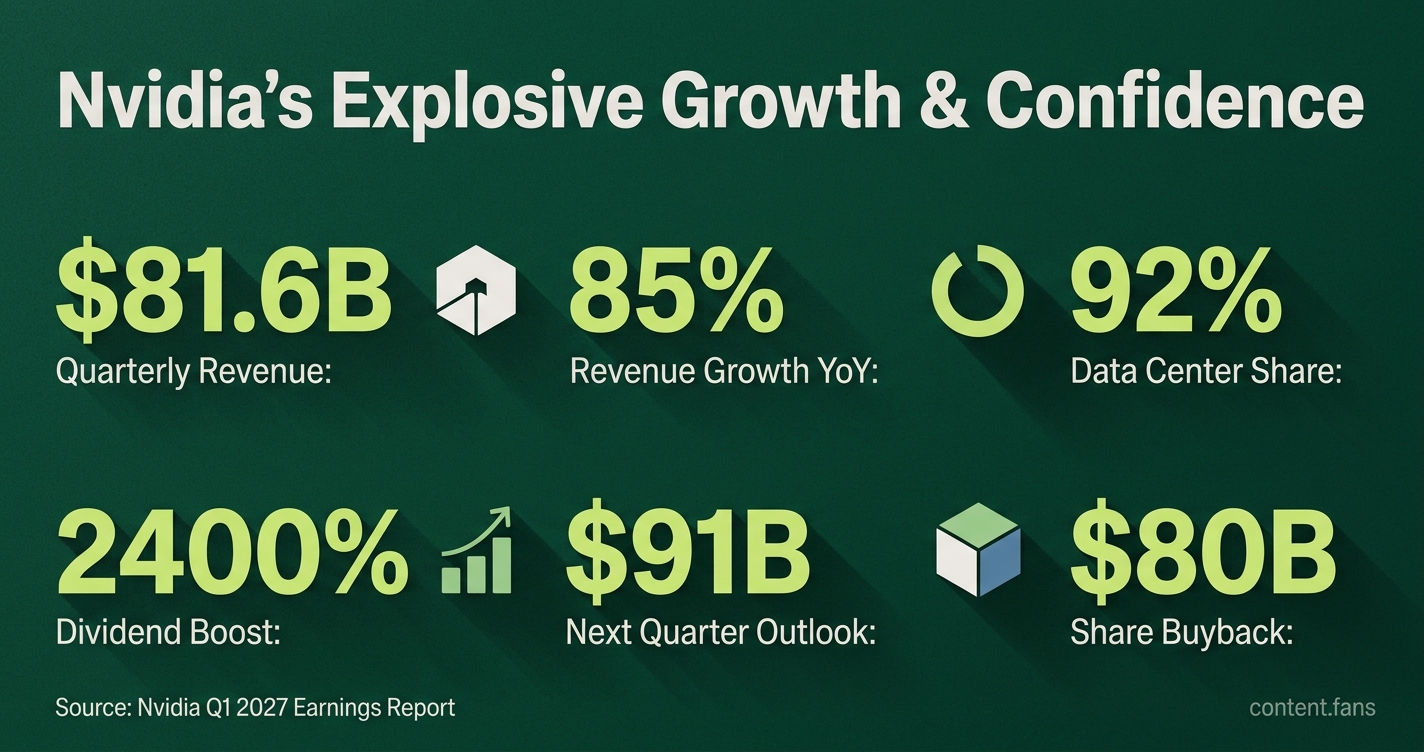
Alongside its stellar earnings, Nvidia announced an $80 billion share buyback and boosted its quarterly dividend by 2400% to $0.25 per share. These capital return initiatives signal strong confidence in future cash flow, despite a muted initial stock reaction.
Key Q1 Financial Highlights
Nvidia announced record first-quarter revenue of $81.6 billion, an 85% year-over-year increase fueled by its Data Center business. The company also raised its dividend 2400%, authorized an $80 billion buyback, and guided for $91 billion in revenue for the upcoming quarter, underscoring its strong market position.
Key figures highlighted during the earnings call include:
- Total revenue: $81.6 billion, up 20% sequentially.
- Data Center revenue: $75.2 billion, accounting for 92% of total sales.
- Free cash flow: Reached a record level.
- Next-quarter revenue outlook: $91 billion ±2%.
- Capital returns: $80 billion buyback authorization and a new $0.25 dividend per share.
New Segments Clarify AI Demand Sources
Nvidia has consolidated its reporting into two primary units: Data Center and Edge Computing. The Data Center segment is now subdivided into "Hyperscale" and "ACIE" (AI Clouds, Industrial, Enterprise). This change helps investors distinguish between spending on centralized AI factories and demand from distributed inference applications. Huang noted that "compute capacity is revenue and profits," suggesting that edge deployments in robotics and industrial settings could soon become as strategically vital as traditional cloud workloads.
Supply Constraints Remain a Key Challenge
CFO Colette Kress affirmed the company is "working vigorously on our supply chain ecosystem" to meet persistent, unmet demand for its GPUs. Management projects a combined $1 trillion revenue opportunity for its Blackwell and upcoming Rubin architectures through 2027, suggesting that supply, not demand, will be the primary limiting factor for near-term growth.
Capital Returns Signal Long-Term Confidence
Analysts from Reuters and Zacks view the increased dividend and large-scale buyback as a strategic move to show confidence and attract a wider investor base. While Goldman Sachs termed the actions "incrementally supportive," Seeking Alpha noted the stock's slight dip post-announcement, implying that extremely high expectations were already priced into the market.
Why the Segment Split Matters Going Forward
By creating a distinct Edge Computing segment, Nvidia offers clearer visibility into emerging use cases like autonomous systems, private AI, and healthcare. This aligns with an industry-wide focus on inference efficiency (tokens-per-watt), a crucial factor for sustainable AI growth that Forrester's analysis has highlighted. The new structure helps track this progress separately from hyperscale training demand.
In summary, Nvidia's first-quarter results, strategic business realignment, and aggressive capital return program depict a company capitalizing on explosive AI demand. While navigating significant supply constraints, Nvidia is positioning itself for sustained growth and rewarding its shareholders.
How big was Nvidia's Q1 FY2027 revenue and where did it come from?
Nvidia posted $81.6 billion in quarterly revenue, up 85% year-over-year and 20% sequentially.
$75.2 billion of that total - 92% - came from Data Center sales alone.
Why did Nvidia raise its quarterly dividend by 2,400% and authorize an $80 billion buyback?
Management increased the dividend from $0.01 to $0.25 per share and added an $80 billion share-repurchase program to return excess cash while signaling confidence in sustained free-cash-flow generation.
What is Nvidia's revenue guidance for Q2 FY2027?
The company projects about $91 billion, +/- 2%, for the second quarter even after excluding any Data Center compute revenue from China.
How is Nvidia changing its financial reporting structure?
Starting this quarter, Nvidia now splits results into two segments:
- Data Center (further divided into Hyperscale and ACIE - AI Clouds, Industrial, Enterprise)
- Edge Computing
Management says the new layout "better reflects its current and future growth drivers."
What do executives say about future AI demand?
On the earnings call, CEO Jensen Huang stated:
"Demand has gone parabolic … agentic AI has arrived … tokens are now profitable."
CFO Colette Kress added that Nvidia sees a $1 trillion cumulative revenue opportunity from the Blackwell and Rubin architectures through calendar 2027, underscoring a multi-year upgrade cycle.