
Bristol Myers Squibb expands AI drug discovery with Anthropic's Claude
Serge Bulaev
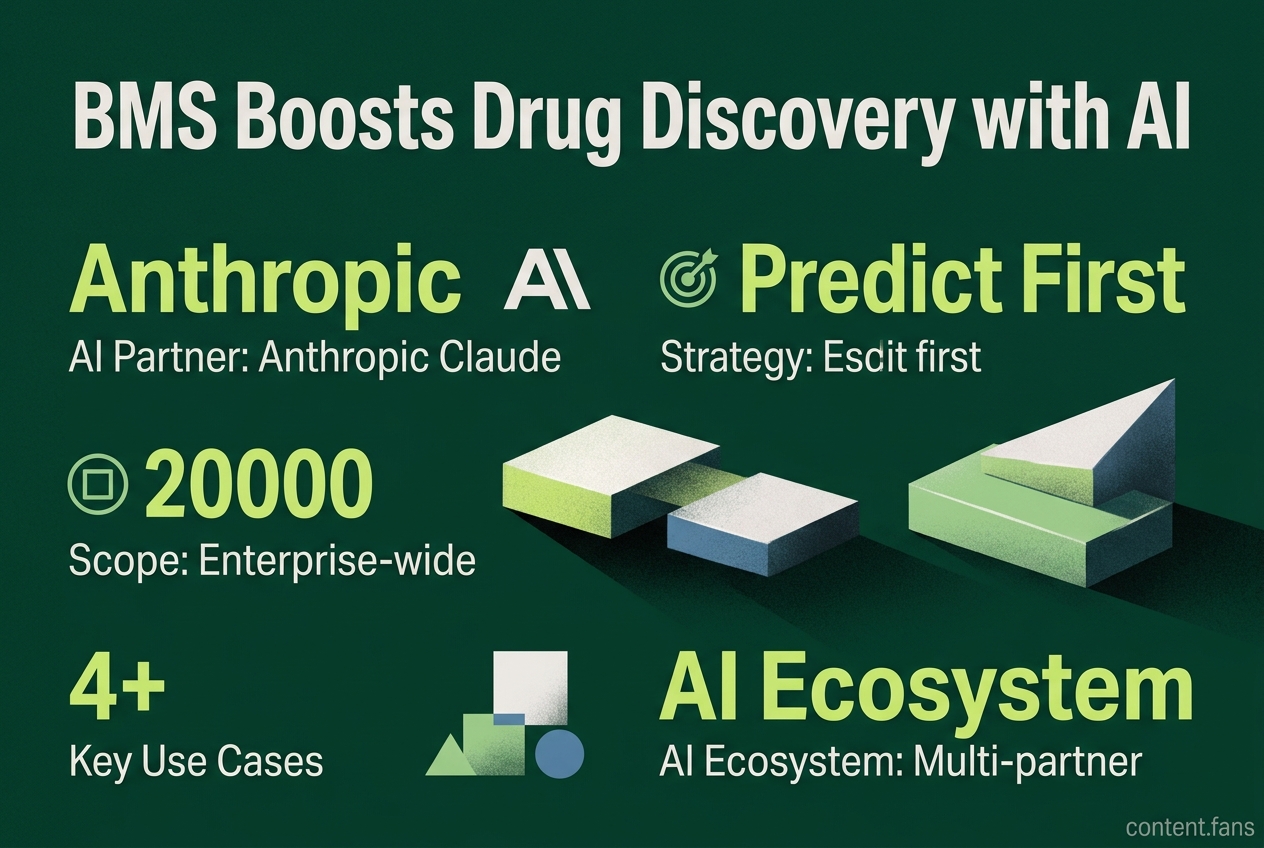
Bristol Myers Squibb has started using Anthropic's Claude AI to help develop new drugs, from early research to regulatory tasks. The company uses a "predict first" approach, where ideas are tested using AI before lab work begins. Claude may help with summarizing research, writing reports, and supporting safety and regulatory documents. BMS is also working with other AI partners, like Tempus and Evinova, to improve different parts of drug discovery and trials. Experts say AI tools might speed up early research, but it is still unclear if this will lead to more drugs getting approved.

Bristol Myers Squibb is expanding its AI drug discovery capabilities through a strategic partnership with Anthropic. The agreement provides BMS enterprise-wide access to the Claude AI model for applications spanning the entire drug development lifecycle, from early research to regulatory submissions. This analysis explores the deal's role in BMS's "predict first" strategy and its broader AI ecosystem.
A "predict first" pipeline
Bristol Myers Squibb is integrating Anthropic's Claude AI across its R&D and operational functions. The model will accelerate drug development by automating literature analysis, hypothesis generation, and the drafting of clinical and regulatory documents, reinforcing the company's "predict first" approach to pharmaceutical innovation.
BMS's R&D philosophy is rooted in a "predict-first" mindset: validating ideas computationally before committing to lab-based chemistry. The company is pursuing the goal of becoming "the first truly predictive biopharmaceutical company" by using AI for target prioritization, virtual screening, and mechanistic modeling Science Firsthand. Internal teams use machine learning to optimize modality-to-mechanism matching, identify patient subgroups, and shorten decision-making cycles.
What the Anthropic agreement covers
This partnership deploys Claude as an intelligence layer across research, clinical, manufacturing, and commercial operations. According to an HLTH report, initial use cases include:
- Literature synthesis for oncology, neuroscience, hematology and immunology programs
- Drafting clinical study reports and patient safety narratives
- Automating root-cause investigations and Corrective and Preventive Action documentation
- Supporting regulatory submissions and medical-affairs communications
This strategy positions Claude as more than a chatbot, embedding it as a guided agent within validated workflows to enhance productivity and compliance.
Complementary AI tie-ups
BMS strategically maintains a multi-partner AI ecosystem to address different pipeline challenges. A collaboration with Tempus leverages multimodal real-world data to improve the Probability of Technical and Regulatory Success in key clinical trials Tempus release. Concurrently, Applied Clinical Trials reports that BMS is adopting Evinova's Study Designer platform to optimize global trial protocols and reduce cycle times. Together, these alliances provide generative reasoning (Claude), large-scale patient data (Tempus), and operational efficiency (Evinova).
What this may mean for timelines
Industry experts concur that AI tools are accelerating drug discovery. According to the World Economic Forum, AI makes "identifying disease targets, generating new compounds and predicting safety" significantly faster. Some early discovery phases have been reduced from years to months. However, whether this speed translates into higher clinical success rates is still an open question. Industry reports suggest that many AI-originated molecules are still progressing through clinical trials, highlighting the ongoing evaluation of AI's impact on final regulatory success.
BMS's AI landscape
BMS is actively blending internal data science with external platforms, creating a hybrid intelligence model that embeds predictive analytics throughout the drug development process. The company's partnerships span multiple areas:
- Anthropic: Generative reasoning and document automation across research to commercial operations
- Tempus: Real-world data analysis and clinical trial design
- Evinova: AI-native study design for global trials
- Internal ML teams: Target ranking and molecule design in discovery
What is the scope of BMS's partnership with Anthropic's Claude?
Bristol Myers Squibb is embedding Claude as an enterprise-wide intelligence layer across research, manufacturing, regulatory, and commercial functions. Initial focus areas include literature synthesis, target identification, clinical-protocol drafting, and manufacturing root-cause investigations. The collaboration goes beyond narrow drug-discovery pilots and is intended to compress cycle times from idea through regulatory filing.
How does this deal fit into BMS's broader AI strategy?
The Anthropic agreement is one pillar of a "predict first" roadmap that BMS has been developing in recent years. Internally the company trains models for virtual screening, patient stratification, and trial modelling, while external alliances with Tempus (real-world data for PTRS) and Evinova (AI-native trial design) cover adjacent stages of the pipeline. Claude now supplies the natural-language reasoning bridge that links these point solutions into a single workflow.
Which tasks will Claude handle first inside BMS?
Priority use-cases disclosed by HLTH and BioPharma Dive include:
- Automated literature reviews across PubMed, bioRxiv, and internal repositories
- Hypothesis generation for oncology, neuroscience, hematology, and immunology programs
- Drafting clinical study reports, patient safety narratives, and regulatory submissions
- Manufacturing CAPA documentation and batch-release decision support
These areas were chosen because they are text-heavy, repeat frequently, and have measurable turnaround-time KPIs.
Are other pharma companies adopting Claude, or is BMS an isolated case?
Industry reports suggest that Claude is being positioned as a cross-company scientific reasoning layer with growing adoption across the pharmaceutical sector. While BMS is among the first major pharma companies to announce an enterprise licence, sandbox deployments have been reported in mid-sized biotechs and CROs, especially for protocol authoring and single-cell data QC. Analysts at Pharmaceutical Executive describe the shift as "from chatbots to auditable agentic systems," implying wider adoption is imminent.
What measurable impact can the industry expect on timelines and success rates?
According to industry reports, generative AI is significantly trimming early discovery timelines in data-rich programs, with many lead-optimization cycles showing substantial improvements. However, a growing number of industry analyses note that AI-originated molecules are still progressing through clinical trials, so the effect on overall clinical success rates remains unproven. Bottom line: expect faster, better-informed go/no-go decisions, but final Phase III attrition is unlikely to change until datasets mature and regulatory precedents accumulate.