
CISA orders agencies to patch critical Cisco SD-WAN flaw by May 17
Serge Bulaev
CISA has ordered federal agencies to fix a critical security flaw in Cisco SD-WAN systems by May 17. This flaw, which has the highest possible severity score, may let attackers gain control of important network parts without logging in. Security officials say attacks started in mid-2026 and are still happening. Some experts suggest the problem could affect more organizations than first thought, and the group behind the attacks has not been linked to any country. CISA also recommends several steps to secure the systems and check for signs of past attacks.
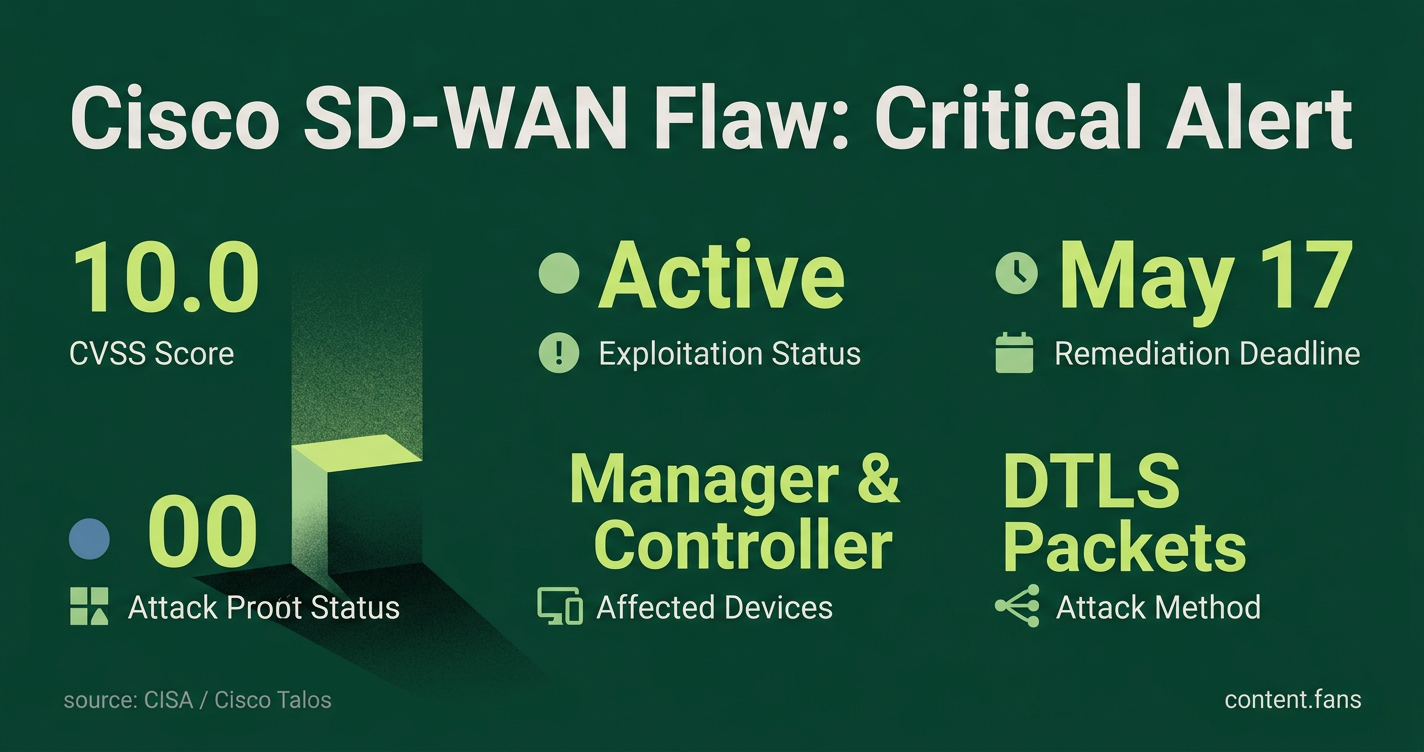
Following confirmation of active exploitation, CISA orders agencies to patch a critical Cisco SD-WAN flaw (CVE-2026-20182) that could allow unauthenticated attackers to gain complete control of network devices. The vulnerability carries the maximum CVSS score of 10.0 and affects Cisco Catalyst SD-WAN Manager and Controller, which are central components for orchestrating network traffic. According to Cisco's Talos unit, an attacker can gain administrative access by abusing the peering authentication mechanism Cisco Talos.
Active exploitation was reported as ongoing by May 2026, and Cisco/Talos linked some exploitation activity in the campaign to as early as 2023. In response, CISA added CVE-2026-20182 to its Known Exploited Vulnerabilities (KEV) catalog on May 14, 2026, setting a May 17 remediation deadline for Federal Civilian Executive Branch agencies Halo Security.
The directive's urgency stems from the central role of SD-WAN controllers, where a single compromise at the control plane can cascade across an entire network of connected branches.
How attackers gain control
Attackers exploit CVE-2026-20182 by sending specially crafted DTLS packets to UDP port 12346 on a vulnerable Cisco Catalyst SD-WAN device. A remote attacker can exploit the flaw via a crafted DTLS handshake on UDP 12346 to bypass authentication and become a trusted peer; subsequent privileged access may then be achieved, but not necessarily instantly from one packet/handshake alone.
Investigations by Cisco's Talos unit show the threat actor, tracked as UAT-8616, first bypasses authentication before using NETCONF to alter fabric settings or inject unauthorized SSH keys for persistence. According to Rapid7, these crafted DTLS packets allow the attacker to run privileged commands. Talos also observed attempts to escalate privileges to root by adding keys and modifying configurations.
Federal response and hardening steps
CISA's Emergency Directive 26-03 outlines a mandatory three-step process for federal agencies: inventory all SD-WAN assets, capture forensic images before patching, and centralize logs in a SIEM. The directive specifies that logs from /opt, /var, and /home directories, along with core dumps, must be preserved. It also mandates isolating management interfaces from untrusted networks. After patching, administrators must implement the following hardening measures:
- set client, server, and CLI inactivity timeouts to five minutes
- enable DTLS encryption between Manager and Controller
- use SNMPv3 exclusively
- enforce pairwise key encryption on the data plane
- monitor for anomalous peering or unexpected root logins
The guidance also directs security teams to verify successful patch application and confirm that previously exposed services are no longer accessible.
Ongoing risk factors
While intelligence agencies describe the perpetrator as an advanced threat actor, no official nation-state attribution has been made. The risk to other organizations remains high due to the public availability of proof-of-concept (PoC) code and the strategic importance of SD-WAN controllers. According to industry reports, security teams have found suspicious authentication events in historical logs, suggesting the attack campaign may be more widespread than initially known.
What exactly is CVE-2026-20182 and why did it earn a CVSS 10.0?
According to security advisories, CVE-2026-20182 is an unauthenticated authentication bypass in the peering logic of Cisco Catalyst SD-WAN Controller and Manager. An attacker can send a crafted DTLS handshake on UDP port 12346 to bypass authentication and become a trusted peer, with subsequent privileged access potentially achievable. Cisco and NVD rate it 10.0/10 because no user interaction, no credentials, and no local access are required for full administrative control of the SD-WAN fabric.
How do we know active exploitation is really happening?
- Cisco Talos confirms "ongoing, in-the-wild exploitation" and tracks the activity under threat actor UAT-8616.
- Security researchers observe multiple independent clusters weaponizing the flaw within days of disclosure.
- CISA added the CVE to the Known Exploited Vulnerabilities catalog on 14 May 2026, citing evidence of compromise and giving agencies a short timeframe to patch.
What can an attacker do once inside?
With the initial bypass the intruder becomes a trusted peer inside the control plane. From there the observed playbook includes:
- Injecting attacker-controlled SSH public keys for durable back-door access.
- Using NETCONF to alter routing policies, redirect traffic, or black-hole critical subnets.
- According to industry reports, potentially rolling software back to an older release to exploit additional vulnerabilities for root privileges, then restoring the current version to erase forensic artifacts.
- Establishing long-term persistence that survives reboots and ordinary log reviews.
What is the federal fix deadline and who must act?
CISA Emergency Directive 26-03 mandates that all Federal Civilian Executive Branch agencies:
- Cisco and partner advisories recommend identifying affected Cisco Catalyst SD-WAN Controller/Manager instances, especially internet-exposed management/control planes.
- Capture forensic snapshots (/opt, /var, /home, core dumps, external syslogs) before patching.
- Apply Cisco's fixed software no later than 17 May 2026.
- Confirm management interfaces are no longer exposed to untrusted networks and submit completion reports to CISA.
Critical-infrastructure operators are strongly urged to follow the same timeline, though not legally bound by the directive.
What monitoring steps should remain in place after the patch?
Patching closes the door but does not evict an existing foothold. CISA's post-patch checklist recommends:
- Centralize SD-WAN logs in an external SIEM and alert on:
- Anomalous peering events
- Successful root or "internal" account logins
- NETCONF sessions outside change windows
- Hunt for:
- Unexpected SSH keys in authorized_keys files
- Modified init scripts or web-shells under /opt/web-app
- Configuration drift produced by downgrades/upgrades
- Harden settings:
- Cap inactivity timeouts at five minutes
- Force DTLS encryption on Manager links
- Replace SNMP v1/v2c with SNMPv3
- Deploy pairwise keys between controllers and edge routers