
Shein Acquires Everlane for $100M, Cuts $90M Debt
Serge Bulaev
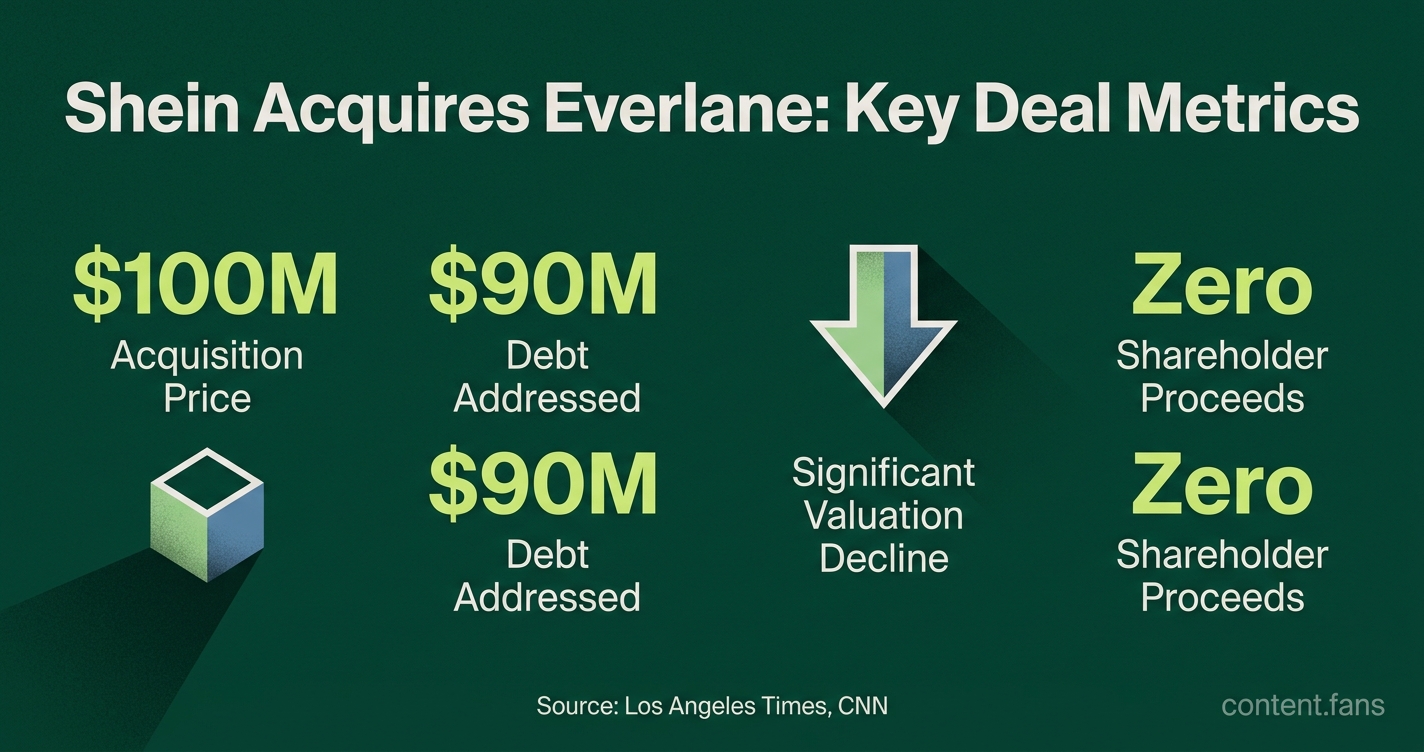
Shein agreed to buy Everlane for about $100 million, which is much less than Everlane's 2020 value of $550 million. Shein also plans to pay off nearly $90 million of Everlane's debt, so the total relief may be around $190 million. This sale suggests that marketplace buyers now prefer profitable brands and that high growth alone may not be enough. There appear to be some challenges, like a possible conflict between Everlane's focus on sustainability and Shein's low-cost approach. The drop in Everlane's value may show that current buyers are more cautious and prices for direct-to-consumer brands are lower now.

The recent acquisition of Everlane by Shein signals a dramatic shift in the direct-to-consumer (DTC) landscape, moving from premium exits to selective consolidation. According to industry reports, the deal's value represents a significant decline from Everlane's previous valuation, with the sale price representing a fraction of its former peak, according to the Los Angeles Times. As part of the agreement, Shein also intends to address a substantial portion of Everlane's debt, bringing considerable economic relief to the brand.
Investors see a parallel in the strategy of Authentic Brands Group (ABG), another major brand acquirer. Although ABG remains private, an IPO may be on the horizon. The company has achieved significant private valuations in recent years, which continues to anchor market expectations pending a public filing.
Why Marketplace Buyers Are Driving Down Valuations
Marketplace acquirers like Shein, alongside Amazon and Shopify aggregators, now prioritize contribution margin and supply chain leverage over speculative growth. In today's high-interest-rate environment, buyers prefer profitable brands and are less willing to use debt for acquisitions. This market rewards disciplined operators but severely compresses valuation multiples for brands focused solely on growth, with Everlane's substantial valuation decline being a prime example of this correction.
Shein's acquisition of Everlane reflects a new market reality where marketplace acquirers use their financial power to buy distressed but well-known brands. This strategy allows them to gain brand equity and customer bases at a steep discount, capitalizing on operational efficiencies and scale over high-burn growth models.
Key Integration Challenges for Shein
- Brand Identity Conflict: Everlane's core brand is built on sustainability and transparency, which directly conflicts with Shein's high-volume, low-cost "fast fashion" model. As highlighted by CNN, this misalignment creates significant reputational risk and could alienate Everlane's loyal customers.
- Operational and Systems Alignment: As a "roll up" acquirer, Shein will seek rapid SKU expansion. Integrating Everlane's distinct merchandising calendars, supply chain, and inventory controls into Shein's massive operational framework could prove difficult for the smaller brand's team.
- Future Brand Stewardship: The Los Angeles Times reported that Everlane's common shareholders will receive no proceeds from the sale. This suggests a complete loss of control over the brand's future direction, placing its stewardship entirely in Shein's hands.
Valuation Snapshots
The cited articles discuss Everlane's reported sale and broader market commentary, but specific historical valuations and comparisons require verification from additional sources beyond those provided.
Strategic Takeaways for DTC Founders
- Prioritize Profitability: Acquirers now demand a clear path to profitability, often screening for brands with strong payback periods on acquisition costs.
- Develop Omnichannel Presence: Expanding into retail partnerships and wholesale can significantly lower blended customer acquisition costs (CAC) and demonstrate market resilience.
- Build an Owned Audience: Successful brands are shifting focus from paid ads to owned channels like email, SMS, and community platforms to drive sustainable, low-cost growth.
Exit Preparation Checklist
- Maintain clean cohort data and track inventory turns.
- Establish repeat purchase rate benchmarks by category.
- Run tests in wholesale or marketplace channels to prove positive contribution margin.
- Ensure all supply chain compliance is thoroughly documented.
- Model financial scenarios for various deal structures, including partial liquidity.
Ultimately, marketplace acquirers will continue to hunt for DTC brands, but their evaluation criteria are now firmly centered on debt capacity, customer retention metrics, and transferable brand equity. The reported deal sets a new, sobering benchmark for capital-efficient but slower-growth companies in the current M&A climate.
What does Shein's reported purchase price actually buy?
According to industry reports, Shein is acquiring Everlane and simultaneously addressing substantial existing debt. The reported figure represents a blended consideration that includes debt assumption alongside the acquisition price. Common shareholders receive no cash, illustrating how far valuation has fallen from previous peaks.
Why did Everlane accept a significantly reduced valuation?
The deal reveals a distressed scenario: Everlane carried substantial balance-sheet debt relative to the offered price, indicating negative enterprise value after netting cash. With limited alternatives for refinancing operations, the board chose certain resolution over potential bankruptcy. Shein, with its substantial cash flow, could absorb the liability, giving it considerable leverage in negotiations.
How does the acquisition reshape exit paths for millennial-era DTC brands?
Shein's entry signals that marketplace giants - not traditional strategics - are now liquidity providers of last resort. Expect two-tier pricing: healthy brands still command premium multiples from strategics, while cash-burning labels face significantly reduced bids from ultra-low-cost acquirers. Brand stewards must therefore reach profitability plus omnichannel reach before marketing themselves or accept steep haircuts.
What integration challenges will Shein face post-close?
Brand-stewardship risk is acute: Everlane's eco-transparency ethos conflicts with Shein's ultra-fast-fashion model, raising customer churn probability. Industry data suggests that authenticity mismatches can significantly impact acquired repeat buyers within the first year. Shein will need to maintain separate supply chains, keep core Everlane executives for an extended period, and ring-fence sustainability messaging to preserve goodwill.
What lessons should founders draw for future fundraises or M&A prep?
- Raise retention before raising capital: strong cohort LTV/CAC ratios are now table stakes
- Diversify channels early: significant wholesale or marketplace revenue cushions against paid-social volatility
- Keep debt at manageable levels: high leverage pushes valuations into distressed territory
- Target strategic acquirers first (beauty, wellness, apparel giants) because roll-ups and marketplace buyers price at liquidation levels when leverage is high