
SpaceX files S-1 for $75B raise, targets $1.75T valuation
Serge Bulaev
SpaceX has filed an S-1 document for its planned IPO, aiming to raise up to $75 billion and possibly reach a valuation of $1.75 trillion, with some reports suggesting it could be as high as $2 trillion. The filing describes big goals, like making life multi-planetary and possibly using satellites for artificial intelligence powered by solar energy. Some analysts say reaching the target valuation may require very high growth over many years and call the price demanding. The company's main sources of revenue appear to be launch services and Starlink, with future plans involving AI technology in space. Details about share pricing are not final yet, and SpaceX may update the filing as market conditions change.

SpaceX's S-1 filing details its IPO plan to raise up to $75 billion, targeting a landmark valuation between $1.75 trillion and $2 trillion. The registration, which appeared on the SEC's EDGAR system, does not yet include share count or pricing. The filing is considered an early draft, and Bloomberg reported the upper end of valuation expectations could reach $2 trillion link.
The prospectus positions SpaceX as a vertically integrated company combining launch services, Starlink broadband, and a future AI infrastructure platform, all in service of its mission to make life multi-planetary.
What the S-1 says about the mission
The SpaceX S-1 filing outlines the financial details of its planned initial public offering, including a target capital raise of $75 billion and a valuation goal of $1.75 trillion. It also details the company's core mission, revenue drivers like Starlink, and future growth plans involving space-based AI.
The filing states a core objective "to build the systems and technologies necessary to make life multi-planetary." It also reportedly includes a plan "to harness the sun to power a truth-seeking artificial intelligence," though this latter phrase has been attributed to secondary analysis rather than directly confirmed from the text.
Key financial figures
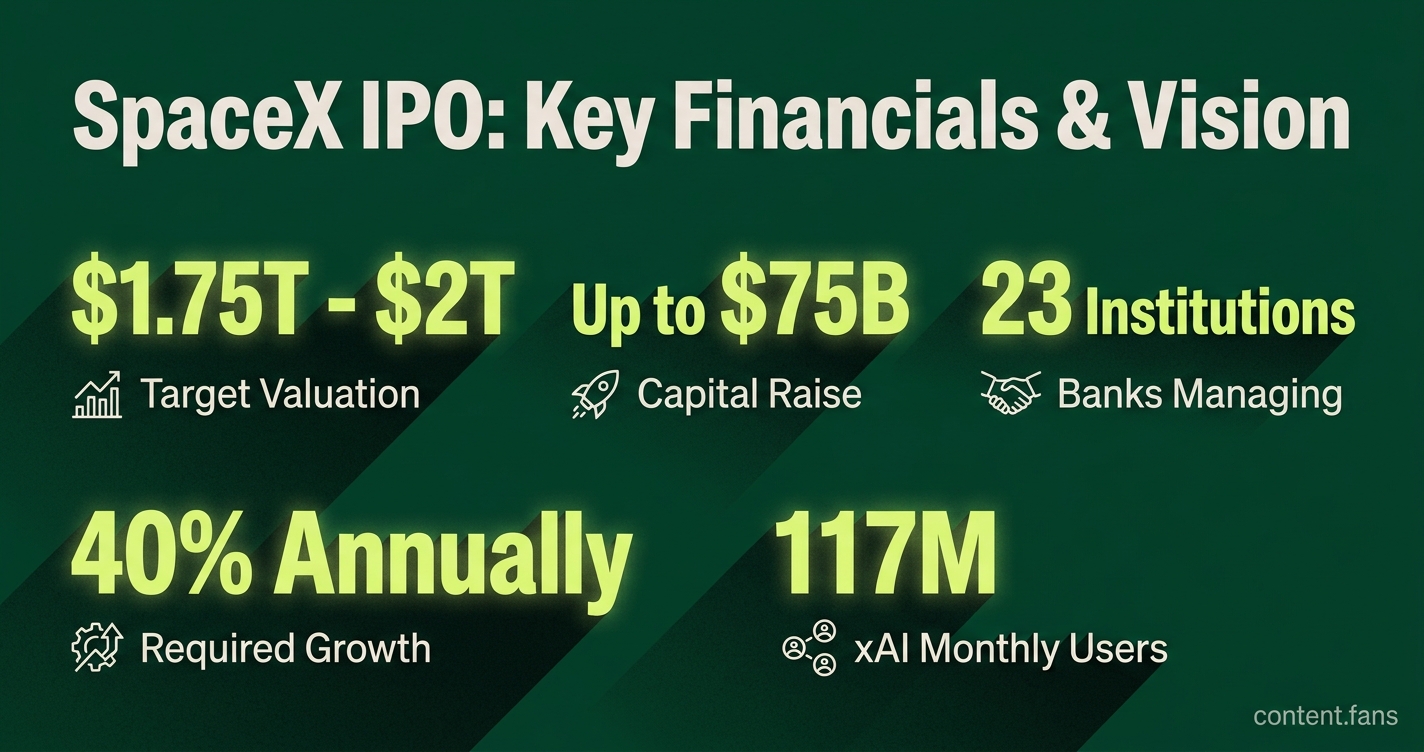
- Proposed Capital Raise: Up to $75 billion, as per the SEC registration.
- Target Valuation: Approximately $1.75 trillion, with reports suggesting a ceiling of $2 trillion.
- Bank Syndicate: 23 institutions led by Goldman Sachs are reportedly managing the offer.
Analysts note this valuation equates to a demanding forward revenue multiple of nearly 61x projected 2026 revenue ($28.5 billion). Justifying this price would require sustained annual growth of around 40% for ten years.
Starlink and xAI in the growth story
The S-1 identifies Starlink and launch services as current primary revenue streams but frames future growth around a "next trillion-dollar market" in AI compute built on orbital infrastructure. This plan is linked to xAI's Grok model, which had a reported 117 million monthly active users by March 2026. The filing suggests deploying large-scale, space-based compute clusters to reduce dependence on Earth's power and cooling resources.
Valuation debate
While some analysts argue the $1.75 trillion valuation "rests on Musk imagination," others believe investors will be enticed by the company's scarcity value. The combination of Starlink's subscriber growth and the potential of orbital AI hardware may convince investors to prioritize long-term optionality over near-term cash flow.
What happens next
SpaceX is expected to amend the S-1 with specific pricing details once market conditions are favorable. In the interim, the filing offers an unprecedented view into the company's revenue streams, risk factors, and strategic ambitions, allowing the market to begin its assessment.
How much is SpaceX trying to raise and at what valuation?
The S-1 registration statement shows a $75 billion primary raise and a targeted $1.75 trillion post-money valuation, a figure that would make the offering the largest public debut in history. Analysts note the number equates to roughly 61× forward revenue for the combined launch, Starlink and AI businesses.
What does "making life multi-planetary" actually mean in the filing?
The document opens with the line:
"Our mission is to build the systems and technologies necessary to make life multi-planetary."
Management spells out three concrete pillars:
- Starship as a reusable Mars-transport system
- Starlink cash flow to fund deep-space R&D
- Orbital solar power and data centers to support off-Earth settlements
Why is an AI company inside a rocket maker?
SpaceX tells investors it will "harness the sun to power a truth-seeking artificial intelligence" by placing compute payloads in space, where solar energy is uninterrupted and cooling is passive. The filing argues this gives the Grok family of models a cost-per-watt advantage over earthbound hyperscalers and creates a new trillion-dollar market for space-based AI compute.
How big are Starlink and Grok today?
- Starlink serves 5.6 million active subscribers and generated $12.7 billion in 2025 revenue, a 62 % year-over-year jump
- Grok reached 117 million monthly active users within 18 months of launch and is now default-search inside the X platform, which adds 350 million fresh posts daily to its training corpus
What risks does the S-1 highlight?
Beyond launch failures and regulatory delays, the company warns:
- Valuation depends on "investor willingness to price long-duration optionality"
- 40 % annual revenue growth for a decade would be required to justify the multiple under conventional DCF models
- Musk control risk - no dual-class shares, but the CEO's time is split among five companies and his personal brand is considered a material asset