
Sierra Raises $950M for AI Customer Support, Hits $15.8B Valuation
Serge Bulaev
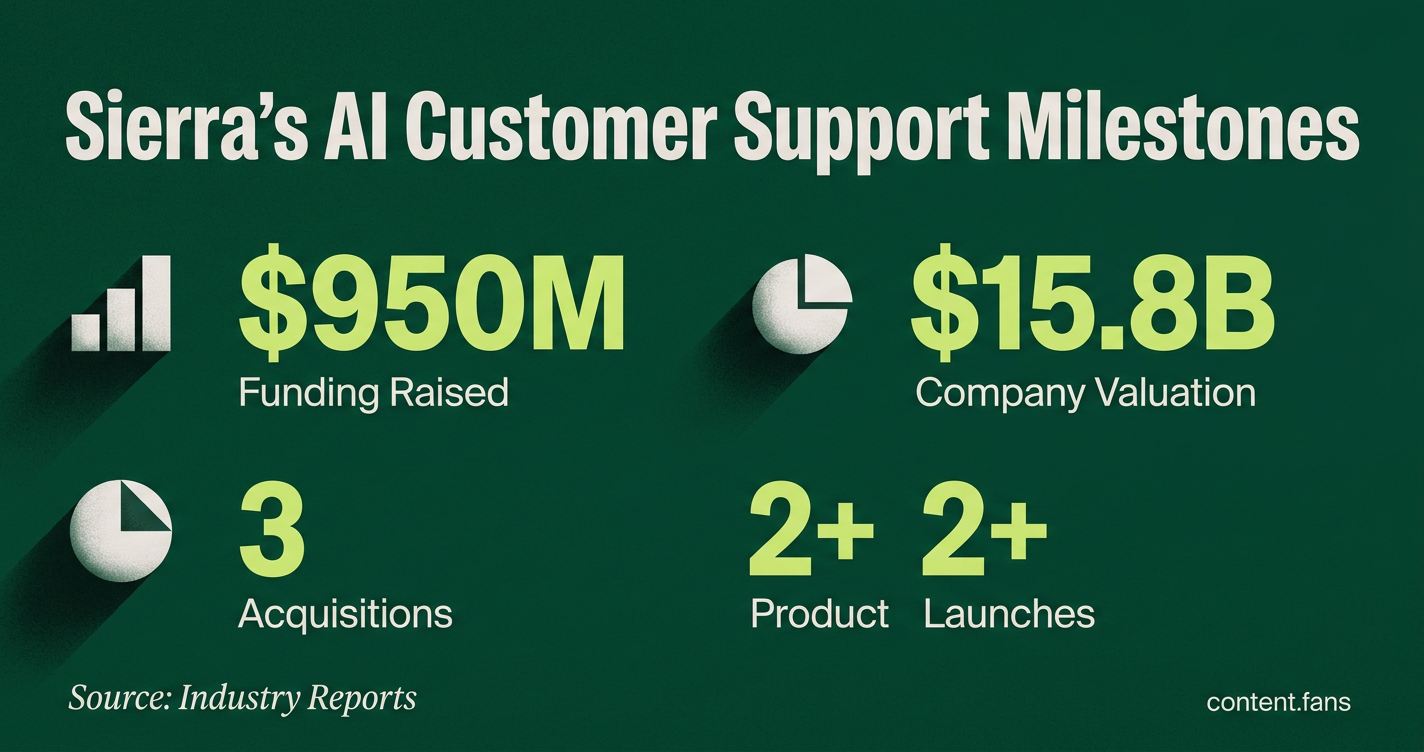
Sierra has raised $950 million, giving it a $15.8 billion valuation, with investors like Tiger Global and GV leading the round. The company says that more businesses now use its voice support than chat, as firms want natural phone conversations that solve issues quickly. Sierra may use the new funds to add more languages, grow to new regions, and improve its technology. The company has made several product updates and small acquisitions, and it appears its platform can handle complex tasks and "billions of customer interactions." Sierra has not shared revenue details, and future growth might depend on customer needs and regulatory approval.

AI customer support platform Sierra has secured substantial new funding according to industry reports, highlighting strong investor confidence in advanced, voice-first enterprise AI solutions.
This latest capital injection comes after an extended period of accelerated product development, during which Sierra has reportedly seen growing adoption of its voice support capabilities. The company credits this shift to a growing enterprise demand for natural, efficient conversational AI that can resolve customer issues over the phone.
How Sierra Will Use The New Funding
According to industry reports, this significant funding round positions Sierra to expand its AI customer support platform globally. The capital will enhance its voice-native technology, support more languages, and deepen integrations, fueling its mission to automate complex enterprise-level customer service workflows.
CEO Bret Taylor highlighted the platform's growing sophistication, noting that Sierra agents can now autonomously phone each other to coordinate complex workflows. The financing validates its capacity to handle substantial customer interactions across industries, as confirmed in a recent Pulse2 report.
Recent Product and Technology Milestones
In the past year, Sierra's engineering team has reportedly launched several key voice-centric features:
- Ghostwriter: An innovative tool that automatically converts standard operating procedures (SOPs), call transcripts, and even whiteboard photos into fully functional AI agents for voice, chat, and email.
- PCI-Compliant Payments: The platform now integrates secure payment processing directly into voice support calls, a critical feature for e-commerce and financial services.
Strategic Acquisitions Fueling Global Expansion
According to industry reports, Sierra has executed targeted acquisitions to accelerate its global roadmap and enhance its technology stack:
- Receptive AI: Bolstered the platform's native voice capabilities.
- Opera Tech: Established a key presence in Tokyo for expansion into the Asia-Pacific market.
- Fragment: Expanded its European engineering talent and capacity.
These acquisitions directly support Sierra's multi-region strategy, as detailed in a Voiceflow summary.
Sierra's Competitive Edge in the AI Market
Unlike single-purpose voice bots, Sierra markets itself as a comprehensive orchestrator of multiple, coordinated AI agents. While its deployment time is longer than some niche competitors like CallBotics, customers choose Sierra for its deep reasoning capabilities and robust integrations with enterprise systems such as Salesforce, Zendesk, and SAP.
Investor Confidence and Market Opportunity
Tiger Global's investment aligns with its recent strategy of making larger, more concentrated bets on proven AI infrastructure companies. Sierra's established footprint within major enterprises and its advanced feature set meet this high bar. The participation of GV (Google Ventures) suggests potential synergies with Google's extensive cloud and AI speech services, though this remains unconfirmed.
Future Outlook and Market Impact
While Sierra has not disclosed specific revenue figures, its valuation is supported by a massive market opportunity. Industry analysts suggest that AI adoption could significantly reduce contact center labor costs in the coming years. As Sierra moves toward a full multi-channel, multi-region offering, its growth trajectory will depend on continued enterprise demand and navigating global regulatory landscapes.
What exactly did Sierra announce and who led the round?
According to industry reports, Sierra has closed a significant Series raise that lifts the company to a substantial valuation. The round was reportedly led by Tiger Global and GV (Google Ventures) and was publicly referenced by CEO Bret Taylor at the Cerebral Valley Voice Summit in San Francisco.
Why are investors willing to price Sierra highly?
The figure reflects rapid commercial traction: the company reportedly powers substantial customer interactions for a significant portion of major enterprises, and enterprise demand for voice-first support is projected to generate substantial cost savings, according to industry analysts.
How is Sierra different from other AI customer-support tools?
Sierra's stack is reportedly voice-native by default:
- inbound/outbound phone agents that integrate directly with existing IVR systems
- multiple languages with real-time language switching
- PCI-compliant payment processing built in
- a simulator called Voice Sims lets enterprises stress-test agents against background noise, interruptions, and emotional callers before going live.
What product launches accompanied the fund-raise?
Two headline features reportedly shipped recently:
1. Ghostwriter - describe an agent in plain English or upload call transcripts and it returns a production-ready voice agent within hours.
2. Voice Sims expansion - adds benchmarking capabilities so teams can measure voice-specific accuracy and empathy scores before deployment.
How will the new capital be used?
According to reports, the funds will scale multi-agent orchestration for complex support journeys, extend proactive engagement (for example, outbound retention calls triggered by churn-risk models), and fuel international expansion through strategic acquisitions including Receptive AI, Opera Tech (Japan), and Fragment (France).