
Anthropic Unveils Claude Managed Agents, Bundles AI Stack for Enterprises
Serge Bulaev
Anthropic introduced Claude Managed Agents, a bundled AI platform that combines model, harness, and compute into one package. This approach may allow faster deployment of smart agents, but some companies worry it could cause lock-in and make switching vendors hard. The new system offers features like splitting tasks between sub-agents, agents rewriting their own memory, and automatic goal-tracking. Reports suggest usage of Claude's tools has grown rapidly, though many businesses still use a mix of managed and self-hosted solutions to stay flexible. It appears that while the bundled platform is popular, concerns about portability and dependence on one provider remain.

Anthropic has officially launched Claude Managed Agents, an enterprise AI platform that bundles its model, orchestration harness, and compute into a single, integrated package. This approach is designed for rapid deployment of intelligent agents, but it also raises significant enterprise concerns about vendor lock-in, data portability, and the long-term costs of switching providers.
Anthropic's Managed Agents in Practice
Claude Managed Agents offer a fully integrated AI stack, combining the Claude model, a proprietary orchestration harness, and managed compute. This bundled service enables enterprises to deploy stateful AI agents rapidly by removing infrastructure overhead, though it centralizes control within Anthropic's ecosystem, which can impact future portability.
At the Code With Claude developer conference held in San Francisco where CEO Dario Amodei announced Q1 results, Anthropic detailed three core platform capabilities. According to industry reports, the system features Multi-agent Orchestration, which allows a primary agent to assign complex tasks to parallel sub-agents. It also includes a "Dreaming" capability, a compound-engineering loop where agents iteratively rewrite their own memory. Finally, the "Outcomes" feature lets developers define success criteria, enabling agents to iterate autonomously until a goal is met.
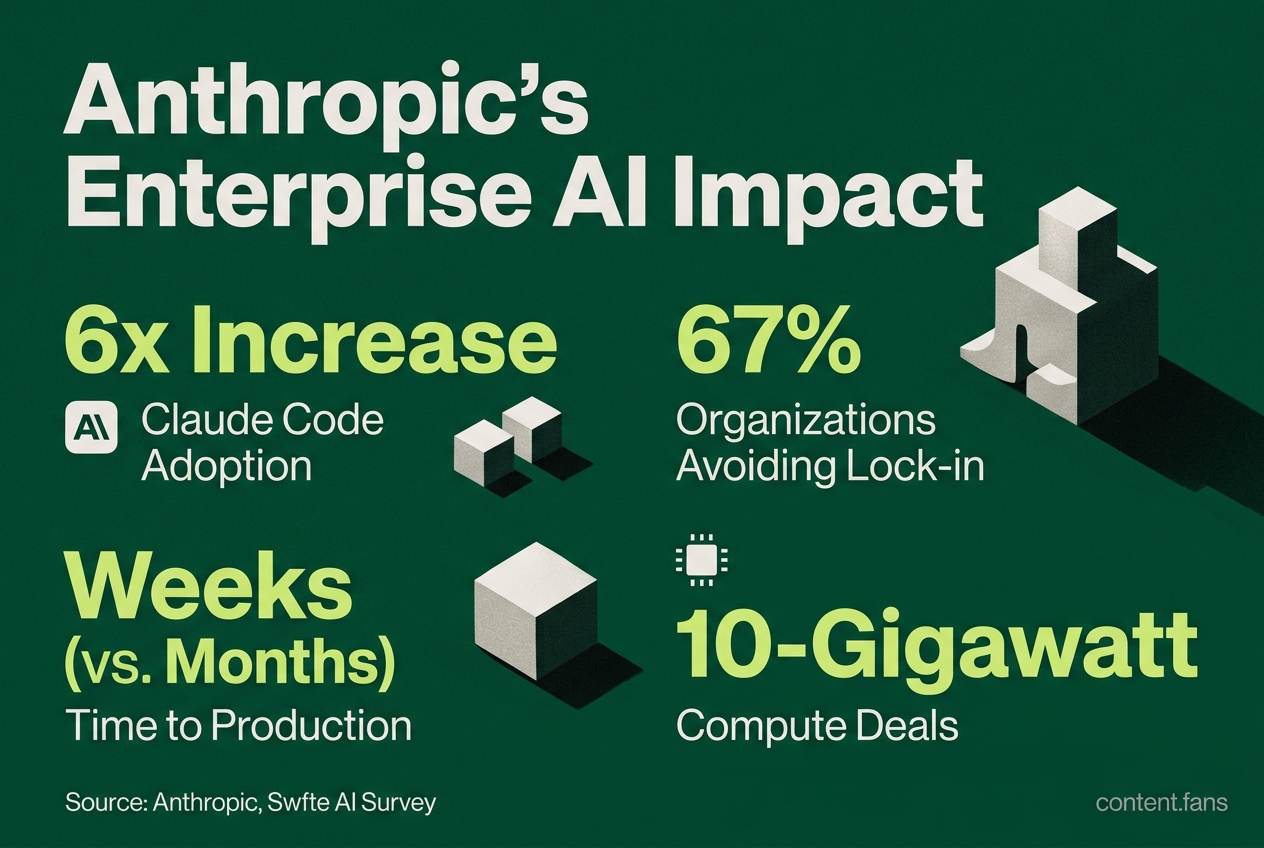
This launch is supported by impressive growth metrics: API traffic for Claude has reportedly grown significantly year-over-year, and enterprise adoption of Claude Code has increased sixfold according to JetBrains survey data. Anthropic announced it would utilize full compute power of xAI's Colossus 1 data center in Memphis within coming month; also signed 10-gigawatt deals with Amazon and Google.
Value Proposition and Emerging Friction Points
The primary value proposition of the integrated stack is simplification. It handles secure hosting, tool authentication through Multi-Channel Protocols, and autoscaling, empowering developers to move from proof-of-concept to production in weeks instead of months.
However, enterprise architects and industry analysts consistently highlight several critical friction points:
- Control-plane lock-in: Proprietary runtimes manage agent memory and permissions, making migration difficult.
- Behavioral lock-in: Agent memories are not designed to be exported, tying workflows to the platform.
- Re-implementation costs: Migrating to a different LLM vendor in the future could require a complete architectural rebuild.
A recent Swfte AI survey indicates that 67 percent of organizations actively seek to avoid dependence on a single AI provider. This aligns with Kai Waehner's April 2026 landscape report, which notes that the most trusted vendors often have the highest switching costs.
Integrated vs. Self-Hosted Approaches
Analysis from firms like Instaclustr and Pocketclaw reveals two competing architectural approaches in the market:
| Dimension | Integrated stack | Self-hosted, model-agnostic |
|---|---|---|
| Deployment | Cloud SaaS, vendor tools | Containers or air-gapped infra |
| Model choice | Tied or partially agnostic | Fully agnostic via Ollama, etc. |
| Governance | Built-in audit trails | Customer-defined controls |
| Setup effort | Low | Higher DevOps load |
According to industry reports, a significant portion of companies exploring coding agents use at least one self-hosted instance. This suggests a prevailing hybrid strategy: leveraging managed agents for speed on general tasks while keeping sensitive workflows on-premises for greater control.
Metrics and Next Checkpoints
With follow-up events scheduled for London on May 19 and Tokyo on June 10, industry analysts will be closely monitoring 90-day adoption figures. If the sixfold year-over-year growth for Claude Code continues, it would signal strong market resonance for the bundled model-harness-host design, despite persistent concerns over portability.