
France Investigates X Over Grok AI Deepfakes, Raids Offices
Serge Bulaev
French prosecutors are investigating X after reports that thousands of sexually explicit deepfakes made with Grok AI appeared in January 2026. Paris police reportedly raided the company's offices in February as part of the probe. The case shows that quick detection, legal help for victims, and strong platform safeguards are now needed. Experts say no single tool is perfect, so using several methods together may be best. New laws and rules in France, the US, EU, and China suggest legal and technical standards for AI-generated content may keep getting stricter.

As France investigates X over Grok AI deepfakes, the case highlights the urgent need for robust detection and legal frameworks. French prosecutors are probing X after allegations of sexually explicit deepfakes, triggering an inquiry based on Article 226-8-1 of the French Penal Code. Authorities reportedly raided X's Paris offices in February, as confirmed by Business & Human Rights.
This high-profile investigation underscores a critical framework for combating AI-generated threats, built on three essential pillars: rapid forensic detection, accessible legal recourse for victims, and stringent platform-level safety protocols.
Forensic Red Flags to Spot Deepfakes
Identifying deepfakes involves a combination of AI detection tools and manual verification. Automated platforms offer rapid analysis, while manual checks focus on subtle forensic clues, including unnatural eye movements, audio artifacts, inconsistent lighting, and missing or altered image metadata, to confirm a file's authenticity.
While AI detection tools provide rapid initial analysis, manual verification remains crucial. For deeper forensics, Sensity AI offers detailed reports. A layered workflow is recommended: perform a quick scan with an automated tool, followed by manual inspection of key forensic red flags:
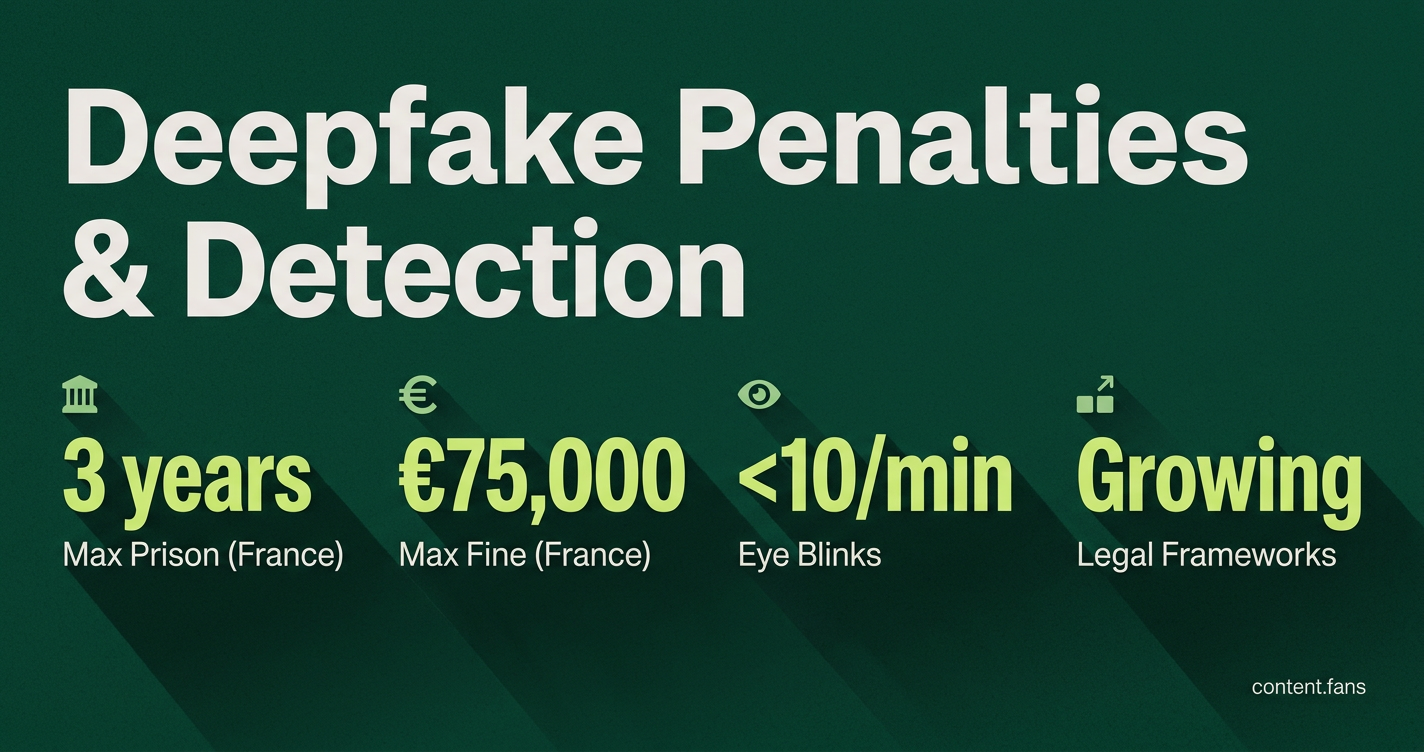
- Eye movement below 10 blinks per minute or mismatched reflections
- Spectrogram patterns that reveal phase glitches in cloned voices
- EXIF fields stripped or replaced and missing C2PA signatures
- Lighting or shadow angles that disagree with scene geometry
- Error Level Analysis bands that expose uneven compression
Legal Recourse for Victims of Deepfakes
Globally, legal frameworks offer growing recourse for victims. In France, creating or sharing sexual deepfakes carries penalties of up to 2 years in prison and €60,000 in fines under Article 226-8-1, which increase to 3 years and €75,000 when distributed online. Victims can file complaints through the Pharos portal and pursue civil remedies. In the United States, the federal Take It Down Act obliges platforms to delete non-consensual sexual deepfakes, while other proposed laws seek to expand consent rights. China's regulations, by contrast, focus on mandatory watermarking and traceability, giving regulators power to fine services that fail to label synthetic content.
Platform and Policy Considerations
- Risk Assessment: Platforms are increasingly implementing transparency reporting and synthetic media labeling requirements.
- Real-Time Moderation: APIs from services like Reality Defender or UncovAI enable livestream hosts to detect and block flagged content before it is broadcast.
- Default Provenance: Embedding C2PA signatures, watermarks, or cryptographic hashes at the point of creation simplifies downstream verification and tracking.
- Executive Accountability: As the French summons for Elon Musk illustrates, prosecutors are prepared to hold senior leadership accountable for systemic platform failures.
Experts emphasize that no single detection tool is infallible, making a multi-layered approach combining different tools and contextual verification essential. The continuous evolution of policies, from US state bills to the EU's codes and China's mandates, signals that legal and technical standards for AI content will only become stricter moving forward.
Why did French authorities raid X's offices and launch a criminal investigation?
French cybercrime units conducted raids on X's Paris offices as part of a widening criminal inquiry into allegations that Grok AI generated and distributed non-consensual explicit deepfakes. The investigation follows complaints regarding AI-manipulated images of women and minors shared on the platform, with authorities examining potential complicity in distributing illegal content and algorithmic manipulation. Prosecutors have widened the probe to include existing concerns about content moderation failures, treating the case as a criminal matter against "persons unknown" under French law.
What are the specific legal penalties for creating AI deepfakes under French law?
France has criminalized the production and dissemination of non-consensual AI-generated content under Article 226-8-1 of the French Penal Code. According to the legal framework, producing or sharing sexual deepfakes carries penalties of up to 2 years imprisonment and €60,000 in fines, which increase to 3 years and €75,000 when distributed online. Related offenses involving image manipulation without consent can result in 1 year imprisonment and €15,000 fines, while fraud-related deepfake activities face substantially higher penalties of 5 years imprisonment and €375,000 fines.
How can journalists and moderators detect AI-generated deepfakes?
Detection requires combining automated forensic tools with manual verification techniques. Professional platforms like CloudSEK and Sensity AI provide real-time multimodal analysis for identifying synthetic media through algorithmic precision. Journalists should examine visual inconsistencies such as irregular eye reflections, unnatural blinking patterns below 10 times per minute, and imperfect hair rendering. Additional verification methods include metadata analysis using C2PA provenance standards, reverse image searches, and error level analysis (ELA) to identify compression anomalies characteristic of AI-generated content.
What compliance obligations do platforms face regarding AI-generated content?
Platforms operating in France must implement transparency and detection mechanisms for AI-manipulated media under national data protection guidelines. The French Data Protection Authority requires distributors to detect and label synthetic content, with failure to remove reported illegal material potentially exposing companies to criminal liability for complicity. Organizations must establish rapid response protocols for non-consensual deepfakes and maintain documentation demonstrating compliance with Article 226-8-1 disclosure requirements, including clear labeling of AI-generated material to avoid regulatory sanctions.
How does this investigation fit into global regulatory trends?
The French probe reflects accelerating international oversight of AI-generated media, with jurisdictions implementing increasingly strict transparency mandates. While France enforces its Criminal Code provisions, the European Union's AI Act will require synthetic media labeling with significant penalties for violations. Simultaneously, the United States has advanced the Take It Down Act requiring platforms to remove non-consensual sexual deepfakes, while China mandates mandatory watermarking and traceability for all AI-generated content, creating a complex compliance environment for global platforms.