
OpenAI opens ChatGPT ads to all US businesses, targets 2026 revenue
Serge Bulaev
OpenAI has opened ChatGPT's ad platform to all U.S. businesses, letting any company with a U.S. billing address run ads through a self-serve system. Advertisers can show a single sponsored message after a chat answer, aiming to match the user's goal instead of keywords. Early data suggests a click-through rate of around 0.68 percent and that ads from ChatGPT may convert better than some other channels. OpenAI hopes to reach about $2.4 billion in ad revenue by 2026, but it is uncertain if current results will continue as the platform grows. Early signs suggest that using chat context may give advertisers a new way to reach people.

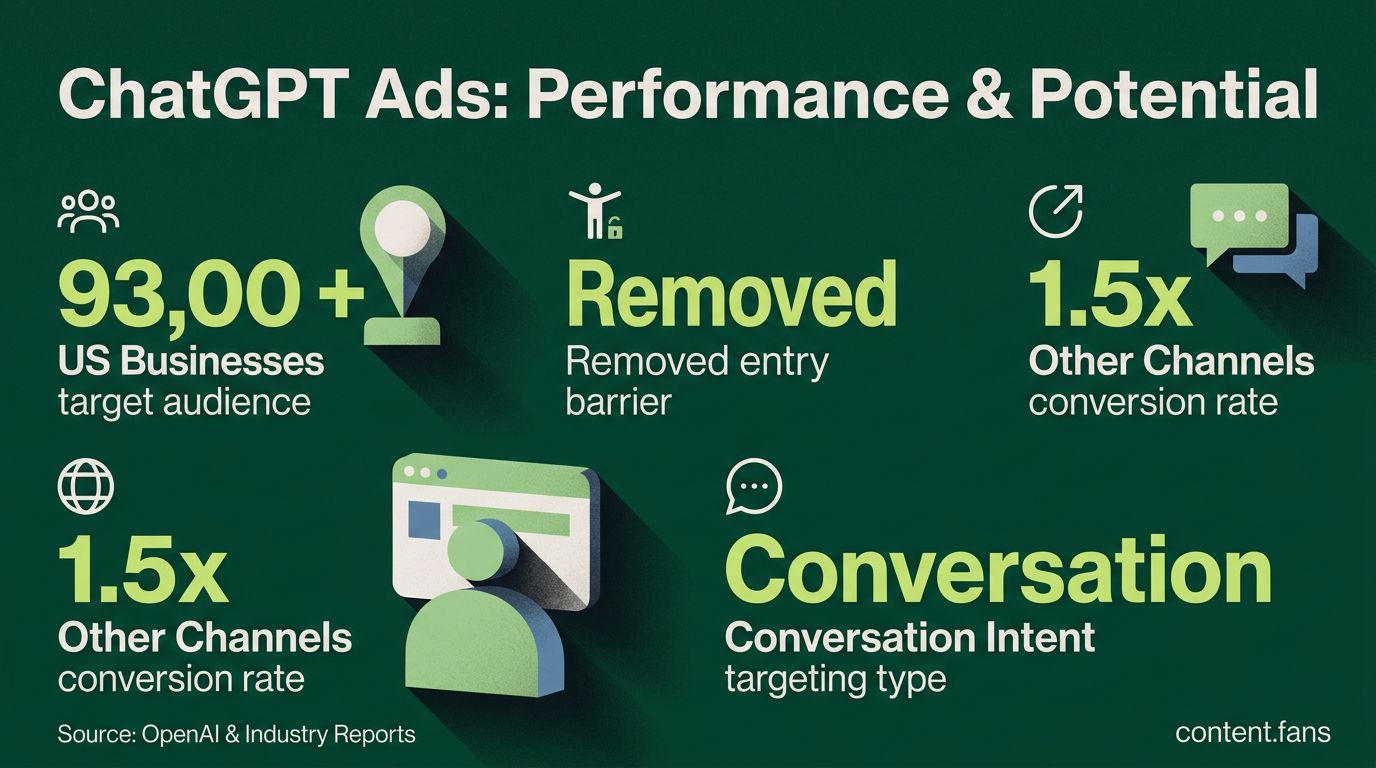
According to industry reports, OpenAI has opened its ChatGPT ad platform to companies with a U.S. billing address, launching a self-serve Ads Manager that removes previous entry barriers like minimum spend requirements. This strategic move positions ChatGPT as a new intent-based advertising channel where ads target user goals derived from conversations, not just keywords, with cost-per-click bids reportedly available at competitive rates (PPC Land).
What advertisers receive
ChatGPT ads provide a new surface for reaching users based on conversational context. Early data shows promising click-through rates and conversion rates that appear to outperform many other channels, indicating strong potential for advertisers to connect with high-intent audiences during their decision-making process.
Early pilot metrics offer a glimpse into potential performance:
* Click-Through Rate (CTR): Industry reports suggest competitive CTR performance, with top-performing campaigns showing particularly strong results.
* Conversion Rate: Criteo reported that referrals from large language model answers converted at roughly 1.5 times the rate of other channels for 500 retailers.
* Revenue Potential: Managed pilot campaigns have generated significant revenue in early testing phases, according to figures cited by 2Point Agency.
The platform's reporting dashboard tracks impressions, clicks, spend, CPC/CPM, and conversions. Advertisers can implement the OpenAI Pixel or Conversions API to attribute on-site actions back to chat impressions. To maintain user experience, ads are currently shown in a limited portion of eligible sessions on ChatGPT Free or Go.
How conversation-intent targeting differs
Unlike traditional search advertising that revolves around literal keywords, conversation-intent systems analyze the full dialogue to infer user purpose, budget, and timeline. This changes the campaign setup process: instead of uploading keyword lists, marketers provide creative prompts and describe a target "decision moment." The model then identifies when a conversation reflects a similar purchase intent.
Key differences for advertisers include:
* Less Manual Control: There is no direct equivalent to negative keywords for excluding traffic.
* Timing Advantages: Ads can appear during follow-up questions, even if the user doesn't repeat their initial need.
* Higher Learning Periods: Performance requires time to stabilize as the model accumulates sufficient conversational data.
While Google's Gemini-powered ads use a similar predictive layer, OpenAI offers a unique placement within a dedicated chat interface. The participation of major agencies like Dentsu, Omnicom, Publicis, and WPP in the pilot suggests that major brands see value in this incremental reach, even at premium costs.
Access checklist for U.S. businesses
Any U.S. business can now get started with the following steps:
1. Create an account using a corporate email and credit card.
2. Verify domain ownership to enable ad delivery.
3. Install the OpenAI Pixel or set up the Conversions API for tracking.
4. Build a campaign targeting a high-intent user moment (e.g., "book a demo").
5. Set an initial CPC bid at competitive market rates and monitor early CTR performance.
With industry reports suggesting ambitious revenue targets, OpenAI appears heavily invested in this new platform. While it remains uncertain if pilot performance will scale, early benchmarks suggest that conversation-level context offers advertisers a powerful new way to reach prospects in the AI chat era.
What changed for U.S. advertisers?
OpenAI removed significant gatekeepers: minimum spend requirements, white-glove agency requirements, and invite-only status. Any U.S. business can now open an account at ads.openai.com, add a credit card, and launch campaigns in minutes. The new self-serve Ads Manager supports CPC bidding at competitive rates and lets you install the OpenAI Pixel or Conversions API for full-funnel tracking without further spend commitments.
How does "conversation-intent" targeting work, and how is it different from keyword ads?
Instead of matching a static keyword, ChatGPT reads the live dialogue and surfaces an ad only when it detects a high-intent purchase moment. According to early Criteo data, traffic from these LLM referrals converts at 1.5× the rate of keyword-based traffic, with some partners claiming significantly higher conversion potential when the ad is inserted at the precise moment the user asks for solutions. You bid on context, not queries, so your ad for noise-canceling headphones can appear when someone says, "I need something to block office chatter," even if the word "headphones" never appears.
What performance can I realistically expect right now?
- Average CTR: Industry reports suggest competitive performance across all placements, with top quartile showing strong results
- Cost: CPMs have reportedly cooled from higher launch prices, while CPC rates are now available at competitive market levels
- Scale: A limited portion of eligible Free/Go sessions show ads today, so inventory is still thin but expanding quickly
- Revenue signal: The U.S. pilot has shown strong performance in early testing phases - industry reports suggest ambitious growth targets
Do I need special creative or technical setup?
You can reuse existing ad copy and landing pages, but high-context creatives outperform generic ones. Required steps:
1. Claim your OpenAI Ads account and verify the domain (no minimum spend)
2. Install the OpenAI Pixel or connect the Conversions API to report sales and leads
3. Pick a purchase-related conversation objective (e.g., "Find the best ergonomic chair under $300") and set CPC bids at competitive market rates to start
OpenAI provides standard Campaign > Ad Group > Ad hierarchy plus impression, click, CTR, and conversion columns.
When will the platform roll out to non-U.S. businesses?
According to industry reports, additional markets including the U.K., Japan, South Korea, Brazil, and Mexico are expected to gain access in upcoming phases. The self-serve Ads Manager will follow a similar phased expansion, with plans for broader global availability and programmatic buying capabilities in the future.