
OpenAI, Microsoft, Google ship new agentic AI to enterprises
Serge Bulaev
OpenAI, Microsoft, and Google have recently added agentic AI to their business software, which may help automate more tasks and make decisions with less human input. These new AI agents can work with popular business tools and keep records of their actions, and companies can still require human approval for important tasks. Google and Microsoft have also made their agent platforms more available to businesses, and early results suggest these agents might speed up some work processes. At the same time, the European Union has set new rules for AI that will start being enforced in 2026, so companies are starting to add more control and monitoring to their AI systems. This change appears to show that AI is becoming a core part of how businesses run, but some risks and challenges remain.

Recent agentic AI releases from OpenAI, Microsoft, and Google mark a pivotal moment for enterprise technology, shifting AI from a decision-support tool to a core business operating system. Analysts see this as a transition from suggestion to execution, as new autonomous agents can now independently plan tasks, integrate with enterprise software, and act on data without constant human prompting.
OpenAI and Microsoft Push Agents into Core Workflows
These new agentic AI systems represent a significant evolution from passive copilots. Instead of just providing suggestions, they can autonomously plan and execute multi-step tasks, interact with other software via APIs, and maintain context over time, fundamentally changing how workflows are automated and managed within an enterprise.
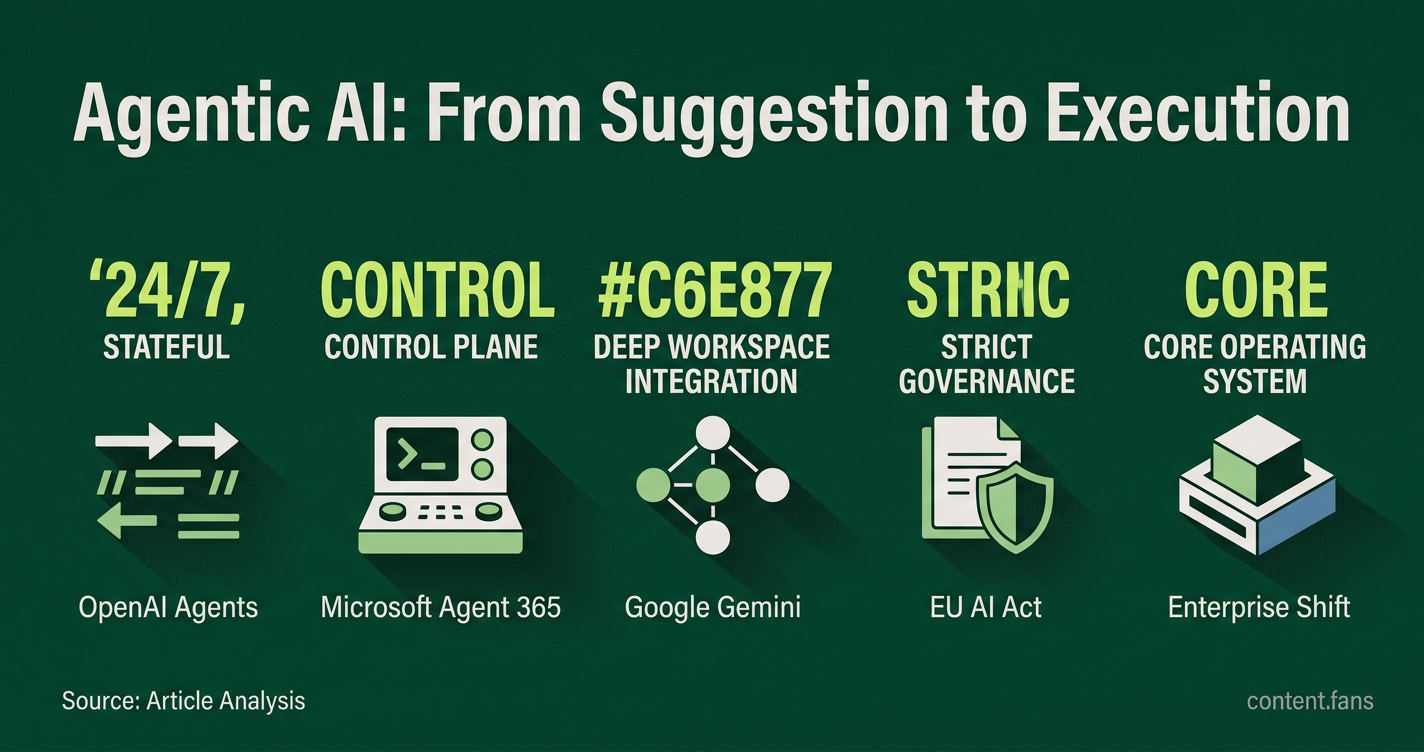
The shift toward autonomous execution is now tangible. OpenAI has released Workspace Agents for its Business and Enterprise plans. According to an overview of the launch, these agents run 24/7, maintain state, and integrate with Slack, Salesforce, Google Drive, Microsoft apps, Notion, and Atlassian. Microsoft has followed with the general availability of Microsoft Agent 365. Agent 365 is a control plane for observing, governing, and securing agents across Microsoft and partner ecosystems, available in M365 E7 or standalone. Both companies emphasize control, offering human approval workflows and compliance APIs to log all agent actions.
Google Deepens Gemini's Role in Workspace and Cloud
Google is also moving aggressively, integrating its Gemini model more deeply into Google Workspace and Google Cloud. Gemini can now autonomously draft emails, populate spreadsheets, and manage project checklists within core applications like Gmail and Docs. This functionality is available to a growing number of paid Gemini Enterprise users.
Further signaling its commitment, Google rebranded Vertex AI to the Gemini Enterprise Agent Platform. The platform provides a low-code Agent Studio and extensive connectors, empowering businesses to build their own custom agents on Google's infrastructure.
Balancing Speed with Governance Amidst New Regulations
As agent capabilities expand, so does regulatory scrutiny. The European Union's AI Act is introducing significant governance requirements, with enforcement milestones approaching. According to industry reports, companies will need to conduct conformity assessments and meet strict transparency duties for high-risk AI systems.
Early results from agentic AI deployments are promising. Industry reports show significant improvements in customer support ticket resolution, while other reports indicate document workflows are running substantially faster and DevOps cycles are being reduced. However, experts also highlight risks such as data sprawl and vendor lock-in. In response, forward-thinking enterprises are proactively implementing audit logs and sandbox environments.
The recent releases from OpenAI, Microsoft, and Google confirm that AI is evolving into a true operating system for business. The key to competitive advantage will be balancing the immense speed and efficiency gains from agentic AI with the disciplined governance required to manage its risks.
What exactly changed this week that makes analysts call it a "turning point" for enterprise AI?
All three hyperscalers simultaneously pushed autonomous agents out of pilot status and into live, revenue-critical systems.
- OpenAI Workspace Agents now run 24/7 inside ChatGPT Enterprise and can query systems, draft contracts in Word, and post deal-notes to Slack without human clicks. Early adopters are reporting significant improvements in document workflows and customer-support cycles.
- Microsoft made its Agent 365 layer generally available, embedding sub-agents inside Outlook, Dynamics and Power Platform. Fortune 500 users that connect Azure OpenAI Service are seeing substantial reductions in DevOps cycle time.
- Google opened the Gemini Enterprise Agent Platform to Workspace customers, letting non-technical teams spin up low-code agents that pull live data from Gmail, Drive and BigQuery. A significant number of paid seats are being adopted across many companies.
For the first time the vendors are selling "doing" instead of "suggestions", flipping AI from decision-support to decision-execution.
How do these agents differ from the copilots enterprises already have?
Copilots recommend; agents act.
- They hold state across hours or days - an agent can open a ticket Monday, wait for human approval Tuesday, then close the ticket Wednesday.
- They call APIs natively - no RPA bot needed to move data between Salesforce, Jira and an ERP.
- They request permission only when an action is irreversible (send email, update CRM, release payment), lowering risk without killing speed.
Microsoft describes its platform as an agent control system, while OpenAI markets the shift as "AI becoming the operating system of business".
What measurable business impact are early adopters seeing?
According to industry reports from recent deployments:
- Sales organisations automating deal intelligence are saving significant hours per rep every week.
- Document-heavy workflows (legal, HR, RFP responses) are running substantially faster inside companies using OpenAI agents.
- DevOps teams connected to GitHub Copilot and Agent 365 show meaningful cycle-time reductions, translating to substantial cost savings across large enterprises.
OpEx savings arrive weeks, not quarters, after connection because agents reuse existing licences (M365, Google Workspace, Salesforce) rather than demanding new platforms.
Where does the EU AI Act come in - and what must enterprises do?
The EU is accelerating governance exactly as autonomy grows. According to regulatory experts, upcoming deadlines will require:
- Any AI system classified as high-risk (most agents that influence hiring, credit, pricing or safety) must be registered, audited and CE-marked before use.
- Providers must maintain conformity assessments, risk-management files and human-oversight logs.
- National enforcement will begin; penalties could reach significant percentages of global turnover.
Companies that wait to map their agent inventory risk market suspension in the EU. Early movers are already creating AI governance boards and sandboxing each new agent in a controlled environment to collect the audit trail regulations will demand.
What practical steps should technology leaders take this quarter to stay in control and still move fast?
- Inventory & classify - List every agent (home-grown or SaaS) and tag it against EU AI Act risk tiers.
- Insert "approval gates" - Use the native approval hooks Microsoft and OpenAI expose so no external email, payment or contract goes out without a human click.
- Log everything - Route agent decisions into the same SIEM you use for security; auditors will ask for chronological action logs.
- Start small, measure hard - Pick one high-volume, low-risk workflow (expense filing, support ticket routing), run a controlled test and measure the OpEx impact to win board confidence.
- Negotiate vendor data clauses - Agents touch more data than chatbots; make sure your company - not the vendor - owns the audit trail and can delete it on demand.
Leaders who pair rapid agent deployment with proactive governance are positioned to capture substantial efficiency gains without becoming the first regulatory casualty of the agentic era.