
ServiceNow unveils AI Control Tower to gate agents, meter usage
Serge Bulaev
ServiceNow has introduced an AI Control Tower to manage how AI agents access customer data and trigger actions in its system. This tool verifies agent identity, controls permissions, and keeps records of what agents do, which may help reduce security concerns and protect company revenue. Agents need approval through the Control Tower before acting and their usage is measured, with some free credits to encourage testing. There are also safeguards to stop agents behaving badly. Whether customers will accept this new system or object to possible extra costs is still unclear.

ServiceNow is deploying its new AI Control Tower to govern how autonomous software agents access enterprise data and execute actions. This governance layer addresses rising enterprise security concerns and protects platform revenue as customers experiment with agents capable of triggering workflows without human intervention.
How the AI Control Tower Provides Governance and Security
ServiceNow's AI Control Tower is a centralized governance hub designed to manage autonomous AI agents. It provides a zero-trust framework that verifies agent identity, enforces permissions, meters usage, and creates a complete audit trail for all agent-driven actions within the Now Platform ecosystem.
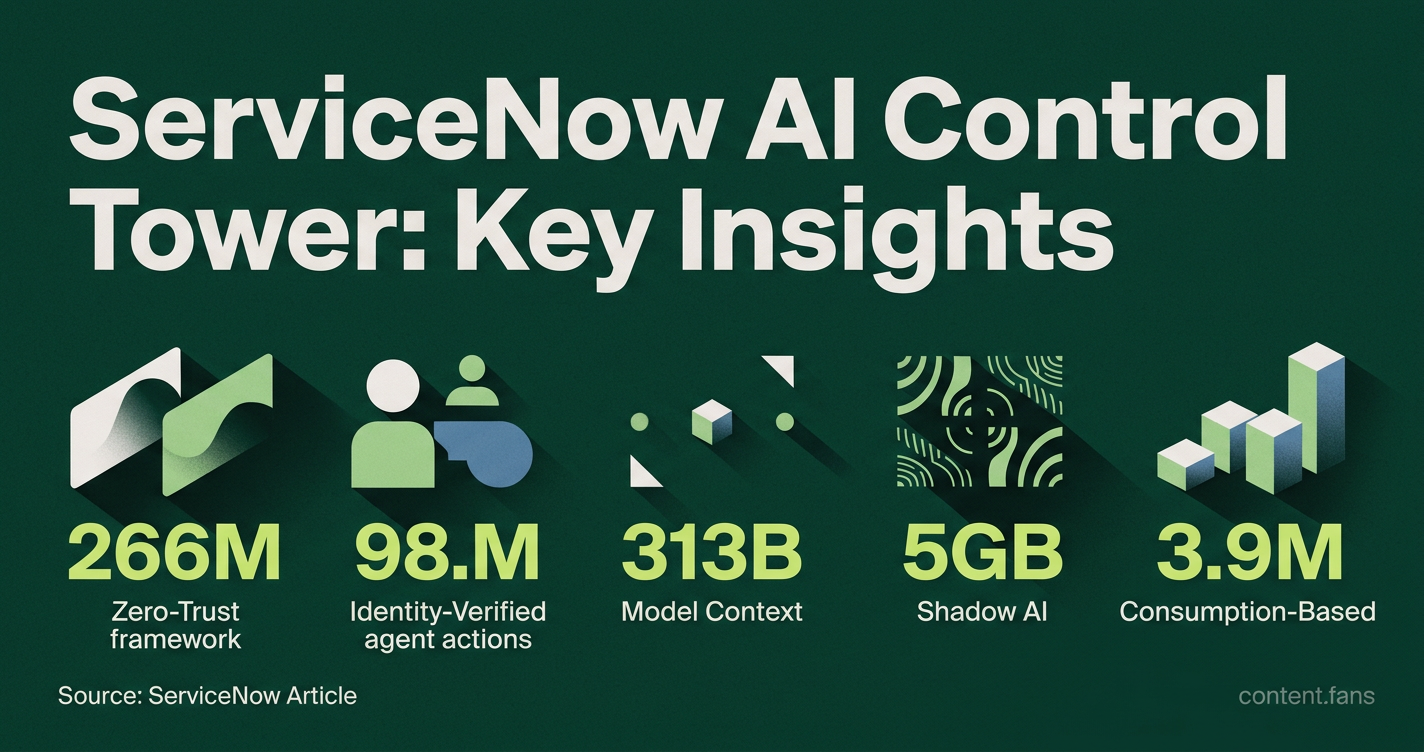
All requests from AI agents are routed through the AI Control Tower, which functions as a zero-trust hub for identity verification, permission scoping, and auditing. According to industry reports, the console is designed to make all agent actions identity-verified, permission-scoped, and fully auditable, while also metering consumption.
Instead of calling APIs directly, agents use the Model Context Protocol (MCP) Server to request approved "headless" actions, like opening a support ticket or updating an asset. A private MCP Registry reportedly provides a catalog of pre-vetted tools from partners, offering a list of approved capabilities.
The system includes built-in kill switches to disable rogue agents if their behavior deviates from norms. Additionally, "shadow AI" monitoring detects and blocks unauthorized bots. According to industry reports, early adopters in the energy and banking sectors have achieved significant improvements in threat containment after eliminating dormant non-human identities.
Monetization and Pricing: The Consumption-Based Model
ServiceNow integrates agent usage into its unified consumption model. Headless actions by AI agents consume the same "Assist currency" that customers use for Now Assist services. To encourage adoption, each tenant receives a number of free Build Agent calls before usage-based charges apply.
A dashboard tracks:
- Number of agent calls and linked large-language-model tokens
- Workflows triggered and time saved
- Cost per outcome against legacy manual steps
- Alerts when usage nears preset caps
Industry reports suggest that ServiceNow has seen significant growth in customers with substantial annual contract values for Now Assist. Management has attributed this growth to the transparent metering model, which they believe removes barriers related to security, compliance, and governance.
The Broader SaaS Context: Preventing Revenue Leakage
Industry analysts note that other major SaaS vendors, including Salesforce and SAP, are developing similar control layers. The primary motivation is to combat "seat compression" - the risk of a single AI agent replacing multiple human users, thereby eroding traditional per-user licensing revenue. Industry research reports have advised SaaS incumbents to increase switching costs through deeper integrations and strategically limit open endpoints until pricing models can be realigned.
Technology industry outlooks reinforce this, stating that advanced metering and real-time observability are essential for managing autonomous agents that operate 24/7. Credit-based systems are emerging as the preferred solution, allowing customers to prepay for a flexible pool of usage. This model offers budget predictability while still capturing the value of agent-driven productivity.
ServiceNow's AI Control Tower directly addresses these industry trends. By assigning each agent digital credentials and metering its actions, the platform maintains control over data security and its own revenue streams. The key question now is whether customers will embrace this consumption-based model or resist what some may view as an "AI tax" as new SaaS pricing strategies continue to evolve.
What is ServiceNow's AI Control Tower and how does it regulate AI agents?
ServiceNow's AI Control Tower (AICT) acts as a universal gatekeeper that identity-verifies, permission-scopes and audits every headless action an AI agent attempts inside the Now Platform.
- Agents inherit enterprise roles, so they appear in the org-chart as "digital employees" subject to the same Microsoft 365 or SSO policies that govern people.
- A built-in kill-switch disables anomalous agents in real time, while shadow-AI monitoring blocks unauthorized bots from touching customer data.
- All traffic is funneled through the Model Context Protocol (MCP) Server, giving security teams a single console for OAuth, session management and granular metering of each API call or workflow execution.
How does ServiceNow monetize AI agent usage without creating surprise bills?
ServiceNow unifies AI spend under its existing "Assist currency": every headless action, Now Assist prompt or third-party agent call consumes the same pre-purchased credits.
- Customers buy predictable credit tiers; overage is either capped or triggers auto-approval workflows, preventing the renewal shock seen at other vendors.
- Real-time ROI dashboards show tokens burned, tasks completed and dollar value delivered, letting finance teams forecast burn before the invoice arrives.
- New SKUs are avoided: AI Control Tower is bundled into every Now Assist and AI Native package, so enterprises are not forced into a "forced SKU migration" to access governance features.
Why are AI tollgates critical for platform economics?
AI agents can replace multiple human seats while generating significantly more API calls, collapsing traditional per-seat revenue and creating revenue leakage.
- Industry reports suggest significant market value concerns as investors price in this structural risk.
- Tollgates convert agent activity into metered consumption, letting platforms monetize the true workload instead of the head-count.
- Industry reports indicate that ServiceNow has seen significant growth in customers with substantial ACV for Now Assist, crediting the transparent credit model for lower churn and higher expansion.
How do customers retain budget predictability under consumption pricing?
Best-practice enterprises negotiate bundled credit pools with quarterly true-ups instead of pure pay-as-you-go, creating an internal governance layer before agents start work.
- Credit-based pricing is emerging as the default pattern: one bucket covers users, API calls and value delivered, giving finance a single lever to throttle spend.
- Procurement teams add hard monthly caps and autonomous billing alerts at high utilization levels, reducing the likelihood of an unexpected cloud bill.
- Case-in-point: industry reports suggest that energy firms have achieved significant improvements in threat containment while keeping AI spend flat by assigning each business unit a dedicated credit wallet monitored by AICT.
Are other SaaS vendors building similar controls?
According to industry reports, major vendors including SAP, Salesforce and Microsoft are developing comparable metering layers.
- Analysts predict that a significant portion of enterprise SaaS spend will shift to usage or outcome-based models in the coming years, making tollgates an industry norm.
- Industry surveys suggest that vendors that lack agent-level governance face higher churn and lower gross margins.