
Sequoia raises $7B fund, aggressively targets AI startups in 2026
Serge Bulaev
Sequoia has raised about $7 billion for a new fund mainly focused on U.S. and European AI startups, following a leadership change in late 2025. The firm appears to be investing more aggressively and taking bigger risks, aiming for larger stakes in fewer AI companies. Reports suggest this approach may be changing market prices and making it harder for non-AI startups to get funding. Sequoia's memo indicates it now values companies with real revenue more than just research. The market may be shifting, with most venture capital going to leading AI companies while others may find it harder to raise money.

In a decisive move following a major leadership transition, Sequoia Capital is reshaping the venture landscape as it raises a $7B fund to aggressively target AI startups in 2026. Under new leaders Alfred Lin and Pat Grady, the firm is adopting a more concentrated, high-risk strategy, pursuing larger stakes in fewer AI companies - a tactic poised to alter market-wide valuations.
Capital ramp after the leadership transition
Under its new leadership, Sequoia Capital is executing a more aggressive AI investment strategy, backed by a new $7 billion fund. The firm is now focusing on acquiring larger stakes in a smaller number of high-potential AI companies across the U.S. and Europe, a tactical shift from its previous approach.
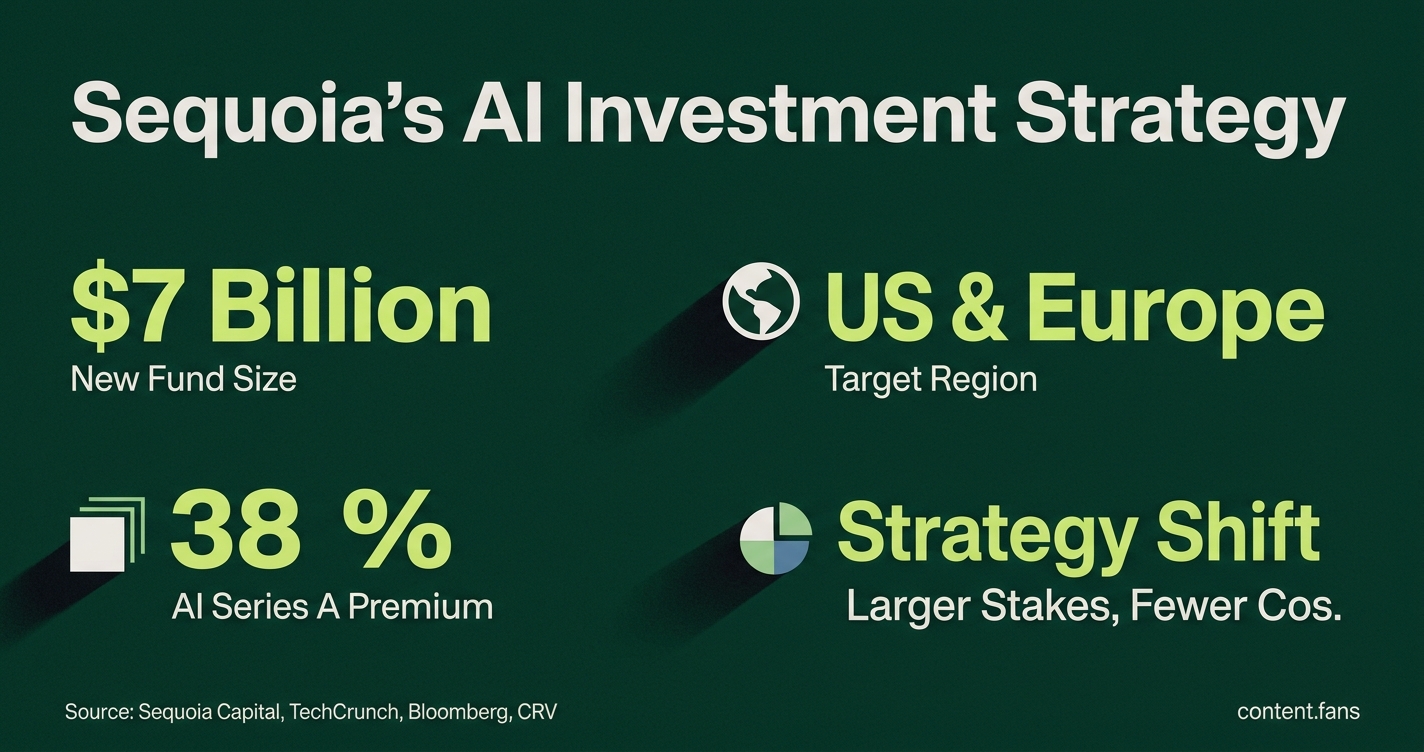
TechCrunch confirms Sequoia has raised about $7 billion for its first fund since the transition, with the majority allocated for U.S. and European AI investments. Illustrating this new risk tolerance, Bloomberg reports that partners considered a plan to increase its stake in Anthropic with a significant investment, signaling a new comfort with backing direct competitors and accepting late-stage pricing.
Sequoia's portfolio signals a multi-layer strategy:
- Frontier models: OpenAI and Anthropic
- Embodied AI: Physical Intelligence
- Enterprise agents: Factory
- Seed formation: A dedicated seed sleeve announced in 2025
The firm's own memo, "AI in 2026: A Tale of Two AIs," suggests a preference for companies with proven revenue traction over pure research achievements, framing 2026 as a year of brisk AI product adoption despite data center delays.
Market ripple effects and competitive context
Sequoia's strategic shift is amplifying a market-wide trend. According to industry reports, AI startups captured a significant portion of venture deal value through Q3 2025. This capital concentration has led to a pronounced valuation premium for AI companies, with industry data suggesting that late-stage step-ups reached substantially higher multiples compared to non-AI businesses.
Competition for top-tier AI deals is fierce, with VCs like Andreessen Horowitz, Khosla Ventures, and Thrive Capital driving faster rounds and auction-style term sheets. According to CRV data, AI companies at Series A now command a 38% valuation premium, a figure many founders now see as a baseline.
For founders, Sequoia's new approach presents both opportunity and pressure. While larger checks can extend runway, higher entry valuations create significant future performance hurdles. For investors, the trend increases concentration risk as capital pools around a small cohort of perceived AI leaders.
Key takeaways for upcoming funding cycles include:
* A growing share of total VC funding is being absorbed by late-stage AI rounds.
* Top-tier funds are increasingly willing to back direct competitors, breaking from traditional exclusivity norms.
* Non-AI sectors are likely to face a more challenging funding environment as portfolios tilt heavily toward machine learning.
The result, according to multiple market trackers, is a bifurcated venture landscape defined by abundant capital for AI frontrunners and a significantly tougher path for everyone else.
How much capital did Sequoia raise for its 2026 AI expansion strategy?
Sequoia Capital raised approximately $7 billion for its 2026 AI-focused expansion. This is the first major fund under its new leadership and is primarily allocated for investments in U.S. and European AI startups, representing one of the largest VC deployments in the sector this year.
What changed in Sequoia's AI investment approach after its leadership transition?
Following the leadership transition to Alfred Lin and Pat Grady in late 2025, Sequoia adopted a more aggressive AI strategy. The firm shifted from picking single champions to hedging bets across multiple AI leaders, a significant departure from its tradition of not backing direct competitors. This is highlighted by its move to increase its stake in Anthropic with a substantial commitment while also backing other major players.
Which specific AI companies is Sequoia targeting with its new fund?
Sequoia's 2025-2026 portfolio targets multiple layers of the AI stack to diversify its investments:
- Frontier/model layer: OpenAI and Anthropic
- Robotics/embodied AI: Physical Intelligence
- Enterprise AI agents: Factory
This multi-layer approach allows Sequoia to capture value across foundational infrastructure and practical applications. The firm continues to support its pipeline with substantial allocations for early-stage and seed investments as of October 2025.
How is increased VC competition affecting AI startup valuations and funding dynamics?
Intensified VC competition is creating profound market effects. According to industry reports, AI startups captured a significant portion of all venture deal value in 2025, and valuations showed a significant premium. AI companies saw substantially higher step-ups compared to non-AI firms, with the gap widening at later stages. At Series A, an "AI premium" of 38% emerged. This climate leads to larger rounds and intense auctions for top AI startups, creating a bifurcated market where capital concentrates in perceived winners.
Who are Sequoia's main competitors in the AI investment arms race?
Sequoia competes in an "AI arms race" against other top-tier firms, including Andreessen Horowitz, Khosla Ventures, Lightspeed Venture Partners, and Thrive Capital. These funds are pursuing similarly aggressive AI strategies. For example, Khosla Ventures is targeting substantial funding for its next fund, primarily for AI. This intense competition is fueled by a concentration of capital among top-tier VC funds, forcing firms to act decisively to secure premium deals.