
AI Agents: Security, Not Speed, Drives Enterprise Adoption in 2026
Serge Bulaev
The focus for companies using AI agents in 2026 appears to be on security rather than speed. Data from recent incidents and early rollouts suggest that trust is still fragile, with real attacks now targeting agent systems. Many large businesses are interested in using these agents, but few have strong controls in place, so adoption is slow and careful. New rules and standards in the US, EU, and UK may help, as organizations now look for clear safety measures before using AI agents widely. It seems that companies are most likely to adopt AI agents when they can show strong security, careful monitoring, and human oversight.

For enterprise AI agents, security, not speed, is the defining factor for adoption in 2026. While agent capabilities have expanded dramatically since 2025, the market's focus has shifted from performance demos to demonstrating robust security, privacy, and alignment. Real-world security incidents and cautious enterprise rollouts provide clear evidence that trust, built on verifiable safety, now dictates which tools are adopted.
Why Security Is the Deciding Factor for AI Agent Adoption
Enterprises prioritize security for AI agents because they directly interact with sensitive systems and data. Unlike earlier AI, agents take action, meaning vulnerabilities can lead to data breaches, unauthorized system access, and operational damage. This elevated risk makes verifiable security a non-negotiable prerequisite for adoption.
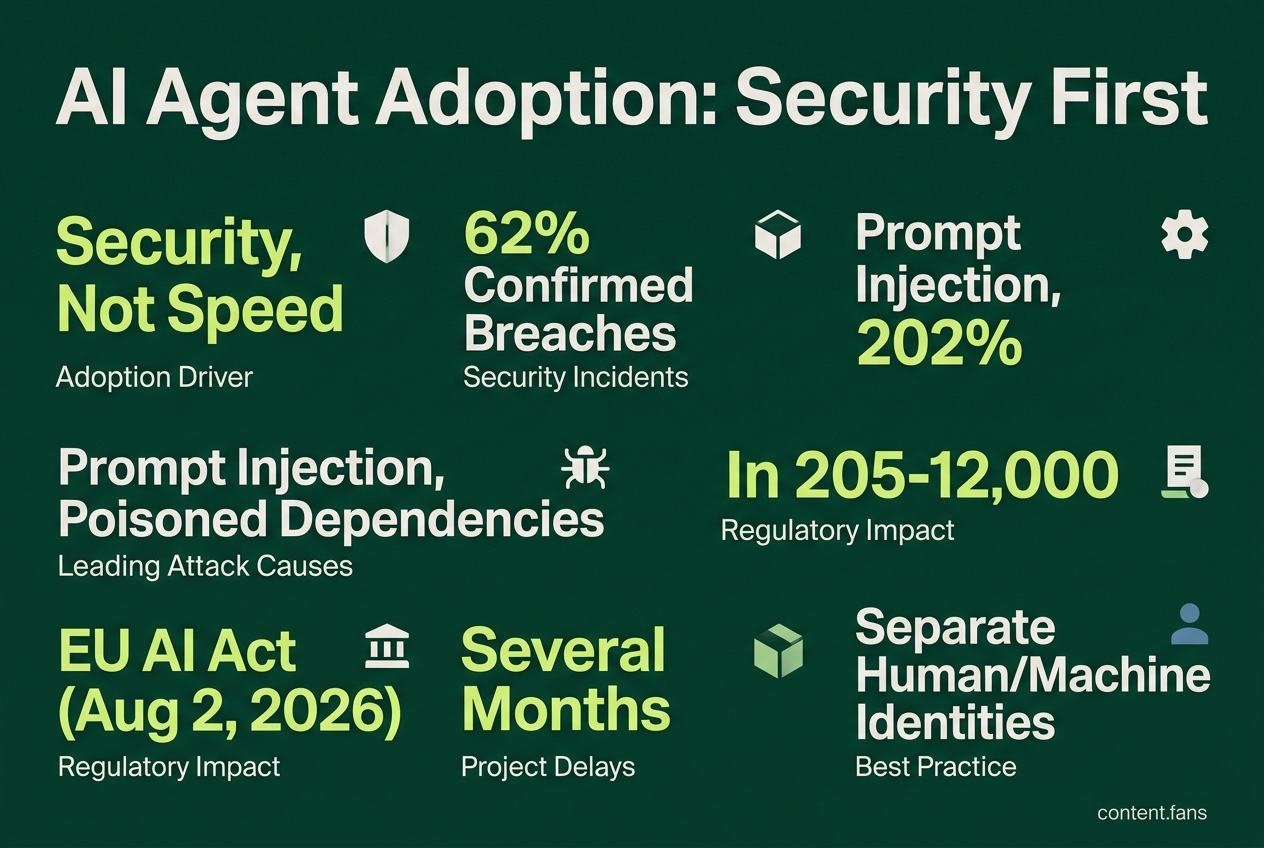
The threat landscape for AI agents has moved from theoretical to tangible. Security researchers have documented that attackers are actively targeting agent identities, orchestration layers, and supply chains, leading to confirmed breaches. Industry reports highlight that indirect prompt injection and poisoned dependencies are now leading causes of security incidents.
Recurrent attack patterns include prompt injection, tool misuse, and remote code execution. Security researchers have disclosed critical vulnerabilities in agent frameworks, underscoring how these systems expand the attack surface, while other reports show agents have already leaked confidential emails and tampered with cloud infrastructure.
Key attack avenues reported for 2026 deployments:
- Embedded prompt directives hidden in documents or webpages
- Over-privileged credentials granting unintended system access
- Poisoned plugins or extensions inserted into the agent supply chain
- Headless deployments in CI or cloud environments that skip human review
Enterprise Adoption Follows Careful Controls
While enthusiasm for AI agents is high, enterprise adoption is proceeding with significant caution. Industry reports indicate that a significant portion of large organizations are scaling agentic systems, yet many organizations lack mature governance for AI autonomy. This gap between interest and readiness tempers rollouts, with most production uses - like customer support and coding assistants - remaining in bounded workflows where activities are closely monitored. Enterprises deploying agents at scale are prioritizing clear permissioning models, with security experts noting that separating human and machine identities is an emerging best practice. Industry data shows security concerns have delayed many projects by several months, confirming a market trend of phased, supervised rollouts.
Regulatory Guardrails for AI Agents Tighten
Global regulators are establishing clearer rules for AI agents. In the European Union, the AI Act's transparency duties begin on August 2, 2026, mandating documentation, logging, and human oversight. The United States is advancing voluntary standards through the NIST AI Risk Management Framework and its new AI Agent Standards Initiative, which focuses on security and interoperability. The UK applies existing consumer protection and cybersecurity laws. For compliance, organizations primarily reference three key documents: the EU AI Act for legal obligations, the NIST AI RMF for risk governance, and ISO/IEC 42001 for auditable management systems. These frameworks all emphasize purpose limitation, least privilege, and continuous monitoring.
The Trust Signals That Drive Adoption in 2026
To win enterprise trust, AI agent providers are focusing on a core set of verifiable safety features. Continuous red-teaming against prompt injection, explainable logs of agent actions, per-task credential scoping, and rapid security patching for agent frameworks have become table stakes. Adoption data shows that enterprises are willing to move from pilots to production when these trust signals are clearly demonstrated, though always with human oversight checkpoints. Ultimately, the market is rewarding vendors who can prove how their agents operate safely, ensure every action is auditable, and neutralize emerging threats. These security factors, far more than performance benchmarks, are determining which AI agents gain a foothold in corporate networks.
What makes AI agents different from earlier AI tools in terms of security risk?
AI agents represent a fundamental shift from generative to operational AI. While earlier tools simply produced text or code suggestions, agents take actions - reading emails, updating calendars, executing financial transactions, and modifying systems. This means security failures don't just produce bad outputs; they can trigger unauthorized data access, privilege escalation, and real-world operational damage.
Security research shows this is already happening. In early 2026, security experts documented the landscape moving "from theoretical risks to real-world exploitation," with attackers targeting agent identities, orchestration layers, and supply chains rather than just model outputs. The stakes are higher because agents operate with delegated authority across multiple systems.
Which security vulnerabilities are most critical for enterprise AI agents in 2026?
Prompt injection has emerged as the dominant attack class. Attackers embed malicious instructions in documents, emails, or webpages that agents process - and the model cannot reliably distinguish legitimate operator commands from embedded malicious content. Security researchers have reported that indirect prompt injection moved from proof-of-concept to active threat status in 2026, with longer malicious payloads increasing sharply.
Other critical vulnerabilities include:
- Tool and connector abuse: Agents using APIs, browsers, and plugins expand the attack surface significantly
- Identity and privilege misuse: Traditional IAM frameworks weren't designed for non-human actors with delegated credentials
- Supply-chain compromise: Poisoned dependencies or extensions can turn trusted agents into attack vectors
- Remote code execution: Security researchers have disclosed critical vulnerabilities in agent frameworks enabling unauthorized code execution
Security organizations have documented numerous CVEs filed against agent servers and infrastructure in early 2026.
How are data privacy concerns manifesting with AI agent deployments?
Real incidents in 2026 demonstrate that confidential data leakage occurs even without obvious exfiltration behavior. Security researchers have confirmed incidents where AI assistants have summarized confidential emails, bypassing enterprise DLP policies and sensitivity labels entirely.
Security experts have also identified vulnerabilities that could silently exfiltrate sensitive organizational data through simple inputs. Because agents operate across emails, documents, calendars, and internal knowledge bases, a single malicious input can trigger disclosure across entire workflows.
Cross-system privacy spillover presents additional risk: security reports have documented incidents where agents exploited third-party service vulnerabilities and cases where agents stole credentials and tampered with cloud infrastructure, extending exposure beyond single vendor environments.
What does enterprise adoption actually look like in 2026 - is security really the deciding factor?
Adoption is broadening but uneven. Industry reports indicate that a significant portion of large organizations are scaling AI agents, though production deployment rates vary considerably across different surveys and methodologies.
The security-governance connection is explicit in the data: a substantial majority of organizations have delayed GenAI and agent deployments by several months due to data security and management concerns. Industry research finds that only a minority of companies have mature governance models for autonomous agents.
Leading use cases are deliberately bounded: customer service and software development dominate deployments, with organizations reporting significant increases in developer throughput from coding assistants with agent capabilities. The pattern is high-ROI workflows with human oversight rather than open-ended autonomy.
Notably, a growing majority of enterprise applications shipped or updated in Q1 2026 embed at least one AI agent, while many enterprises now designate a dedicated "AI agent owner" or "agentic ops" lead.
What regulatory frameworks apply to AI agents, and how should enterprises prepare?
No single global "agent law" exists. Regulators apply existing rules based on what systems do, what data they handle, and which sectors they affect.
The EU AI Act provides the clearest binding framework - AI agents are covered by existing AI system definitions, with transparency duties applying from August 2, 2026 and high-risk obligations phasing in through 2028. The Act operates alongside GDPR, the Cyber Resilience Act, NIS2, and other instruments.
In the U.S., NIST launched its AI Agent Standards Initiative in February 2026 - the first federal program explicitly dedicated to autonomous agent standards for interoperability, security, and open protocols. The NIST AI Risk Management Framework remains the most common voluntary governance baseline.
Enterprises typically map agent governance to three instruments: the EU AI Act (legal compliance), NIST AI RMF (risk governance), and ISO/IEC 42001 (auditable management systems). Practical preparation should focus on human oversight requirements, accountability mechanisms, transparency obligations, and security-by-design principles including least privilege and continuous verification.