
OpenAI launches 'dots' AI agents, powered by GPT-6 Astra
Serge Bulaev
OpenAI has launched 'dots', AI agents powered by the GPT-6 Astra model that can do background work like research and managing tasks across different apps. Dots may help with things that usually stop when a chat window closes and let users control what each agent can access. The rollout depends on the user's subscription and region, and extra pricing details are not yet available. Some features, like Enterprise access, are only available if an admin turns them on, and dots are not yet offered in all countries. OpenAI says there may be limits or pauses if a task seems unclear or risky. The most important phrase is that 'dots' are AI agents powered by the GPT-6 Astra model that can do background work like research and managing tasks across different apps.
OpenAI has launched 'dots', a new class of persistent AI agents built on the GPT-4o model. These agents handle ongoing background tasks like research and cross-app management, continuing to work even after a chat window is closed. This bridges the gap between single-turn assistants and fully autonomous software, giving users explicit control over each integration.
Availability: Tiered Access and Regional Rollout
OpenAI's dots are persistent AI agents that perform background work independently. Unlike standard ChatGPT, they don't stop when a chat closes. Powered by the GPT-4o model, dots can conduct research, manage tasks, and integrate with applications to provide continuous, autonomous assistance.
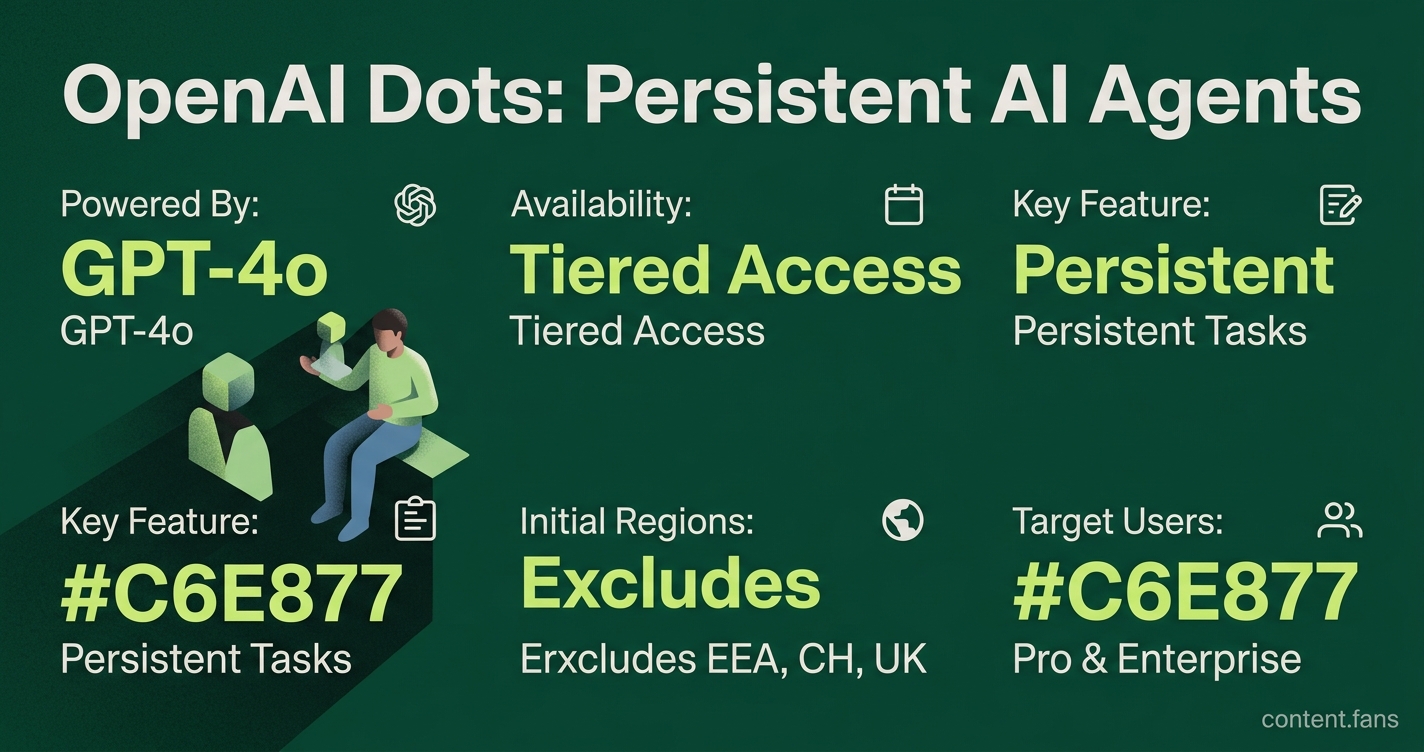
Access to dots is rolling out gradually based on subscription tier and geographic region. Initially, the feature will not be available in the EEA, Switzerland, or the UK. OpenAI has confirmed pricing for additional agents beyond the first included one is "forthcoming," leaving future capacity costs unclear.
| Plan | Status | Included Quota | Key Caveats |
|---|---|---|---|
| Pro | Gradual rollout | First dot included | Not available at launch in the EEA, Switzerland, or UK |
| Business Premium | Gradual rollout | First dot included | Same regional restrictions as Pro |
| Enterprise | Beta (off by default) | Admin must enable | Full admin control over scope and logging |
The Technology Behind Dots: GPT-4o Explained
Each dot is powered by GPT-4o, which OpenAI describes as its most aligned and capable model for computer use, browsing, and software tasks. The model's substantial context window allows dots to maintain long-running tasks without losing context, a significant leap from short-term summaries.
Key technical capabilities include:
- Direct Control: Manages web and desktop tools, even those without public APIs.
- Asynchronous Processing: Reasons and plans while external tools execute tasks in parallel.
- Enhanced Efficiency: Requires fewer retries per task compared to previous models, per internal benchmarks.
- Advanced Safety: Includes monitoring that can pause jobs if instructions become ambiguous or risky.
These features enable complex scenarios like filling out web forms, updating a CRM, or testing software autonomously.
How Dots Stack Up Against the Competition
Industry analysts view dots as OpenAI's strategic response to competitors in the AI agent space. The market for persistent AI agents is heating up, with major tech companies targeting the same niche. By gating dots behind paid subscriptions, OpenAI appears to be focusing on professional and enterprise use cases over mass-market consumer adoption.
Practical Use Cases and User Guardrails
OpenAI highlights several key applications for dots, focusing on recurring and long-term workflows:
* Continuous Research: Automatically surfaces new information on monitored topics.
* Streamlined Project Management: Tracks progress across multiple workstreams without needing manual updates.
* Workflow Automation: Connects calendars, ticketing systems, and documents for seamless task execution.
* Developer Support: Monitors feedback channels to help identify and draft bug fixes.
* Enhanced Collaboration: Facilitates teamwork within ChatGPT and other platforms.
To balance autonomy with security, users can set granular permissions, deciding which applications each dot can access and requiring manual approval for sensitive actions. Enterprise administrators have additional oversight through workspace controls to limit or audit agent activity.
Current Limitations and Future Outlook
Dots are launching with several known limitations. The feature is currently unavailable in many European markets, and Enterprise access is disabled by default, requiring an admin to opt in. Pricing for more than one dot per user remains unpublished. Furthermore, OpenAI has not yet announced a timeline for availability to free or lower-tier ChatGPT users. The company also notes that its safety systems may automatically pause long-running tasks if they detect potential "scope drift" or ambiguity.