
Anthropic, IBM, and AWS Detail 5 Stages for AI Agent QA
Serge Bulaev
Anthropic, IBM, and AWS describe a five-stage process for testing and validating AI agent software. This pipeline starts with automatic code checks during development and continues with automated and human evaluations before and after release. Canary deployments and ongoing monitoring may help catch issues that do not show up in pre-release tests. The process suggests collecting feedback from real incidents to improve tests over time, while governance policies and versioned datasets might help teams track changes and maintain quality. Some experts note that these controls may speed up delivery, but there might be initial slowdowns as teams adapt.

To ensure the quality of AI agents, a robust QA process is essential. Leading insights from Anthropic, IBM, and AWS outline a five-stage framework for validating AI agent software, preventing bugs before they impact users. This comprehensive pipeline integrates unit tests, canary deployments, and observability, extending from initial development through production to validate agent behavior at every step.
Guidance from Anthropic highlights the value of automated evaluations pre-launch, complemented by production monitoring to detect post-release drift (Anthropic guidance). Similarly, IBM research emphasizes versioning and auditing test datasets to trace regressions during model upgrades (IBM AI Agent Testing).
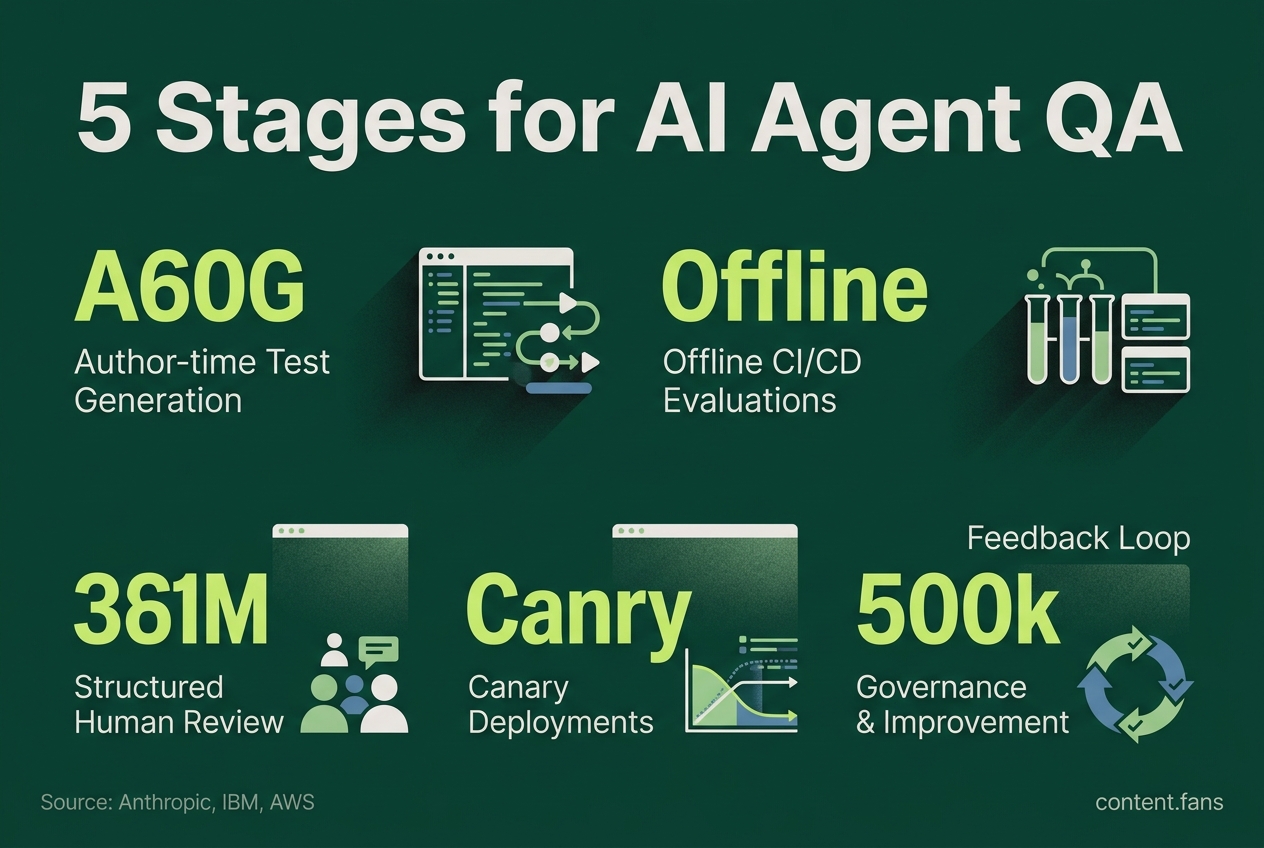
Stage 1 - Author-time test generation
The five-stage process for AI agent QA involves a continuous validation pipeline. It begins with author-time test generation and offline CI/CD evaluations, followed by structured human review. The final stages include canary deployments with production observability and a feedback loop for governance and ongoing improvement.
The first line of defense occurs during development, where agent output is validated in the IDE and through CI jobs. These deterministic checks enforce schema conformance, prevent forbidden API calls, and apply static security rules. AWS recommends augmenting static analysis with specialized rules for prompt-injection vulnerabilities. Furthermore, LLMs can synthesize new linting patterns, with research showing that LLM-authored rules, enforced by a deterministic engine, can effectively cover rapidly changing libraries while ensuring consistent execution.
Stage 2 - Offline evaluations in CI/CD
The next stage integrates an automated evaluation suite into the CI/CD pipeline, running on every pull request and nightly build. A minimal suite should include:
- A curated set of prompts covering core functionality, edge cases, and adversarial inputs.
- Calibrated LLM judges providing binary or rubric-based scores for clear, objective feedback.
- Deterministic checks for tool call structure, length limits, and PII redaction.
- A process for converting every production incident into a new regression test.
- Versioned datasets committed alongside code to ensure auditability and reproducibility.
According to industry observations, even small initial suites are effective and can be expanded as new failures are identified. Calibrated LLM judges are also reported to offer stronger signals and better inter-rater agreement than simple Likert scales.
Stage 3 - Structured human review
Automated testing cannot fully capture nuances related to context, ethics, or complex reasoning. This stage introduces structured human review, where experts sample agent traces each sprint. Reviewers inspect the agent's reasoning, tool arguments, and refusal behaviors. To facilitate this, a balanced scorecard can be used to evaluate correctness, safety, latency, and cost, providing product owners with a clear view of performance trade-offs.
Stage 4 - Canary deployment and production observability
Pre-release testing cannot account for all real-world scenarios. Therefore, this stage uses canary deployments and robust production observability to monitor live behavior. Best practices advise implementing tracing with OpenTelemetry from the project's start to detect performance drift and link production failures back to regression tests (Azure observability best practices). Key signals to monitor include task completion rates, token usage, latency, and the frequency of guarded actions. However, relying on observability alone is insufficient; it must be built upon strong foundational CI/CD practices to be effective.
Stage 5 - Feedback loop and governance
The final stage establishes a continuous feedback loop and robust governance. Every production incident should be converted into a new test for the offline evaluation suite, transforming it into a living specification of correct behavior. This process supports an agent-orchestrated software development lifecycle (SDLC), where humans transition to supervisory roles focused on architecture, risk management, and quality control. This technical pipeline must be supported by organizational guardrails, including policies that define agent scope, security review gates, and clear provenance logs. While these controls are expected to accelerate delivery long-term, teams may experience initial productivity adjustments as they adapt to new workflows and metrics.