
Codacy: AI code needs independent quality gates for validation
Serge Bulaev
Large language models are quickly generating lots of new code, but this code still needs to be checked for mistakes, security, and if it works well. Codacy suggests that teams should use an independent quality check, called a quality gate, to look at code before it is accepted. Tools like static analysis and continuous testing help find problems, but some AI-written code may still fail important security checks. Research suggests using models to create checking rules once, then running them automatically, can save money and time. There are still challenges, like tools not sharing information and code referencing packages that do not exist, so more work may be needed to improve these systems.

Validating AI-generated code at scale requires independent quality gates to ensure it is correct, secure, and maintainable. As large language models turn repositories into high-velocity streams of automated pull requests, traditional verification methods are failing to keep up. Codacy stresses that implementing an independent quality-gate layer between AI generation and code acceptance is becoming standard practice.
The emerging discipline of AI engineering addresses this challenge by treating validation as an automated system, not a manual review task. This involves integrating deterministic tools, continuous testing, and targeted human oversight to manage the sheer volume of agentic output.
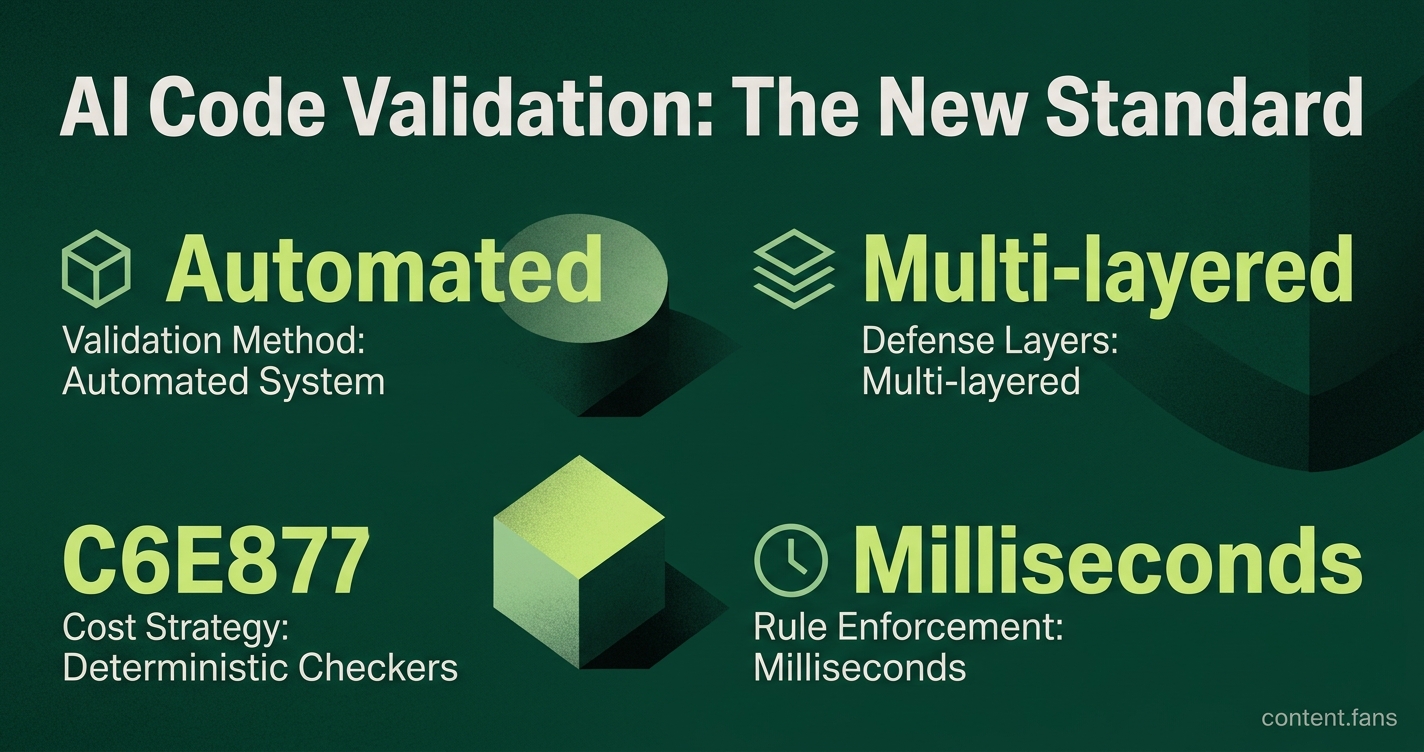
Validating agent-generated code requires layered defenses
Validating AI-generated code involves a multi-layered defense system. This approach combines automated static analysis to catch initial flaws, continuous security scanning in the pipeline, and ongoing monitoring after deployment to ensure code behaves as expected in a live environment, treating all AI output as untrusted by default.
The first layer of defense consists of static analysis and policy linting. Organizations now compile extensive rule sets to flag everything from architectural violations to supply-chain risks before code is merged. Research shows that LLMs can draft these rules with high precision, which are then enforced by traditional, deterministic linters.
Next, security scanning operates within the continuous integration (CI) pipeline. Since reports indicate AI-written code frequently fails critical security tests, every change is treated as untrusted until proven otherwise. As New Relic argues, the ultimate proof of correctness is runtime evidence like telemetry and canary analysis, which should be applied equally to human and AI-generated code.
Post-deployment, the validation continues with agentic review loops. AI reviewers can monitor production behavior and escalate anomalies, shifting from one-off reviews to a model of continuous governance.
Cost pressure drives deterministic validators
Continuously using a frontier LLM to validate every pull request is prohibitively expensive. A more practical and cost-effective strategy involves using the model once to generate deterministic checkers, which can then be run at scale with minimal cost. This pattern is reportedly used by organizations for creating complex lint rules and by frameworks to convert natural language policies into fast AST walkers.
This hybrid approach reduces validation spending significantly by lowering the effort needed to author rules - as LLMs translate standards into code patterns - and by making enforcement cheaper, since compiled rules execute in milliseconds within a CI pipeline. Supporting this, research has found that model-generated rules for code patterns can achieve high accuracy when executed by conventional linters, demonstrating that hybrid workflows can achieve high quality without the recurring token costs of LLM calls.
Open problems and near-term engineering tasks
A primary challenge is tool fragmentation. As Codacy points out, using separate static analyzers, security scanners, and provenance trackers can create dangerous blind spots. To counter this, engineers are developing unified evidence stores that consolidate data from prompts, model versions, and test artifacts with source control metadata.
Supply-chain hallucinations pose another significant risk. Reports indicate that a significant portion of AI-generated snippets reference non-existent packages, which creates opportunities for typo-squatting attacks. Deterministic validators are now used to verify import graphs against official registries before the build process begins.
Finally, ensuring architectural correctness is more complex than simple syntax validation. While techniques like property-based verification and interface-contract monitoring are gaining traction, their limited availability in off-the-shelf tools presents a gap. Experts anticipate this will spur further research into specification mining and formal methods that work in tandem with LLMs.
While agent-driven development dramatically increases coding throughput, maintaining quality and security demands an equivalent evolution in validation. The solution lies in building layered, deterministic, and continuously running verification systems that can scale alongside the AI code generators themselves.
As AI-generated code becomes mainstream, organizations face a critical question: how do you validate code that machines write? Agentic "software factories" are automating creation at scale, but validation and governance gaps remain largely unaddressed. Below are answers to five essential questions about building reliable quality gates for AI-generated code.
What makes validating AI-generated code different from traditional code review?
The core problem is speed and scale. Agentic systems produce code far faster than human teams can review, creating a throughput mismatch that breaks conventional workflows.
Research indicates that agentic quality control is becoming standard because human-only review cannot keep pace with AI output volume. Studies identify a deeper issue: AI code often "looks correct while being wrong." Developer surveys have found that a majority of developers agree AI produces code that appears reliable but isn't, yet many don't always check AI-assisted code before committing.
Traditional phase-gated security and manual pull-request reviews assume human authorship and human-paced output. These assumptions collapse when agents generate hundreds of changes daily.
What are the most common failure modes in AI-generated code?
Security defects, hallucinated dependencies, and architectural flaws dominate the risk landscape:
| Failure Mode | Evidence |
|---|---|
| Security vulnerabilities | Research indicates AI-generated code frequently fails security checks across critical categories |
| Hallucinated packages | Studies show a significant portion of AI code samples reference non-existent packages, creating attack vectors |
| Architectural flaws | Reports indicate increases in privilege escalation paths and design flaws that evade superficial checks |
These failures share a pattern: they pass syntax checks and appear functional while harboring systemic risk. Codacy's analysis warns that current validation often depends on the same probabilistic models that generated the code, creating dangerous feedback loops.
Why is deterministic validation more cost-effective than continuous LLM review?
Running large language models for validation on every pull request creates prohibitive compute costs at scale. The proposed alternative - using LLMs to generate deterministic validators - shifts expense from runtime to build time.
Research supports this hybrid approach, showing that LLM-generated rules can achieve high accuracy with deterministic analysis, noting adaptation costs in "tokens, not engineering hours". Studies demonstrate that AST-based deterministic analysis can detect hallucinations with high precision - at fractions of LLM inference cost. Complex lint rules, once generated, run in milliseconds without API calls.
Important caveat: Research confirms LLMs are fundamentally unsuited as direct validators for certain tasks, with documented failures on basic properties. The pattern is clear: LLMs draft rules, deterministic tools enforce them.
What does a proper validation architecture look like for agentic code?
Effective systems deploy multiple independent verification layers between generation and acceptance:
Layer 1: Deterministic quality gates
- Static analysis, policy checks, and test execution independent of the generating model
- Codacy recommends evaluating each change as a diff using deterministic checks
Layer 2: Continuous validation
- Extends beyond merge into production through telemetry, canaries, and runtime oversight
- Runtime evidence is considered a reliable signal of correctness
Layer 3: Agentic review loops
- AI agents review AI output for security, architecture, and quality
- Humans escalated only for novel or boundary cases
Layer 4: Provenance tracking
- Emphasis on validating authorship and provenance to audit defects and supply-chain contamination
This architecture treats all AI-generated output as untrusted until proven safe - a necessary stance given vulnerability rates.
Is AI engineering becoming a distinct investment category?
Yes. AI engineering has emerged as a rapidly growing job category with substantial market expansion:
- Job market data shows AI Engineer roles experiencing significant growth
- AI-related job postings have increased substantially in recent years
- Wage premiums exist for AI-skilled workers
Market sizing shows consistent growth across multiple research reports, with projections indicating continued expansion in the AI engineering sector.
Investment follows talent. Capital concentrates in AI infrastructure, developer tools, MLOps/LLMOps, and workflow automation - the enabling layers for validated agentic development. The discipline has expanded beyond software into civil, mechanical, and electrical engineering applications.
The bottom line: Organizations scaling AI code generation must build independent, deterministic, multi-layer validation rather than relying on human review or the same probabilistic systems that wrote the code. The tools and economic models exist. Implementation remains the open challenge.