
OpenAI, Meta Race to Build Trusted AI Agents Amid Security Fears
Serge Bulaev
OpenAI and Meta are competing to create AI agents that users trust, focusing on privacy and reliability instead of just intelligence. OpenAI's agents may handle many tasks but are still called "early" and could make mistakes, so the company is being careful with new releases. Meta claims to offer private and encrypted agent experiences, but some people question whether its data practices align with this promise. Surveys suggest most businesses are worried about security risks and want agents with strong controls and human oversight. The industry appears to be shifting from prioritizing smarter AI to making sure these agents are trustworthy and safe to use.

The race between OpenAI and Meta to build trusted AI agents is intensifying, with security and privacy now eclipsing raw intelligence as the key metrics. As enterprises consider granting agents access to sensitive calendars, email, and financial data, trustworthiness has become the new benchmark for success.
OpenAI: Capability Meets Caution
OpenAI's AI agents are designed to plan and execute complex, multi-step tasks involving browsers, code, and desktop applications. According to their API guidance, these models support structured outputs and tool calling, though they are still considered early and can make mistakes.
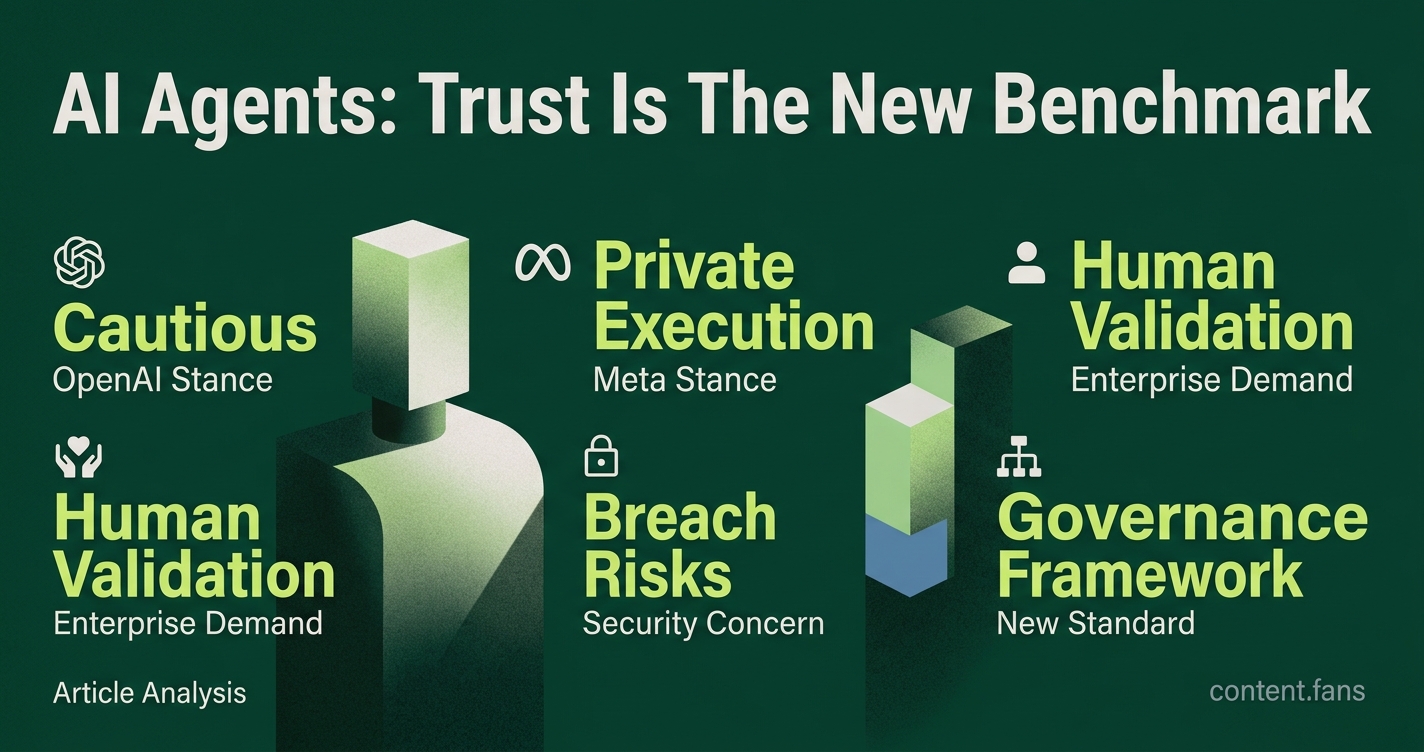
While OpenAI continues to enhance agentic capabilities in its models, the company maintains a cautious public stance. OpenAI labels its ChatGPT agent as "early," warning it can make mistakes and exhibit bounded autonomy. This commitment to safety reflects the company's willingness to prioritize reliability over rapid deployment.
Meta's Approach: Private Execution and Persistent Questions
Meta is promoting its agents by emphasizing features like private execution and encrypted storage. However, industry critics remain skeptical, questioning if these privacy promises can coexist with the company's established ad-driven business model. These concerns are amplified by plans for future integration with smart glasses, which could introduce new data privacy risks via always-on microphones.
The "Grok Bot" Factor: A Note on xAI
While the name 'Grok' has entered the AI conversation, public records do not connect a 'Grok Bot' to SpaceX. The Grok model is a product of xAI, a separate company. Any direct link to SpaceX is currently speculative and unconfirmed.
Why Trust Is the New Currency in AI Agents
Recent industry trends underscore the market's shift toward security. Many security leaders are expressing concerns about agent adoption due to breach risks. Similarly, enterprise surveys indicate most organizations now mandate human validation for agent outputs, while security organizations report that many believe agents are over-privileged with excessive data access.
The Emerging Enterprise Control Stack for AI Agents
In response to these security fears, enterprises are demanding a robust governance framework. This new standard for AI agent control includes:
- Identity Governance: Implementing least-privilege access tokens.
- Human Oversight: Requiring human approval for high-risk actions.
- Auditing and Inventory: Maintaining real-time audit trails and inventory.
- Data Segmentation: Isolating agents within segmented data stores.
- Runtime Monitoring: Continuously monitoring agent behavior in real-time.
From Performance to Protection: The Market's New Mandate
Vendors unable to demonstrate these safeguards are facing longer sales cycles and stricter usage limits. For OpenAI, this means developing better tools for scoped autonomy and cost control. For Meta, the challenge is to convince enterprise buyers that its agent's suggestions won't feed behavioral data into its advertising ecosystem.
Although OpenAI's models prioritize reasoning reliability over speed and Meta continues to advance its AI capabilities, the market signal is unmistakable: a trustworthy, secure workflow is more valuable than a more intelligent but less reliable one. Consequently, product roadmaps are shifting from performance-based features to compliance-driven safeguards like enhanced audit logs.