
Sam Altman proposes US-led forum to govern global AI standards
Serge Bulaev
Sam Altman suggests creating a US-led international group to set standards for advanced AI, which might help avoid different rules in different countries. He proposes that this group would test AI systems before release and share the results publicly. The plan seems to rely on countries choosing to follow the rules, as Altman did not mention any way to force compliance. Some experts say this idea could overlap with existing UN efforts but might also clash with other international plans. It remains uncertain if Altman's proposal will help bring countries together or make differences larger as as global discussions continue.

OpenAI CEO Sam Altman proposes a US-led forum to govern global AI standards, outlining a vision for unified international oversight. He advocates for an independent body to assess advanced AI systems with consistent tests before deployment, similar to how international aviation is regulated. Altman contends that a shared evaluation framework could prevent regulatory fragmentation and ensure frontier models remain accessible to allied nations committed to common safety protocols.
Altman's Blueprint for AI Governance
Sam Altman's proposal calls for an independent, US-anchored body to set global AI safety standards. This forum would test powerful AI models before their release, using consistent, shared benchmarks to prevent fragmented regulations and ensure frontier AI is deployed safely among allied nations that adopt common rules.
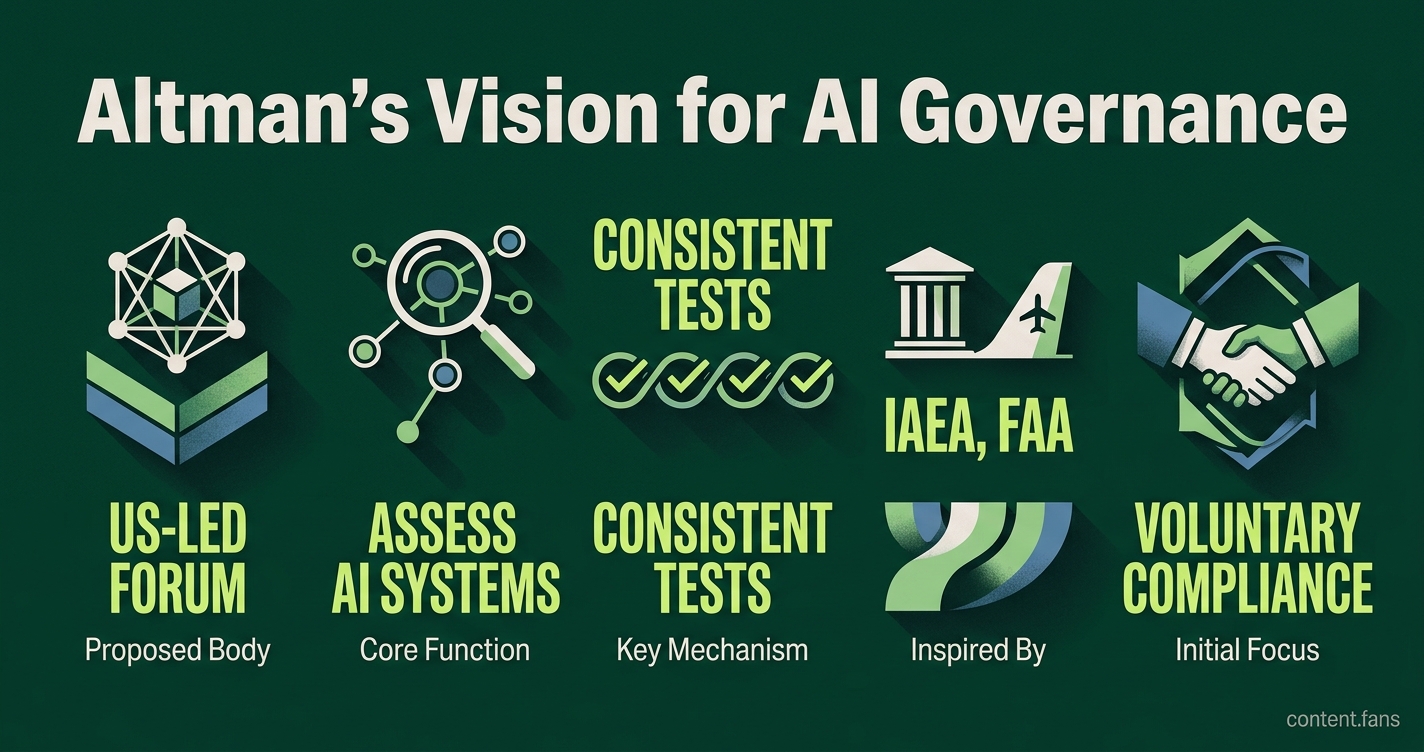
Drawing parallels to the International Atomic Energy Agency (IAEA) and the Federal Aviation Administration (FAA), Altman suggests a joint effort between governments and developers. The core functions would include:
- Establishing uniform "capability thresholds" to trigger mandatory safety reviews.
- Conducting joint red-team exercises on any AI model that exceeds these thresholds.
- Publishing public scorecards to allow for transparent risk comparisons across different AI labs.
The initiative would begin under U.S. leadership but welcome international partners willing to adopt the same testing standards. Notably, the proposal focuses on setting standards through voluntary compliance, as it does not outline specific enforcement mechanisms.
Navigating the Global AI Regulatory Landscape
Altman's call for a new forum enters a crowded field of active AI governance initiatives. The United Nations has established various AI governance frameworks and initiatives.
Simultaneously, the European Union is implementing its landmark AI Act, which is introducing rules for general-purpose models and will apply comprehensive obligations to high-risk systems. Beyond these multilateral efforts, nations are forming bilateral partnerships, such as the US-UK AI Safety Institute agreement from April 2024, to share evaluation methods and conduct joint model testing. Regional regulations, like California's law requiring training data disclosure for generative models sold in the state, add another layer to the complex regulatory map.
Geopolitical Implications and Industry Response
The proposal has drawn mixed reactions, highlighting significant geopolitical tensions. European officials have expressed concerns that a US-centric body could undermine existing multilateral efforts, while U.S. agencies view it as a complementary approach for setting technical standards. Industry leaders like Google's Sundar Pichai have supported increased oversight but warned that an exclusive membership could leave many regions outside the proposed safety framework.
Analysts describe a significant divide between the U.S. and EU approaches to regulation. This divide is prompting middle-income nations to forge alternative approaches by combining principles from various international frameworks. As diplomats prepare for upcoming AI summits, it remains uncertain whether Altman's proposed forum will help bridge these international divides or deepen them.
What exactly is Sam Altman proposing?
In a Financial Times op-ed, Altman calls for a US-led international forum that would create objective, shared standards for measuring AI capability and risk. The body would operate like the International Civil Aviation Organization or the International Atomic Energy Agency, giving allies access to frontier models and ensuring every nation applies the same yardstick before deployment.
Why does Altman think a new body is needed?
He argues that frontier AI systems are becoming too powerful for any single company or government to evaluate alone. An independent, technical institute would cut through geopolitical noise, provide consistent risk assessments, and help prevent accidents or misuse that could derail the entire industry.
How does this fit with existing global AI rules?
The proposal comes as various UN AI governance initiatives are developing. Altman's forum would sit alongside - not inside - the UN system, letting the US and close partners set practical benchmarks faster than a full multilateral process.
What are the biggest geopolitical hurdles?
A US-chaired forum risks deepening the trans-Atlantic split with the EU's risk-based AI Act and could alienate a growing number of middle powers seeking strategic autonomy. Washington's approach signals intent to keep federal control over standards - a move some allies view as transactional dominance rather than inclusive leadership.
When could the forum become reality?
No timeline has been released, but momentum is building: the US AI Safety Institute is already moving toward more comprehensive pre-deployment testing for high-compute models, and various safety summits are addressing technical details. If Congress provides appropriate diplomatic authority, the body could be formally announced at future international AI governance meetings.